. 2016 Aug 23;7(34):54339-54359.
doi: 10.18632/oncotarget.10913.

Inherent low Erk and p38 activity reduce Fas Ligand expression and degranulation in T helper 17 cells leading to activation induced cell death resistance

Affiliations

Inherent low Erk and p38 activity reduce Fas Ligand expression and degranulation in T helper 17 cells leading to activation induced cell death resistance

Doureradjou Peroumal et al. Oncotarget. .

Abstract

Activation Induced Cell Death of T helper cells is central to maintaining immune homeostasis and a perturbation often manifests in aberrant T helper cells that is associated with immunopathologies. Significant presence of T cells positive for IL-17A (Th17) and dual positive for IFN-γ/IL-17A (Th1/Th17) in both effector (CD45RA+RO+) and memory (CD45RA-RO+) compartments with differential FasL protein in RA peripheral blood suggested their differential TCR AICD sensitivity. Lowered active caspase-3 in Th17 and Th1/Th17 over Th1 cells confirmed their capability to resist AICD and pointed to early upstream events. Differential MAPK activities, FasL protein and downstream caspase-3 activities in murine Th1 and Th17 cells established distinct TCR mediated signaling pathways and suggested low Erk and p38 activity as pivotal for AICD sensitivity. We extrapolated our mouse and human data and report that Fas-FasL is the preferred death pathway for both Th1 and Th17 and that inherently low Erk2 activity protected Th17 cells from TCR AICD. The presence of significantly higher numbers of aberrant T helper cells in RA also suggest an inflammatory cytokine milieu and AICD insensitive T cell link to sustained inflammation. Re sensitization to apoptosis by targeting MAPK activity especially Erk2 in RA might be of therapeutic value.

Keywords: AICD; FasL; Immune response; Immunity; Immunology and Microbiology Section; MAPK; T helper cells; rheumatoid arthritis.


Conflict of interest statement

CONFLICTS OF INTEREST

The authors have no conflict of interest.

Figures
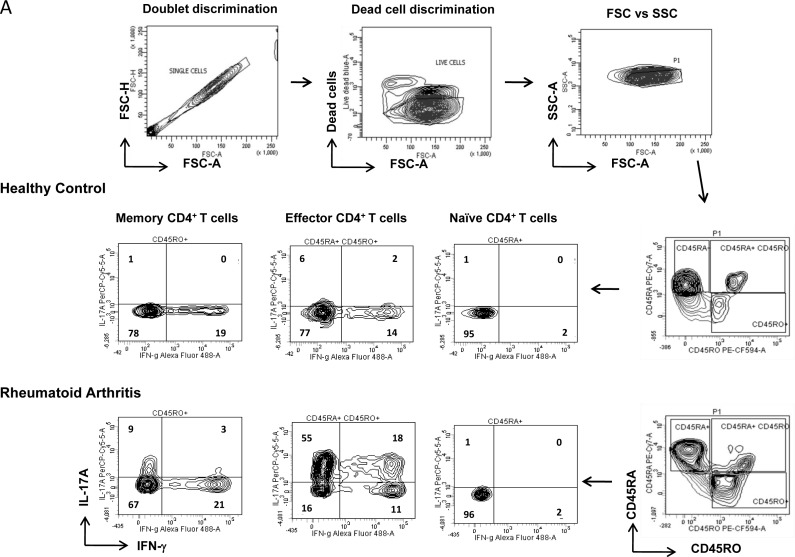
Figure 1
Figure 1. Characterization of inflammatory T helper cells in Rheumatoid Arthritis
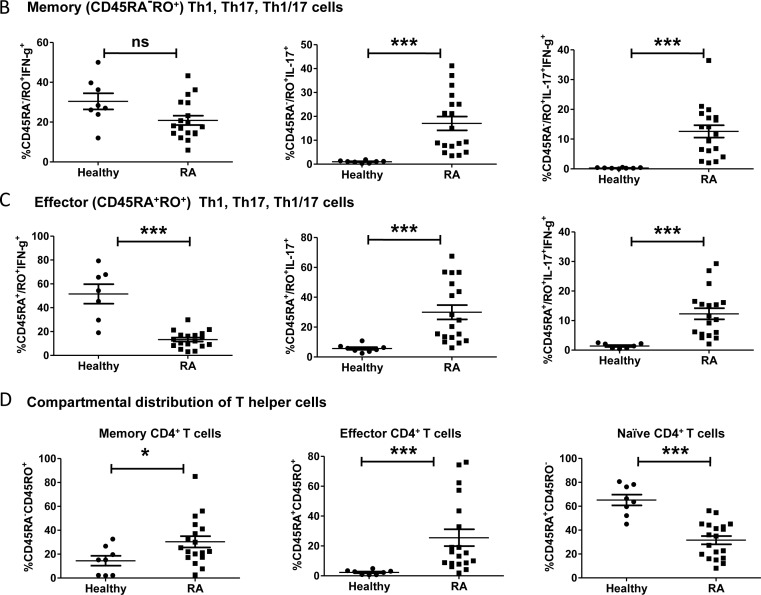
A. Representative gating strategy for the characterization of Th1 and Th17 cells derived from naïve, memory and effector compartments in RA and healthy control. Scatter plot with Mean ± SEM of (D) naïve (CD45RA+), effector (CD45RA+/RO+) and memory (CD45RO+) CD4+T cells; single IFN-γ+ or IL-17A+ and double positive Th1/Th17 cells derived from B. memory and C. Effector CD4 compartments from human RA (n = 18) and control (n = 9) peripheral blood samples. All samples were tested for significance by using Mann Whitney test and p value of less than 0.5 was considered as significant.
Figure 1
Figure 1. Characterization of inflammatory T helper cells in Rheumatoid Arthritis
A. Representative gating strategy for the characterization of Th1 and Th17 cells derived from naïve, memory and effector compartments in RA and healthy control. Scatter plot with Mean ± SEM of (D) naïve (CD45RA+), effector (CD45RA+/RO+) and memory (CD45RO+) CD4+T cells; single IFN-γ+ or IL-17A+ and double positive Th1/Th17 cells derived from B. memory and C. Effector CD4 compartments from human RA (n = 18) and control (n = 9) peripheral blood samples. All samples were tested for significance by using Mann Whitney test and p value of less than 0.5 was considered as significant.
Figure 2
Figure 2. Differential expression of FasL in RA T helper cells
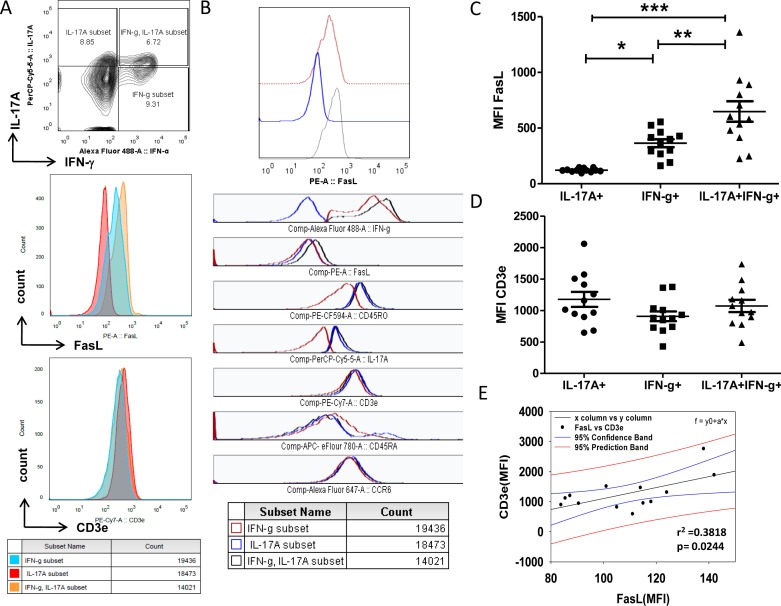
A. FasL and CD3e expression in IL-17A+ or IFN-γ+ or double positive Th1/Th17 cells from human RA peripheral blood samples (n = 13). B. Differential FasL protein expression in RA T helper cells. C. Scatter plot with Mean ± SEM of Median Fluorescent Intensity of FasL protein in IL-17A+, IL-17A+/ IFN-γ+ and IFN-γ+ T cells of human RA blood samples (n = 13). D. Scatter plot with Mean ± SEM of CD3e protein expression in IL-17A+, IL-17A+/ IFN-γ+ and IFN-γ+ T cells of human RA blood samples (n = 13). Kruskal-Wallis test and Dunn's Multiple Comparison post hoc test were performed to find statistical significance using GraphPad prism and p < 0.5 was considered as significant. E. Non-linear regression analysis of FasL and CD3e proteins expression in RA CD4+ T cells using Sigma Plot (r = + 0.3818, p = 0.02, 95% CB) n = 13.
Figure 3
Figure 3. FasL expression in Th1 and Th17 cells of memory and effector compartment in RA
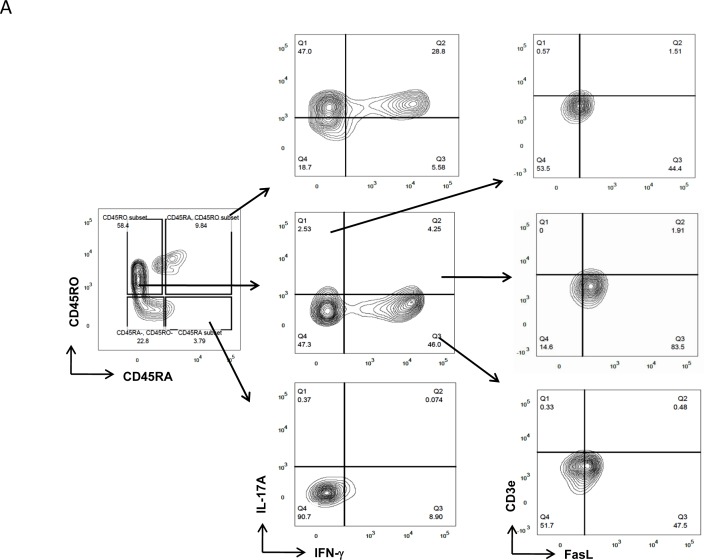
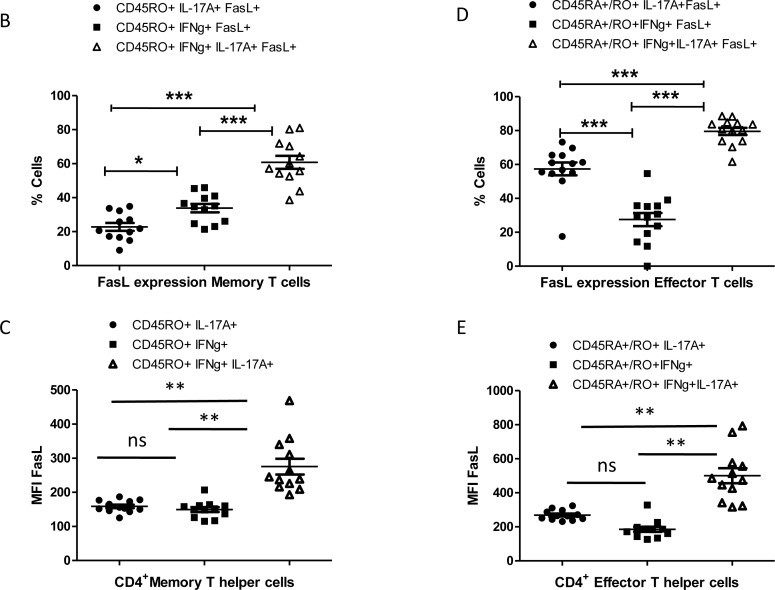
A. Representative gating strategy for the characterization of FasL expressions in Th1 and Th17 cells derived from naïve, memory and effector compartments of RA samples (n = 13). B. Scatter plot with Mean ± SEM of % FasL+ and C. Median Fluorescent Intensity of FasL in population of IL-17A+ or IFN-γ+ and double positive Th1/Th17 cells of memory CD4 T compartments in RA. D. Scatter plot with Mean ± SEM of % FasL+ and E. Median Fluorescent Intensity of FasL in population of IL-17A+ or IFN-γ+ and double positive Th1/Th17 cells of Effector CD4 T compartments in RA. Data was tested for significance by using one-way ANOVA and Tukey's Multiple Comparison post hoc test and p < 0.5 considered as significant.
Figure 3
Figure 3. FasL expression in Th1 and Th17 cells of memory and effector compartment in RA
A. Representative gating strategy for the characterization of FasL expressions in Th1 and Th17 cells derived from naïve, memory and effector compartments of RA samples (n = 13). B. Scatter plot with Mean ± SEM of % FasL+ and C. Median Fluorescent Intensity of FasL in population of IL-17A+ or IFN-γ+ and double positive Th1/Th17 cells of memory CD4 T compartments in RA. D. Scatter plot with Mean ± SEM of % FasL+ and E. Median Fluorescent Intensity of FasL in population of IL-17A+ or IFN-γ+ and double positive Th1/Th17 cells of Effector CD4 T compartments in RA. Data was tested for significance by using one-way ANOVA and Tukey's Multiple Comparison post hoc test and p < 0.5 considered as significant.
Figure 4
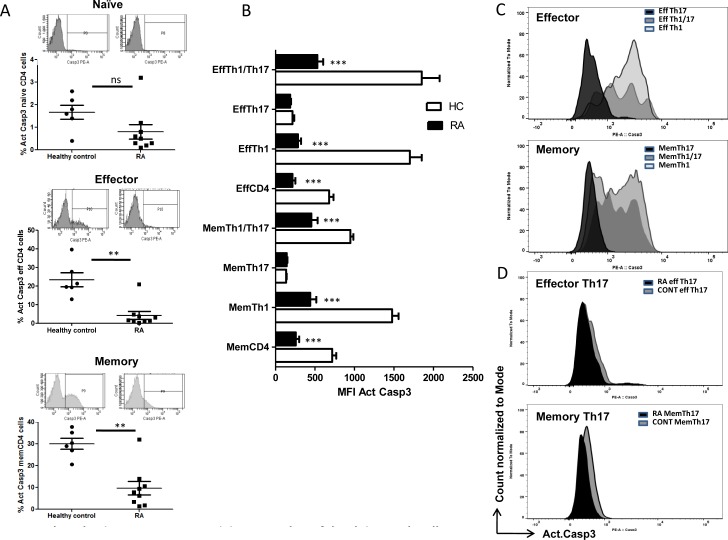
Figure 4. Active Caspase-3 as an index of AICD in Human RA and control T helper cells
A. Scatter plot with Mean ± SEM of % Active Caspase3 and representative flow histogram of compartmental T cells from human RA and control. B. Mean ± SEM of MFI Active caspase3 in compartmental T helper cells from human RA (n = 9) and control (n = 6). C. A representative histogram overlay of Active caspase3 in Effector (upper) and Memory (lower) Th1, Th17 and Th1/Th17 cells from human control. D. A representative histogram overlay of Active caspase3 in Effector Th17 (upper) and Memory 17 (lower) cells from human RA (n = 9) and control (n = 6). Two-way ANOVA and Bonferroni posttests were performed to find statistical significance using GraphPad prism and p < 0.5 was considered as significant.
Figure 5
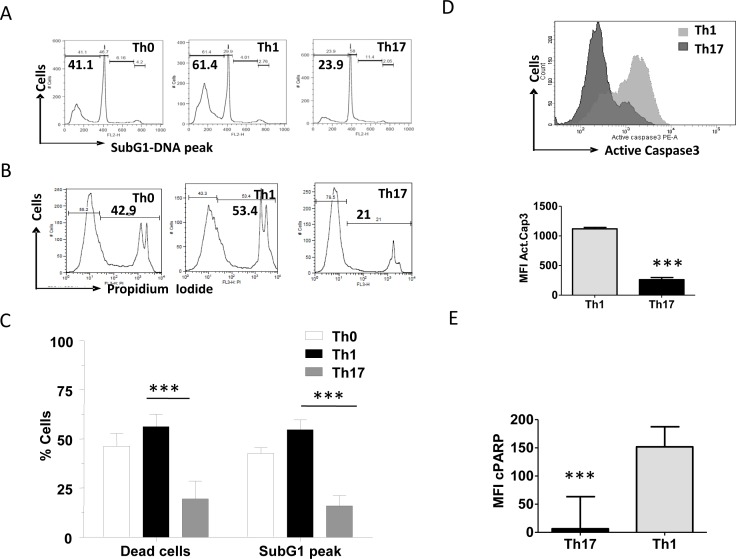
Figure 5. Characterization of differential AICD susceptibility in T helper cells
A. Representative histogram of Sub G1 peaks (upper) and B. loss of viability (lower) in Th0, Th1 and Th17 cells after 16 hrs of anti-CD3 induced reactivation. C. Mean and SEM of percent SubG1 DNA and PI+ dead cells of T helper cells. D. Mean and SEM of Active Caspase3 (below) and representative histogram (above) of active Caspase3 during AICD of Th1 and Th17 cells. E. Mean and SEM of cleaved PARP during TCR-AICD of Th1 and Th17 cells. Data represent at least three independent experiments. Data was tested for significance by using one way ANOVA and Tukey's Multiple Comparison post hoc test and p < 0.5 considered as significant.
Figure 6
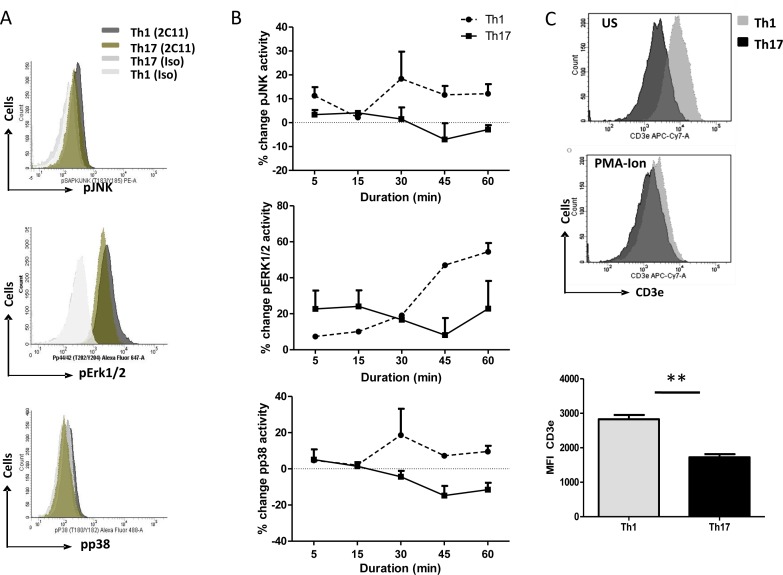
Figure 6. Differential MAPK signaling in T helper cells
A. Representative flow cytometry histogram of phospho-JNK (upper), phospho-ErK1/2 (middle) phospho-p38 (lower) in Th1 and Th17 cells after 30min of anti-CD3 (2C11) reactivation by secondary cross-linking with anti-Hamster IgG. B. Time kinetics of MAPK activity in Th1 and Th17 cells after anti-CD3 (2C11) reactivation by secondary cross-linking with anti-Hamster IgG, phospho-JNK (upper), phospho-ErK1/2 (middle) phospho-p38 (lower). C. CD3e expression in Th1 and Th17 cells of Balb/c or C57BL-6 mice with or without PMA-Ionomycin stimulation.
Figure 7
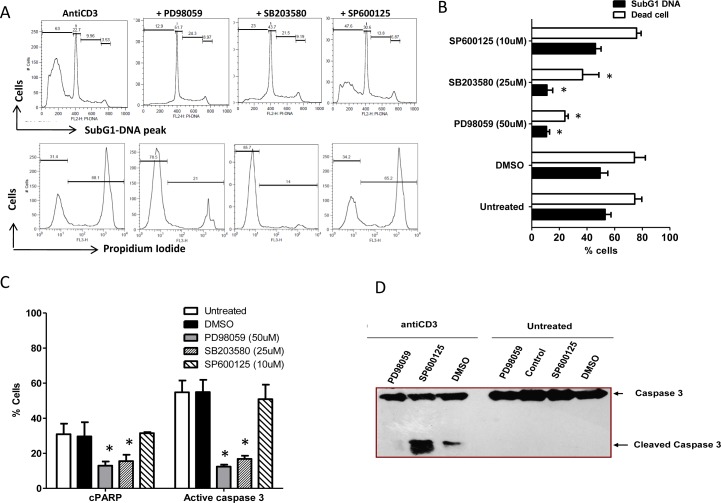
Figure 7. T helper cells AICD and MAPK
A. Representative histogram of Sub G1 peaks (upper) and loss of viability (lower) in Th1 like A1.1 cells treated with or without MAPK inhibitors: PD98059 (50uM), SB203580 (25uM) and SP600125 (10uM) and after 16 hours (overnight) of anti-CD3 induced reactivation. B. Percent SubG1 DNA and PI+ dead cells are represented as Mean and SEM. C. Mean and SEM of Active Caspase3 and cleaved PARP in Th1 like A1.1 cells treated with or without MAPK inhibitors such as PD98059 (50uM) for Erk1/2, SB203580 (25uM) for p38 and SP600125 (10uM) for JNK and after 16 hrs (overnight) of anti-CD3 induced reactivation. D. Western blot analysis of Activate Caspase3 in similarly treated A1.1 cells. Data represent at least three independent experiments and was tested for significance by using one-way ANOVA and Tukey's Multiple Comparison post hoc test and p < 0.5 considered as significant.
Figure 8
Figure 8. MAPK on FasL protein expression and degranulation in T helper cells
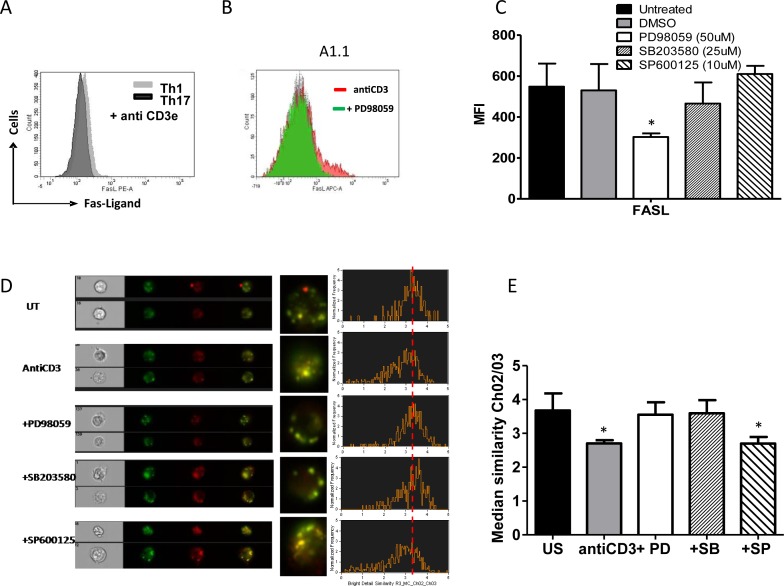
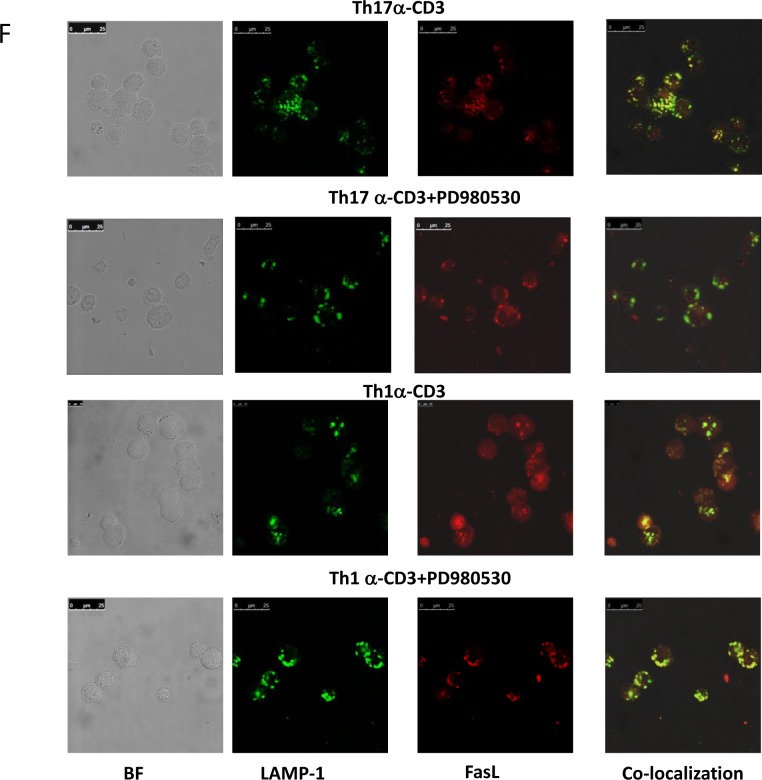
A. Representative histogram overlay of FasL expression in Th1 (grey) and Th17 cells (black) after anti-CD3 stimulation for 10 hrs. B. Representative histogram overlay of FasL expression in A1.1 cells treated with antiCD3 alone (red) and antiCD3 + PD98059 (green). C. Mean and SEM of Total FasL expression (MFI) in Th1 like A1.1 cells treated with and without MAPK inhibitors such as PD98059 (50uM) for Erk1/2, SB203580 (25uM) for p38 and SP600125 (10uM) for JNK and after 10 hrs of anti-CD3 induced reactivation. D. A representative image and histogram of Imaging flow cytometry of FasL protein degranulation from lysosomal co-localization with LAMP-1 FITC (green) and FasL PE (red) in A1.1 cells treated with and without MAPK inhibitors such as PD98059 (50uM) SB203580 (25uM) and SP600125 (10uM) and after 10 hrs of anti-CD3 induced reactivation. E. Mean and SEM of median similarity of Ch02 (LAMP-1-FITC) and Ch03 (FasL PE) in similarly treated A1.1 cells. F. Representative confocal image of FasL protein degranulation from lysosomal co-localization with LAMP-1 FITC (green) and FasL PE (red) in Th1 and Th17 cells.
Figure 8
Figure 8. MAPK on FasL protein expression and degranulation in T helper cells
A. Representative histogram overlay of FasL expression in Th1 (grey) and Th17 cells (black) after anti-CD3 stimulation for 10 hrs. B. Representative histogram overlay of FasL expression in A1.1 cells treated with antiCD3 alone (red) and antiCD3 + PD98059 (green). C. Mean and SEM of Total FasL expression (MFI) in Th1 like A1.1 cells treated with and without MAPK inhibitors such as PD98059 (50uM) for Erk1/2, SB203580 (25uM) for p38 and SP600125 (10uM) for JNK and after 10 hrs of anti-CD3 induced reactivation. D. A representative image and histogram of Imaging flow cytometry of FasL protein degranulation from lysosomal co-localization with LAMP-1 FITC (green) and FasL PE (red) in A1.1 cells treated with and without MAPK inhibitors such as PD98059 (50uM) SB203580 (25uM) and SP600125 (10uM) and after 10 hrs of anti-CD3 induced reactivation. E. Mean and SEM of median similarity of Ch02 (LAMP-1-FITC) and Ch03 (FasL PE) in similarly treated A1.1 cells. F. Representative confocal image of FasL protein degranulation from lysosomal co-localization with LAMP-1 FITC (green) and FasL PE (red) in Th1 and Th17 cells.
Figure 9
Figure 9. Over expression of MAPK in T helper cells AICD
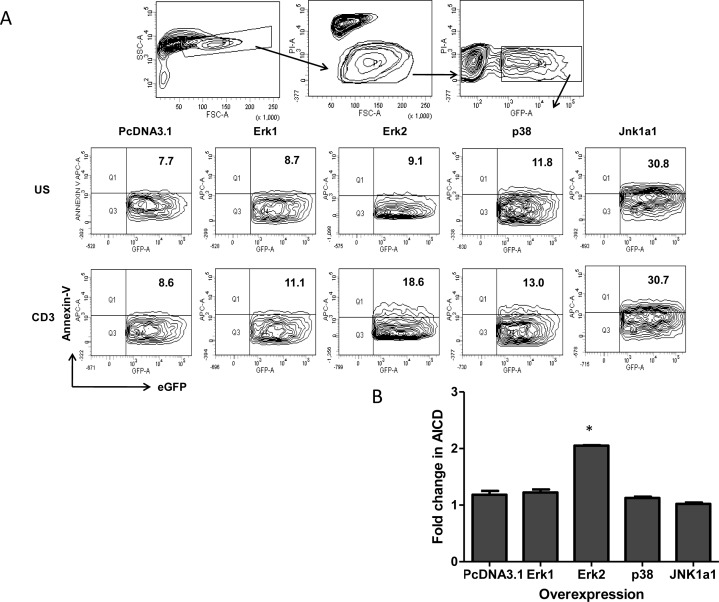
A. A representative gating strategy to study AICD (Annexin-V binding) in transiently transfected Th17-like EL4 cells with Wild type MAPK such as Erk1, Erk2, p38 and Jnk1a1 plasmids. B. Mean and SEM of fold increase (Annexin-V binding) AICD in MAPK over expressed Th17 like EL4 cells. Data was tested for significance by using one-way ANOVA and Tukey's Multiple Comparison post hoc test and p < 0.5 considered as significant.
Figure 10
Figure 10. MAP kinase mechanism in T helper AICD
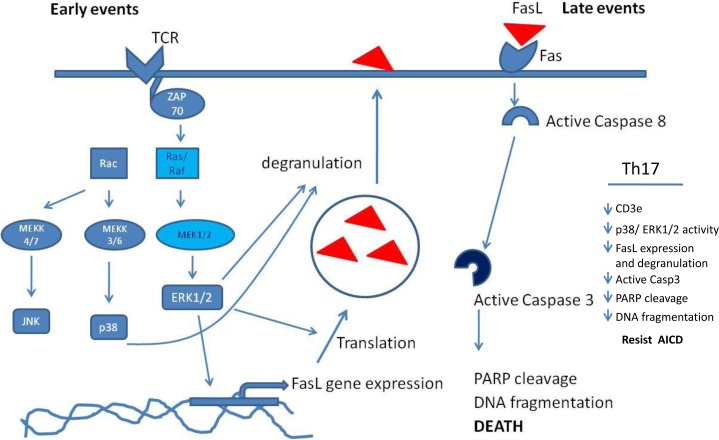
A schematic figure that represent the MAP Kinase involvement in AICD

References

    1. Gibofsky A. Overview of epidemiology, pathophysiology, and diagnosis of rheumatoid arthritis. The American journal of managed care. 2012;18(13 Suppl):S295–302. - PubMed
    1. McInnes IB, Schett G. The pathogenesis of rheumatoid arthritis. The New England journal of medicine. 2011;365(23):2205–2219. - PubMed
    1. Dolhain RJ, ter Haar NT, Hoefakker S, Tak PP, de Ley M, Claassen E, Breedveld FC, Miltenburg AM. Increased expression of interferon (IFN)-gamma together with IFN-gamma receptor in the rheumatoid synovial membrane compared with synovium of patients with osteoarthritis. British journal of rheumatology. 1996;35(1):24–32. - PubMed
    1. Cua DJ, Sherlock J, Chen Y, Murphy CA, Joyce B, Seymour B, Lucian L, To W, Kwan S, Churakova T, Zurawski S, Wiekowski M, Lira SA, Gorman D, Kastelein RA, Sedgwick JD. Interleukin-23 rather than interleukin-12 is the critical cytokine for autoimmune inflammation of the brain. Nature. 2003;421(6924):744–748. - PubMed
    1. Hue S, Ahern P, Buonocore S, Kullberg MC, Cua DJ, McKenzie BS, Powrie F, Maloy KJ. Interleukin-23 drives innate and T cell-mediated intestinal inflammation. The Journal of experimental medicine. 2006;203(11):2473–2483. - PMC - PubMed

Substances