. 2016 Oct;54(10):2530-7.
doi: 10.1128/JCM.01052-16. Epub 2016 Aug 3.

Norovirus Whole-Genome Sequencing by SureSelect Target Enrichment: a Robust and Sensitive Method

Affiliations

Norovirus Whole-Genome Sequencing by SureSelect Target Enrichment: a Robust and Sensitive Method

Julianne R Brown et al. J Clin Microbiol. 2016 Oct.

Abstract

Norovirus full-genome sequencing is challenging due to sequence heterogeneity among genomes. Previous methods have relied on PCR amplification, which is problematic due to primer design, and transcriptome sequencing (RNA-Seq), which nonspecifically sequences all RNA, including host and bacterial RNA, in stool specimens. Target enrichment uses a panel of custom-designed 120-mer RNA baits that are complementary to all publicly available norovirus sequences, with multiple baits targeting each position of the genome, which overcomes the challenge of primer design. Norovirus genomes are enriched from stool RNA extracts to minimize the sequencing of nontarget RNA. SureSelect target enrichment and Illumina sequencing were used to sequence full genomes from 507 norovirus-positive stool samples with reverse transcription-real-time PCR cycle threshold (CT) values of 10 to 43. Sequencing on an Illumina MiSeq system in batches of 48 generated, on average, 81% on-target reads per sample and 100% genome coverage with >12,000-fold read depth. Samples included genotypes GI.1, GI.2, GI.3, GI.6, GI.7, GII.1, GII.2, GII.3, GII.4, GII.5, GII.6, GII.7, GII.13, GII.14, and GII.17. When outliers were accounted for, we generated >80% genome coverage for all positive samples, regardless of CT values. A total of 164 samples were tested in parallel with conventional PCR genotyping of the capsid shell domain; 164/164 samples were successfully sequenced, compared to 158/164 samples that were amplified by PCR. Four of the samples that failed capsid PCR analysis had low titers, which suggests that target enrichment is more sensitive than gel-based PCR. Two samples failed PCR due to primer mismatches; target enrichment uses multiple baits targeting each position, thus accommodating sequence heterogeneity among norovirus genomes.


Figures

FIG 1
FIG 1
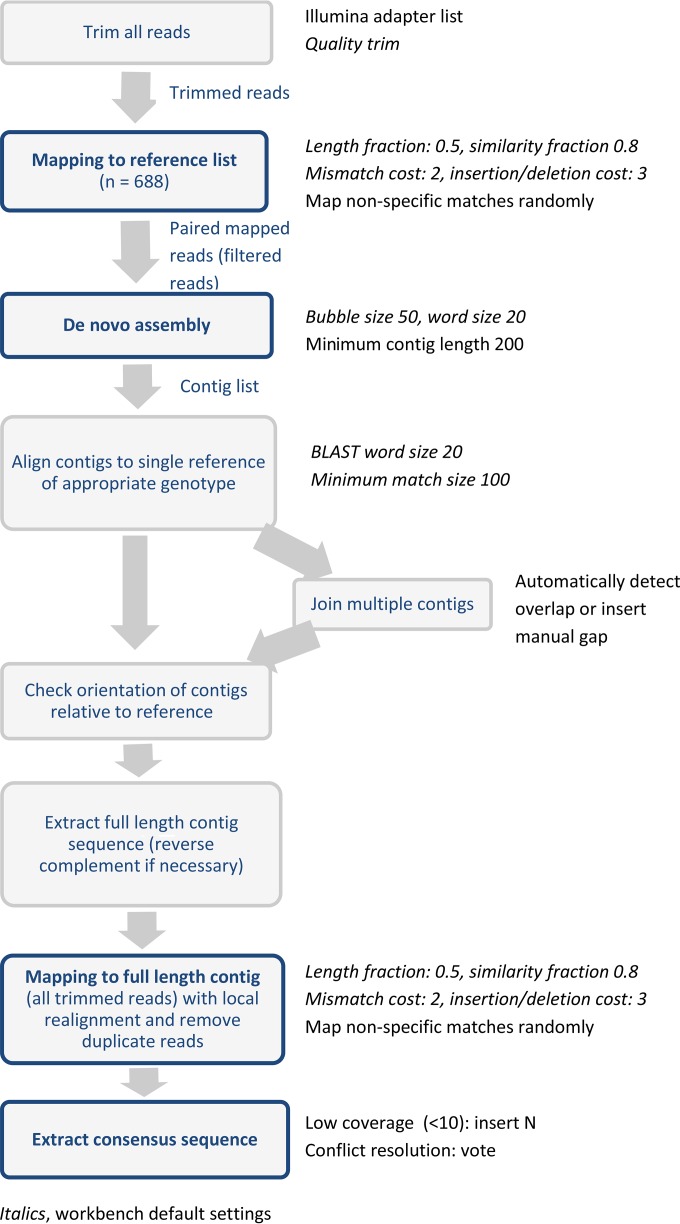
Schematic of the norovirus full-genome assembly pipeline.
FIG 2
FIG 2
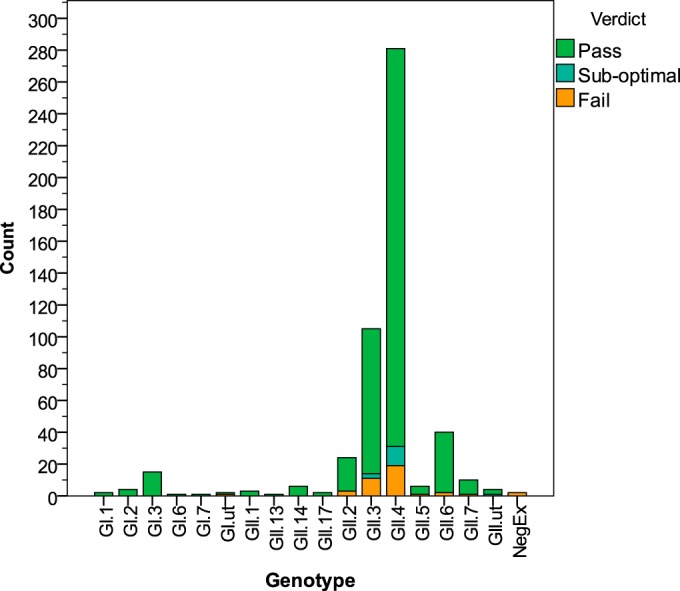
Numbers of samples sequenced according to norovirus genotype, classified by sequencing outcome. Pass, >90% genome coverage and >100-fold read depth; suboptimal, >90% genome coverage or >100-fold read depth; fail, <90% genome coverage and <100-fold read depth. Genotype refers to capsid genotype only.
FIG 3
FIG 3
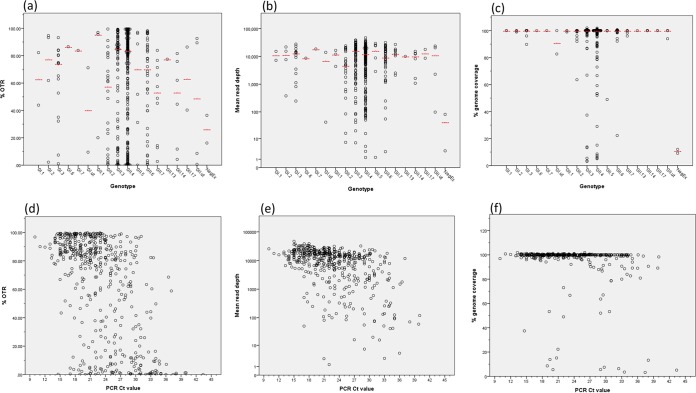
Norovirus full-genome sequencing outcome metrics according to norovirus genotype (a to c) and RT-qPCR CT values (d to f). OTR, on-target reads; CT, cycle threshold; NegEx, negative control. Red lines, median values.
FIG 4
FIG 4
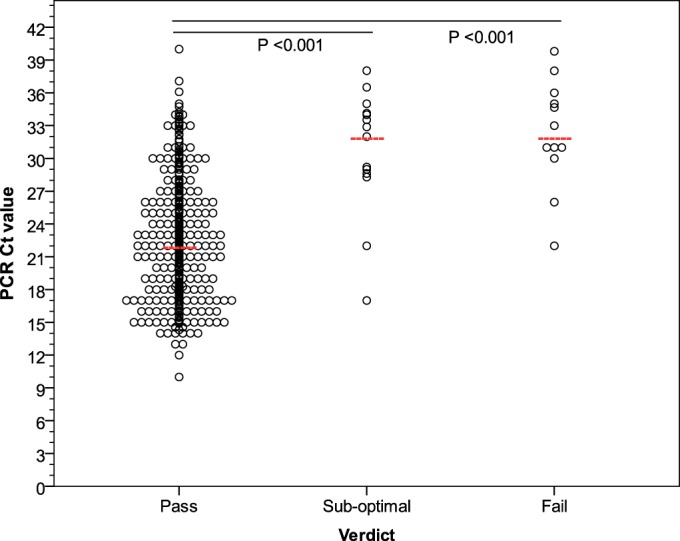
RT-qPCR CT values for all samples, excluding runs 30 and 31 (n = 413), sequenced with SureSelect target enrichment. Pass, >90% genome coverage and >100-fold read depth; suboptimal, >90% genome coverage or >100-fold read depth; fail, <90% genome coverage and <100-fold read depth. Red lines, median values.
FIG 5
FIG 5
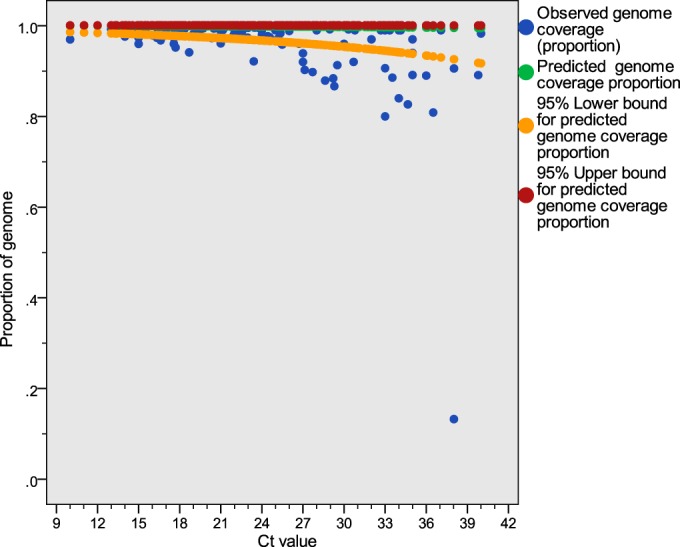
Observed and predicted genome coverage values with 95% prediction intervals, excluding outliers identified in Fig. SA3 in the supplemental material. The fitted linear regression model is y = 7.432 − 0.059x, where the dependent variable y is the logit-transformed genome coverage proportion and the independent variable x is the PCR CT value (n = 477).

References

    1. de Wit MA, Koopmans MP, Kortbeek LM, Wannet WJ, Vinje J, van Leusden F, Bartelds AI, van Duynhoven YT. 2001. Sensor, a population-based cohort study on gastroenteritis in the Netherlands: incidence and etiology. Am J Epidemiol 154:666–674. doi:10.1093/aje/154.7.666. - DOI - PubMed
    1. Scallan E, Hoekstra RM, Angulo FJ, Tauxe RV, Widdowson MA, Roy SL, Jones JL, Griffin PM. 2011. Foodborne illness acquired in the United States: major pathogens. Emerg Infect Dis 17:7–15. doi:10.3201/eid1701.P11101. - DOI - PMC - PubMed
    1. Ahmed SM, Hall AJ, Robinson AE, Verhoef L, Premkumar P, Parashar UD, Koopmans M, Lopman BA. 2014. Global prevalence of norovirus in cases of gastroenteritis: a systematic review and meta-analysis. Lancet Infect Dis 14:725–730. doi:10.1016/S1473-3099(14)70767-4. - DOI - PMC - PubMed
    1. Lopman BA, Reacher MH, Vipond IB, Hill D, Perry C, Halladay T, Brown DW, Edmunds WJ, Sarangi J. 2004. Epidemiology and cost of nosocomial gastroenteritis, Avon, England, 2002–2003. Emerg Infect Dis 10:1827–1834. doi:10.3201/eid1010.030941. - DOI - PMC - PubMed
    1. Koo HL, Neill FH, Estes MK, Munoz FM, Cameron A, Dupont HL, Atmar RL. 2013. Noroviruses: the most common pediatric viral enteric pathogen at a large university hospital after introduction of rotavirus vaccination. J Pediatr Infect Dis Soc 2:57–60. doi:10.1093/jpids/pis070. - DOI - PMC - PubMed

Publication types