


Nonmedical use of prescription drugs in the European Union
- PMID: 27488186
- PMCID: PMC4972971
- DOI: 10.1186/s12888-016-0909-3
Nonmedical use of prescription drugs in the European Union
Abstract
Background: Nonmedical prescription drug use (NMPDU) refers to the self-treatment of a medical condition using medication without a prescriber's authorization as well as use to achieve euphoric states. This article reports data from a cross-national investigation of NMPDU in five European Countries, with the aim to understand the prevalence and characteristics of those engaging in NMPDU across the EU.
Methods: A parallel series of self-administered, cross-sectional, general population surveys were conducted in 2014. Data were collected using multi-stage quota sampling and then weighted using General Exponential Model. A total of 22,070 non-institutionalized participants, aged 12 to 49 years, in 5 countries: Denmark, Germany, Great Britain, Spain, and Sweden. Lifetime and past-year nonmedical use of prescription medications such as stimulants, opioids, and sedatives were ascertained via a modified version of the World Health Organization's Composite International Diagnostic Interview. Information about how the medications were acquired for NMPDU were also collected from the respondent.
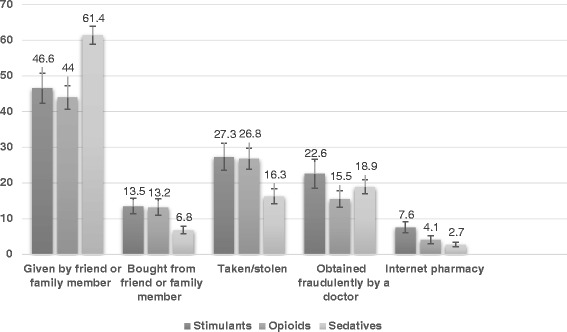
Results: Lifetime and past-year prevalence of nonmedical prescription drug use was estimated for opioids (13.5 and 5.0 %), sedatives (10.9 and 5.8 %), and stimulants (7.0 and 2.8 %). Germany exhibited the lowest levels of NMPDU, with Great Britain, Spain, and Sweden having the highest levels. Mental and sexual health risk factors were associated with an increased likelihood of past-year nonmedical prescription drug use. Among past-year users, about 32, 28, and 52 % of opioid, sedative, and stimulant nonmedical users, respectively, also consumed illicit drugs. Social sources (sharing by friends/family) were the most commonly endorsed methods of acquisition, ranging from 44 % (opioids) to 62 % (sedatives). Of interest is that Internet pharmacies were a common source of medications for opioids (4.1 %), stimulants (7.6 %), and sedatives (2.7 %).
Conclusions: Nonmedical prescription drug use was reported across the five EU countries we studied, with opioids and sedatives being the most prevalent classes of prescription psychotherapeutics. International collaborations are needed for continued monitoring and intervention efforts to target population subgroups at greatest risk for NMDU.
Figures
Comment in
-
Prescription drug misuse in Europe is higher than previously thought.BMJ. 2016 Aug 4;354:i4304. doi: 10.1136/bmj.i4304. BMJ. 2016. PMID: 27492387 No abstract available.
References
-
- Manchikanti L, Helm S, 2nd, Fellows B, et al. Opioid epidemic in the United States. Pain Physician. 2012;15(3 Suppl):ES9–38. - PubMed
-
- ONDCP. Epidemic: Responding to America's prescription drug abuse epidemic. 2012. http://www.whitehouse.gov/sites/default/files/ondcp/policy-and-research/.... Accessed 15 Jan 2015.
-
- Time. Why America can't kick its pain reliever problem. 2015. http://time.com/3908648/why-america-cant-kick-its-painkiller-problem/. Accessed 25 Jun 2015.
MeSH terms
Substances
LinkOut - more resources
Full Text Sources
Other Literature Sources
Medical
Miscellaneous
