


Comparison of detection methods and follow-up study on the tyrosine kinase inhibitors therapy in non-small cell lung cancer patients with ROS1 fusion rearrangement
- PMID: 27488371
- PMCID: PMC4973062
- DOI: 10.1186/s12885-016-2582-9
Comparison of detection methods and follow-up study on the tyrosine kinase inhibitors therapy in non-small cell lung cancer patients with ROS1 fusion rearrangement
Abstract
Background: The screening of ROS proto-oncogene 1, receptor tyrosine kinase(ROS1) fusion rearrangement might be potentially beneficial for an effective therapy against non-small cell lung cancer (NSCLC). However, the three main ROS1 rearrangement detection methods have limitations, and no routine protocol for the detection of ROS1 rearrangement in NSCLC is available. In this study, our aims were to compare immunohistochemistry (IHC), fluorescent in situ hybridization (FISH) and quantitative real-time polymerase chain reaction (qRT-PCR) in their ability to detect ROS1 rearrangement in NSCLC, and discuss the clinical characteristics and histopathology of the patients with ROS1 rearrangement. Moreover, the effects of tyrosine kinase inhibitors (TKIs) therapy on the patients with ROS1 rearrangement and advanced stage disease (III b-IV) were investigated.
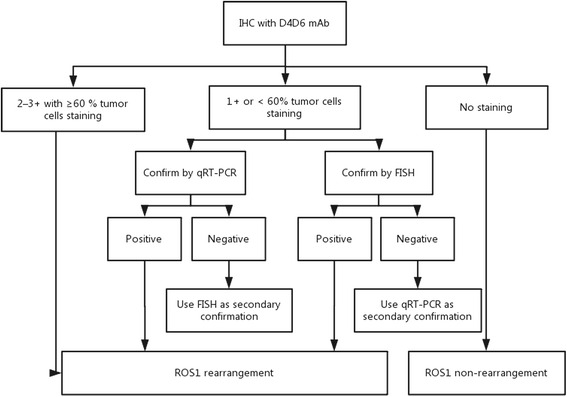
Methods: Patients with a previously diagnosed NSCLC were recruited in this study from November 2013 to October 2015. IHC was performed using the D4D6 monoclonal antibody (mAb) in an automatic IHC instrument, while FISH and qRT-PCR were carried out to confirm the IHC results. FISH and qRT-PCR positive cases underwent direct sequencing. After detection, patients with advanced ROS1 rearranged NSCLC had received TKI therapy.
Results: Two hundred and thirty-eight patients were included in this study. ROS1 rearrangement was detected in 10 patients. The concordant rate of FISH and qRT-PCR results was 100 %, while in the FISH and IHC results high congruence was present when IHC showed a diffusely (≥60 % tumor cells) 2-3+ cytoplasmic reactivity pattern. Patients harboring ROS1 rearrangement were mostly young (8/10), females (7/10) and non-smokers (7/10) with adenocarcinoma (10/10) and acinar pattern. Most of their tumor were in intermediate grade (6/8). Among these 10 patients, three of them in stage IV with ROS1 rearrangement gained benefits from ROS1 TKI therapy.
Conclusions: IHC, FISH and qRT-PCR can reliably detect ROS1 rearrangement in NSCLC, while IHC can be used as a preliminary screening tool. These results supported the efficacy of ROS1 TKI therapy in treating advanced NSCLC patients with ROS1 rearrangement.
Keywords: Fluorescent in situ hybridization; Immunohistochemistry; Non-small cell lung cancer; Quantitative real-time polymerase chain reaction; ROS1; Tyrosine kinase inhibitors.
Figures

References
-
- Acquaviva J, Wong R, Charest A. The multifaceted roles of the receptor tyrosine kinase ROS in development and cancer. Biochim Biophys Acta. 1795;2009:37–52. - PubMed
Publication types
MeSH terms
Substances
LinkOut - more resources
Full Text Sources
Other Literature Sources
Medical
