


High-Intensity Drinking Among Young Adults in the United States: Prevalence, Frequency, and Developmental Change
- PMID: 27488575
- PMCID: PMC5008981
- DOI: 10.1111/acer.13164
High-Intensity Drinking Among Young Adults in the United States: Prevalence, Frequency, and Developmental Change
Abstract
Background: This study is the first to examine the developmental course of high-intensity drinking (i.e., consuming 10+ drinks in a row) across late adolescence and the transition to adulthood.
Methods: National longitudinal data (N = 3,718) from Monitoring the Future were used to examine trajectories of 10+ high-intensity drinking from age 18 through 25/26 overall and across sociodemographic subgroups; results were compared with similar analysis of 5+ binge drinking trajectories.
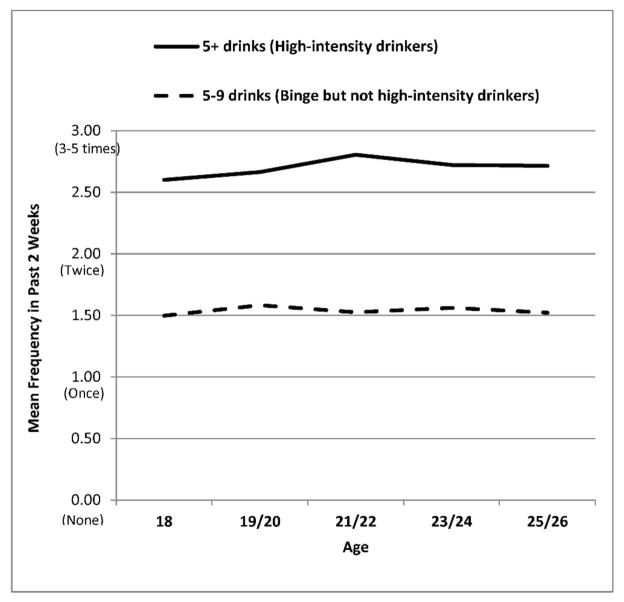
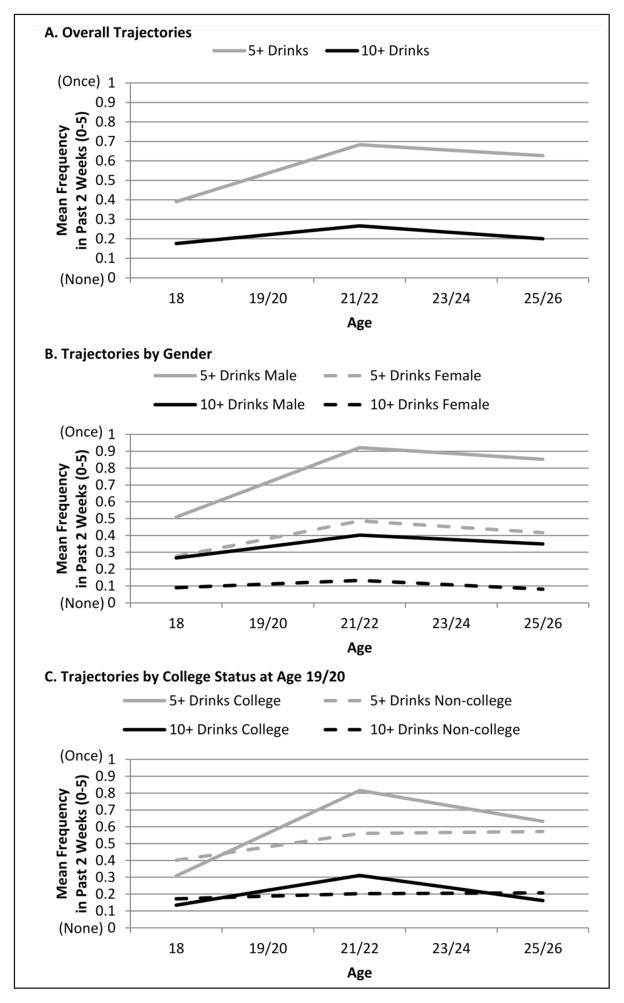
Results: Results document that 10+ drinkers consume not just a greater quantity of alcohol on a given drinking occasion, but also engage in 5+ drinking more frequently than drinkers who do not report having 10 or more drinks. Developmental patterns for 10+ and 5+ drinking were similar, with peak frequencies reported at age 21/22. Greater peaks in both 10+ and 5+ drinking were documented among men and among college attenders, compared with women and nonattenders, respectively. However, there was a steeper decline in 10+ drinking after age 21/22, indicating that risk for consumption of 10 or more drinks in a row is more clearly focused on the early 20s. Patterns of developmental change in both behaviors were driven largely by college students: No significant age-related change in 10+ drinking was observed among men and women who did not go to college, and no significant age-related change in 5+ drinking was observed among female nonattenders.
Conclusions: Findings underscore the importance of recognizing high-intensity drinkers as a unique high-risk group, and that college attendance is associated with particularly strong peaks in the developmental course of high-intensity drinking.
Keywords: Binge Drinking; College Attendance; Development; Extreme Binge Drinking; High-Intensity; Trajectories.
Copyright © 2016 by the Research Society on Alcoholism.
Figures
Comment in
-
Commentary on Patrick and Colleagues: High-Intensity Drinking Among Young Adults in the United States: Prevalence, Frequency, and Developmental Change.Alcohol Clin Exp Res. 2017 Feb;41(2):270-274. doi: 10.1111/acer.13306. Epub 2017 Jan 19. Alcohol Clin Exp Res. 2017. PMID: 28102543 No abstract available.
References
-
- Alexander EN, Bowen AM. Excessive drinking in college: behavioral outcome, not binge, as a basis for prevention. Addict Behav. 2004;29:1199–205. - PubMed
-
- Bachman JG, Johnston LD, O'Malley PM, Schulenberg JE, Miech RA. The Monitoring the Future project after four decades: Design and procedures (Monitoring the Future Occasional Paper No. 82) Ann Arbor, Mi: Institute for Social Research; 2015. http://monitoringthefuture.org/pubs/occpapers/mtf-occ82.pdf.
-
- Chassin L, Pitts SC, Prost J. Binge drinking trajectories from adolescence to emerging adulthood in a high-risk sample: predictors and substance abuse outcomes. J Consult Clin Psychol. 2002;70:67–78. - PubMed
-
- Chassin L, Presson CC, Sherman SJ. ‘Constructive’ vs. ‘destructive’ deviance in adolescent health behaviors. J Youth Adolesc. 1989;18:245–262. - PubMed
Publication types
MeSH terms
Grants and funding
LinkOut - more resources
Full Text Sources
Other Literature Sources
Medical
