Review
. 2016 Aug 3;36(31):8038-49.
doi: 10.1523/JNEUROSCI.0856-16.2016.

Functional Heterogeneity in the Bed Nucleus of the Stria Terminalis

Affiliations
Review

Functional Heterogeneity in the Bed Nucleus of the Stria Terminalis

Nur Zeynep Gungor et al. J Neurosci. .

Abstract

Early work stressed the differing involvement of the central amygdala (CeA) and bed nucleus of the stria terminalis (BNST) in the genesis of fear versus anxiety, respectively. In 2009, Walker, Miles, and Davis proposed a model of amygdala-BNST interactions to explain these functional differences. This model became extremely influential and now guides a new wave of studies on the role of BNST in humans. Here, we consider evidence for and against this model, in the process highlighting central principles of BNST organization. This analysis leads us to conclude that BNST's influence is not limited to the generation of anxiety-like responses to diffuse threats, but that it also shapes the impact of discrete threatening stimuli. It is likely that BNST-CeA interactions are involved in modulating responses to such threats. In addition, whereas current views emphasize the contributions of the anterolateral BNST region in anxiety, accumulating data indicate that the anteromedial and anteroventral regions also play a critical role. The presence of multiple functional subregions within the small volume of BNST raises significant technical obstacles for functional imaging studies in humans.

Keywords: BNST; amygdala; anxiety; fear.


Figures

Figure 1.
Figure 1.
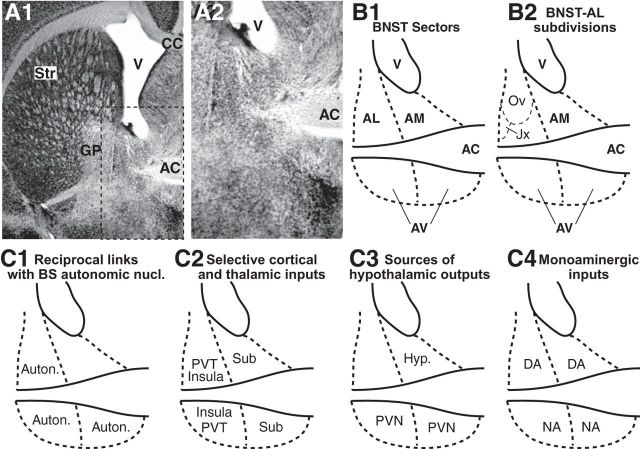
Structure and main connections of BNST. A, Anterior BNST at low (1) and high (2) magnification. Coronal sections processed to reveal NeuN immunoreactivity. B, Nomenclature. C, Connections. Two major fiber bundles, the intra-BNST segment of the stria terminalis (ST) and the anterior commissure (AC), naturally divide the anterior part of BNST in three sectors: Dorsal to the AC are the AL and AM sectors, located lateral and medial to the ST, respectively. Ventral to the AC is the AV region. In contrast with BNST-AL, BNST-AM receives little or no CeA inputs (see references in main text), (1) it does not project to brainstem autonomic centers (C1) (Norgren, 1976; Ricardo and Koh, 1978; Saper and Loewy, 1980; Schwaber et al., 1982; Sofroniew, 1983; Gray and Magnuson, 1987, 1992; Shin et al., 2008; Panguluri et al., 2009; Bienkowski and Rinaman, 2013); (2) it is innervated by largely distinct cortical areas and thalamic nuclei (C2) (Cullinan et al., 1993; McDonald et al., 1999; Reynolds et al., 2005; Li and Kirouac, 2008; Shin et al., 2008; Bienkowski and Rinaman, 2013); and (3) moreover, its hypothalamic projections are comparably massive (C3) (Conrad and Pfaff, 1976a, b; Saper et al., 1976; Swanson, 1976; Swanson and Cowan, 1979; Kita and Oomura, 1982a; b; Dong and Swanson, 2003, 2004, 2006a, b, c; Dong et al., 2000, 2001b). Although the connectivity of the lateral and medial portions of BNST-AV is similar to that of BNST-AL and AM, respectively, it must be considered separately because of its heavy noradrenergic innervation, among the densest in the brain (C4) (Fallon and Moore, 1978; Forray et al., 2000), as well as its strong projections to the VTA (Dong et al., 2001b; Georges and Aston-Jones, 2002) and PVN of the hypothalamus (Sawchenko and Swanson, 1983; Moga and Saper, 1994). AC, Anterior commissure; Auton, autonomic centers; BS, brainstem; CC, corpus callosum; DA, dopamine; GP, globus pallidus; Hyp, hypothalamus; Jx, juxtacapsular; NA, noradrenaline; Ov, oval; PVT, paraventricular nucleus of thalamus; Sub, subiculum; Str, striatum; V, ventricle.
Figure 2.
Figure 2.
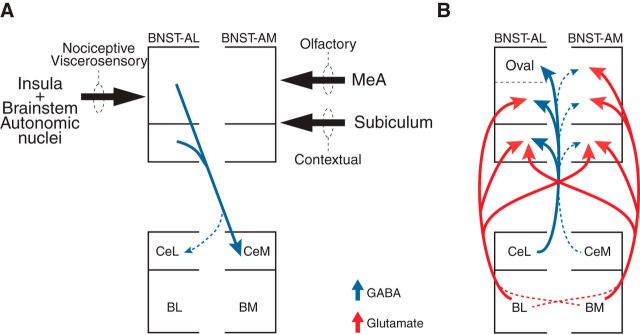
Reciprocal connections between the amygdala and the anterior part of BNST. A, BNST projections to the amygdala. Black arrows indicate dominant sensory inputs. MeA, Medial nucleus of the amygdala. B, Amygdala projections to BNST.
Figure 3.
Figure 3.
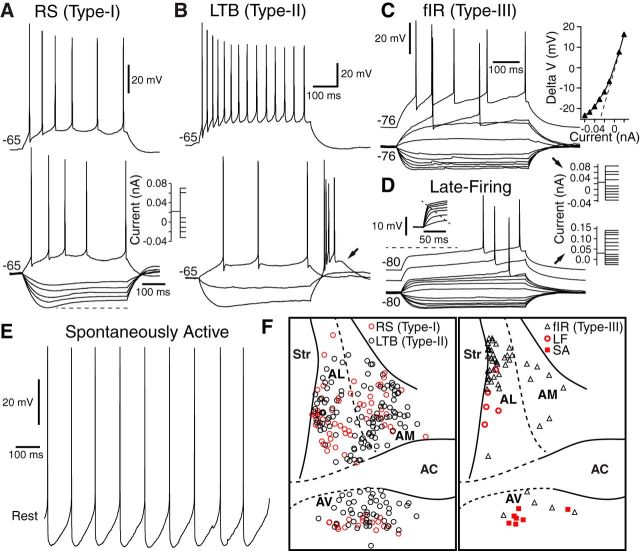
Physiological properties of BNST neurons. Five types have been described (A–E). In decreasing order of incidence, they are low-threshold bursting (LTB; Type II; B), regular spiking (RS, Type I; A), with a fast inward rectifying K+ conductance (fIR; Type III; C), late-firing (D), and spontaneously active (E) neurons. The relative incidence of Type I and II cells is similar in the three BNST regions (F, left), but the other three cell types are mostly found in one of the three regions (F, right). Type III cells are concentrated in the oval nucleus, spontaneously active cells in BNST-AV, and late-firing cells in BNST-AL. C, Inset, Amplitude of voltage response to current pulses (y-axis) as a function of current (x-axis). D, Inset, Expanded view of initial voltage response to current injection. Modified from Rodriguez-Sierra et al. (2013).
Figure 4.
Figure 4.
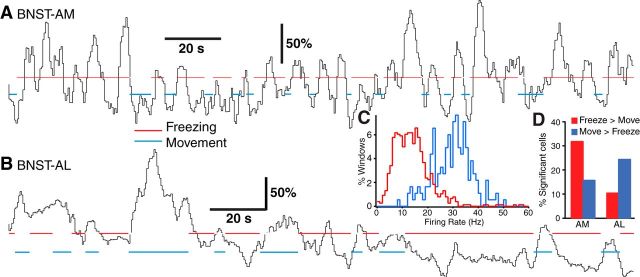
Inverse fluctuations in the firing rate of BNST-AM and BNST-AL neurons in relation to contextual freezing. Rats were subjected to a classical auditory fear conditioning protocol. The next day, while recording BNST neurons, rats were exposed to the conditioning context in the absence of CS. Rats froze 40%–50% of the time during exposure to the aversive context. A, B, Black traces represent average firing rates of 5 BNST-AM (A) and 3 BNST-AL (B) cells during epochs of contextual freezing (red lines) or movement (blue lines). C, For all available cells, multiple epochs of freezing (red) or movement (blue) were segmented and distribution of firing rates compared. D, Percentage cells with significantly different firing rates during freezing versus movement in BNST-AM versus AL. Red and blue bars represent cells with higher versus lower firing rates during freezing than movement. Modified from Haufler et al. (2013).
Figure 5.
Figure 5.
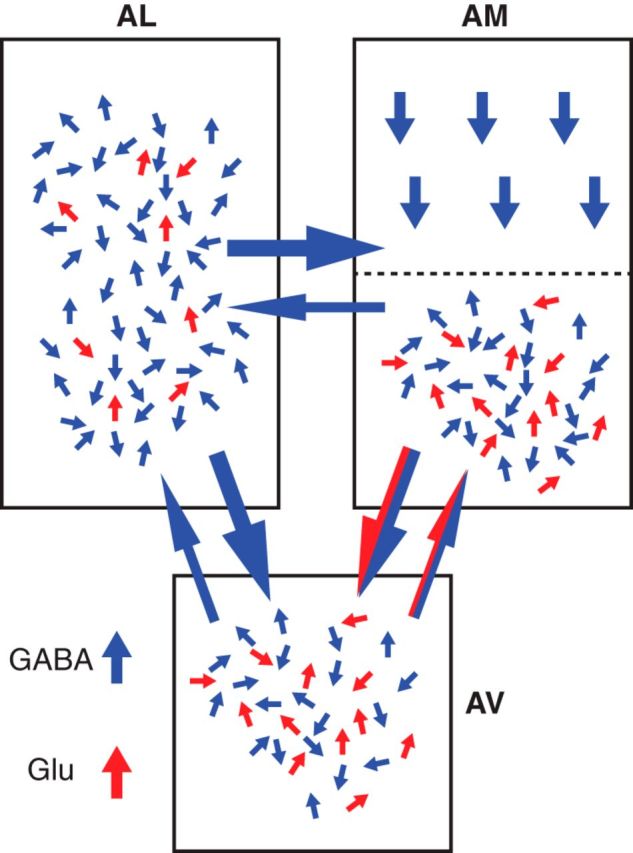
Intrinsic BNST connections. Pattern of intrinsic connections in the anterior BNST, as revealed with glutamate uncaging. Neurons were recorded with the whole-cell method in slices in vitro. Glutamate was uncaged by applying brief flashes of ultra-violet light to a circumscribed region (250 μm in diameter) of BNST. The light stimulus was moved to systematically scan the slice in search of BNST sites containing neurons projecting to the recorded cell. For intraregional connections, the number of blue (GABAergic) and red (glutamatergic) arrows approximates the relative frequency of inhibitory and excitatory connections, respectively. For inter-regional connections, the thickness of the arrows was adjusted to represent the relative incidence of connections. Data from Turesson et al. (2013).
Figure 6.
Figure 6.
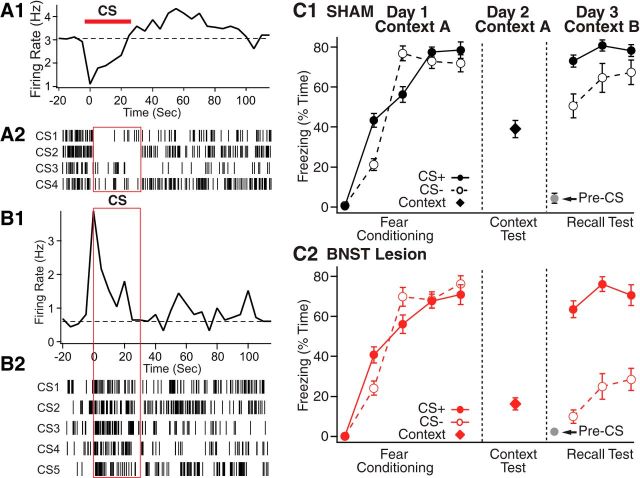
BNST activity alters the processing of discrete threatening stimuli. A, B, Two examples of anterior BNST neurons with short-latency responses to discrete threatening cues. These cells were recorded extracellularly in rats that had been subjected to a classical auditory fear conditioning protocol (CS, conditioned stimulus, pure tone). We show CS-evoked activity during the recall test, conducted 1 d after conditioning. A1, B1, Peri-CS histograms of neuronal discharges. A2, B2, Rasters where each tick represents an action potential. Cells with inhibitory responses prevailed in BNST-AL, whereas cells with excitatory responses were concentrated in BNST-AM. C, Excitotoxic BNST lesions enhance the stimulus specificity of conditioned fear responses. The two graphs compare percentage time freezing to the CS+ (filled symbols and solid lines), CS (empty symbols and dashed lines), or conditioning context exposure in sham (C1, black) or BNST-lesioned (C2, red) rats. There is markedly reduced freezing to the CS with no change in behavior to the CS+ in BNST-lesioned rats. C, Modified from Duvarci et al. (2009).

References

    1. Adhikari A, Lerner TN, Finkelstein J, Pak S, Jennings JH, Davidson TJ, Davidson TJ, Ferenczi E, Gunaydin LA, Mirzabekov JJ, Ye L, Kim SY, Lei A, Deisseroth K. Basomedial amygdala mediates top-down control of anxiety and fear. Nature. 2015;527:179–185. doi: 10.1038/nature15698. - DOI - PMC - PubMed
    1. Aston-Jones G, Harris GC. Brain substrates for increased drug seeking during protracted withdrawal. Neuropharmacology. 2004;47:167–179. doi: 10.1016/j.neuropharm.2004.06.020. - DOI - PubMed
    1. Avery SN, Clauss JA, Blackford JU. The human BNST: functional role in anxiety and addiction. Neuropsychopharmacology. 2016;41:126–141. doi: 10.1038/npp.2015.185. - DOI - PMC - PubMed
    1. Bienkowski MS, Rinaman L. Common and distinct neural inputs to the medial central nucleus of the amygdala and anterior ventrolateral bed nucleus of stria terminalis in rats. Brain Struct Funct. 2013;218:187–208. doi: 10.1007/s00429-012-0393-6. - DOI - PMC - PubMed
    1. Breitfeld T, Bruning JE, Inagaki H, Takeuchi Y, Kiyokawa Y, Fendt M. Temporary inactivation of the anterior part of the bed nucleus of the stria terminalis blocks alarm pheromone induced defensive behavior in rats. Front Neurosci. 2015;9:321. doi: 10.3389/fnins.2015.00321. - DOI - PMC - PubMed