Post-discharge heart failure monitoring program in Turkey: Hit-PoinT
- PMID: 27488754
- PMCID: PMC5336747
- DOI: 10.14744/AnatolJCardiol.2016.6812
Post-discharge heart failure monitoring program in Turkey: Hit-PoinT
Abstract
Objective: The aim of this study was to assess the efficacy and feasibility of an enhanced heart failure (HF) education with a 6-month telephone follow- up program in post-discharge ambulatory HF patients.
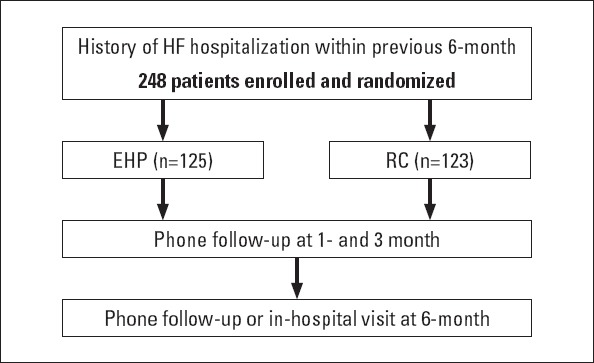
Methods: The Hit-Point trial was a multicenter, randomized, controlled trial of enhanced HF education with a 6-month telephone follow-up program (EHFP) vs routine care (RC) in patients with HF and reduced ejection fraction. A total of 248 patients from 10 centers in various geographical areas were randomized: 125 to EHFP and 123 to RC. Education included information on adherence to treatment, symptom recognition, diet and fluid intake, weight monitoring, activity and exercise training. Patients were contacted by telephone after 1, 3, and 6 months. The primary study endpoint was cardiovascular death.
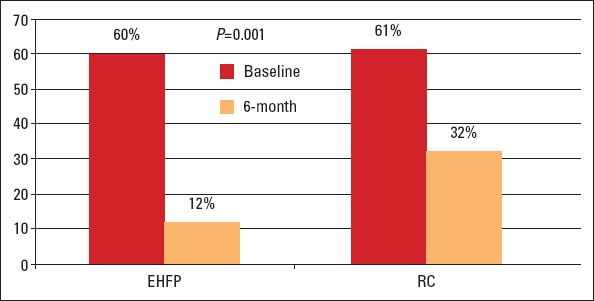
Results: Although all-cause mortality didn't differ between the EHFP and RC groups (p=NS), the percentage of cardiovascular deaths in the EHFP group was significantly lower than in the RC group at the 6-month follow up (5.6% vs. 8.9%, p=0.04). The median number of emergency room visits was one and the median number of all cause hospitalizations and heart failure hospitalizations were zero. Twenty-tree percent of the EHFP group and 35% of the RC group had more than a median number of emergency room visits (p=0.05). There was no significant difference regarding the median number of all-cause or heart failure hospitalizations. At baseline, 60% of patients in EHFP and 61% in RC were in NYHA Class III or IV, while at the 6-month follow up only 12% in EHFP and 32% in RC were in NYHA Class III or IV (p=0.001).
Conclusion: These results demonstrate the potential clinical benefits of an enhanced HF education and follow up program led by a cardiologist in reducing cardiovascular deaths and number of emergency room visits with an improvement in functional capacity at 6 months in post-discharge ambulatory HF patients.
Conflict of interest statement
Figures
References
-
- Seferovic PM, Stoerk S, Filippatos G, Mareev V, Kavoliuniene A, Ristic AD, et al. Organization of heart failure management in European Society of Cardiology member countries: survey of the Heart Failure Association of the European Society of Cardiology in collaboration with the Heart Failure National Societies/Working Groups. Eur J Heart Fail. 2013;15:947–59. - PubMed
-
- Değertekin M, Erol Ç, Ergene O, Tokgözoğlu L, Aksoy M, Erol MK, et al. Heart failure prevalence and predictors in Turkey: HAPPY study. Arch Turk Soc Cardiol. 2012;40:298–308. - PubMed
-
- Loehr LR, Rosamond WD, Chang PP, Folsom AR, Chambless LE. Heart failure incidence and survival (from the Atherosclerosis Risk in Communities study) Am J Cardiol. 2008;101:1016–22. - PubMed
-
- Maggioni AP, Dahlström U, Flippatos G, Chioncel O, Leiro MC, Drozdz J, et al. EURObservational Research Programme: regional differences and 1-year follow-up results of the Heart Failure Pilot Survey (ESC-HF Pilot) Eur J Heart Fail. 2013;15:808–17. - PubMed
Publication types
MeSH terms
LinkOut - more resources
Full Text Sources
Other Literature Sources
Medical
Research Materials
Miscellaneous