


Coffee Drinking Is Widespread in the United States, but Usual Intake Varies by Key Demographic and Lifestyle Factors
- PMID: 27489008
- PMCID: PMC4997286
- DOI: 10.3945/jn.116.233940
Coffee Drinking Is Widespread in the United States, but Usual Intake Varies by Key Demographic and Lifestyle Factors
Abstract
Background: Despite widespread popularity and possible health effects, the prevalence and distribution of coffee consumption in US adults are poorly characterized.
Objective: We sought to estimate usual daily coffee intakes from all coffee-containing beverages, including decaffeinated and regular coffee, among US adults according to demographic, socioeconomic, and health-related factors.
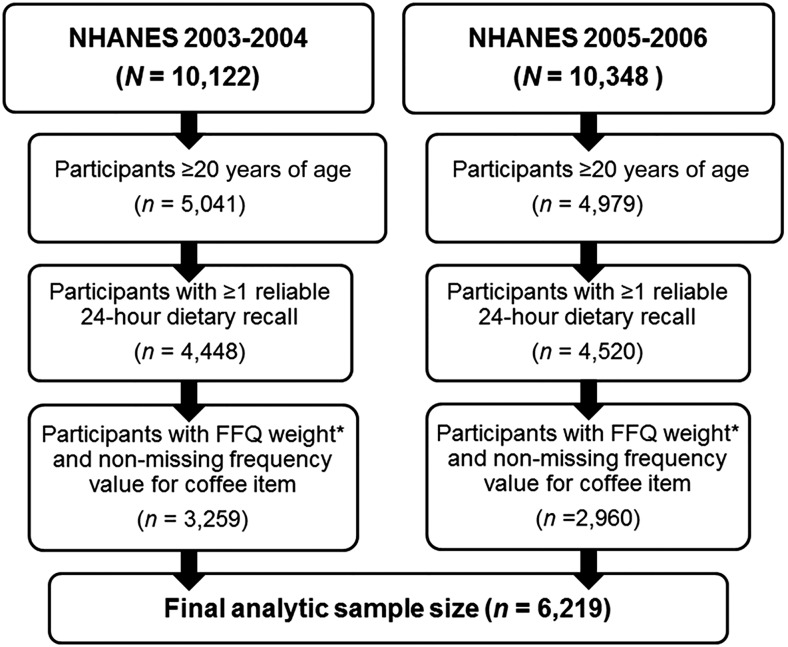
Methods: Dietary intake data from ≤2 nonconsecutive 24-h dietary recalls and a food-frequency questionnaire administered during the NHANES 2003-2006 were used to estimate the person-specific probability of consuming coffee on a particular day and the usual amount consumed on consumption days. Trends in population mean coffee consumption over time were evaluated by using multiple linear regression and 1-d 24-h recall data from NHANES 2003-2012. Analyses were weighted to be representative of the US adult population aged ≥20 y.
Results: An estimated 154 million adults, or 75% of the US population, aged ≥20 y reported drinking coffee; 49% reported drinking coffee daily. Prevalence did not vary by sex, education, income, or self-reported general health (all P ≥ 0.05) but did vary by age, race/ethnicity, smoking status, and alcohol drinking (all P < 0.05). Among coffee drinkers, the mean ± SE usual intake was 14.1 ± 0.5 fluid ounces/d (417 ± 15 mL/d). Mean usual intakes were higher in men than women, in older age groups than in those aged 20 to <30 y, in non-Hispanic whites than in non-Hispanic blacks or Hispanic/other races, in smokers than in never smokers, and in daily alcohol consumers than in nonconsumers (all P < 0.05). Population mean coffee consumption was stable from 2003 to 2012 (P-trend = 0.09).
Conclusions: Coffee is widely consumed in the United States, with usual intakes varying by lifestyle and demographic factors, most notably by age. Longitudinal studies are needed to determine whether observed differences by age reflect birth cohort effects or changes in drinking patterns over the lifetime.
Keywords: National Cancer Institute method; coffee; diet; population survey; usual intake.
© 2016 American Society for Nutrition.
Conflict of interest statement
2 Author disclosures: E Loftfield, ND Freedman, KW Dodd, E Vogtmann, Q Xiao, R Sinha, and BI Graubard, no conflicts of interest.
Figures
References
-
- Ukers WH. All about coffee. New York: The Tea & Coffee Trade Journal Co.; 1935.
-
- Foreign Agriculture Service. 2015/2016 Forecast overview. Coffee: world markets and trade. Washington (DC): USDA; 2015.
-
- Jick H, Miettinen OS, Neff RK, Shapiro S, Heinonen OP, Slone D. Coffee and myocardial infarction. N Engl J Med 1973;289:63–7. - PubMed
-
- Wu JN, Ho SC, Zhou C, Ling WH, Chen WQ, Wang CL, Chen YM. Coffee consumption and risk of coronary heart diseases: a meta-analysis of 21 prospective cohort studies. Int J Cardiol 2009;137:216–25. - PubMed
MeSH terms
Substances
LinkOut - more resources
Full Text Sources
Other Literature Sources
