


Comment
doi: 10.3389/fendo.2016.00091.
eCollection 2016.
Crucial Role Reported for TSPO in Viability and Steroidogenesis is a Misconception. Commentary: Conditional Steroidogenic Cell-Targeted Deletion of TSPO Unveils a Crucial Role in Viability and Hormone-Dependent Steroid Formation
Affiliations
- PMID: 27489176
- PMCID: PMC4947589
- DOI: 10.3389/fendo.2016.00091
Item in Clipboard
Comment
Crucial Role Reported for TSPO in Viability and Steroidogenesis is a Misconception. Commentary: Conditional Steroidogenic Cell-Targeted Deletion of TSPO Unveils a Crucial Role in Viability and Hormone-Dependent Steroid Formation
Front Endocrinol (Lausanne).
.
No abstract available
Keywords: Leydig cells; adrenal cortex; cholesterol; embryonic lethality; lipid metabolism; mitochondria; steroid biosynthesis; translocator protein TSPO.
Figures
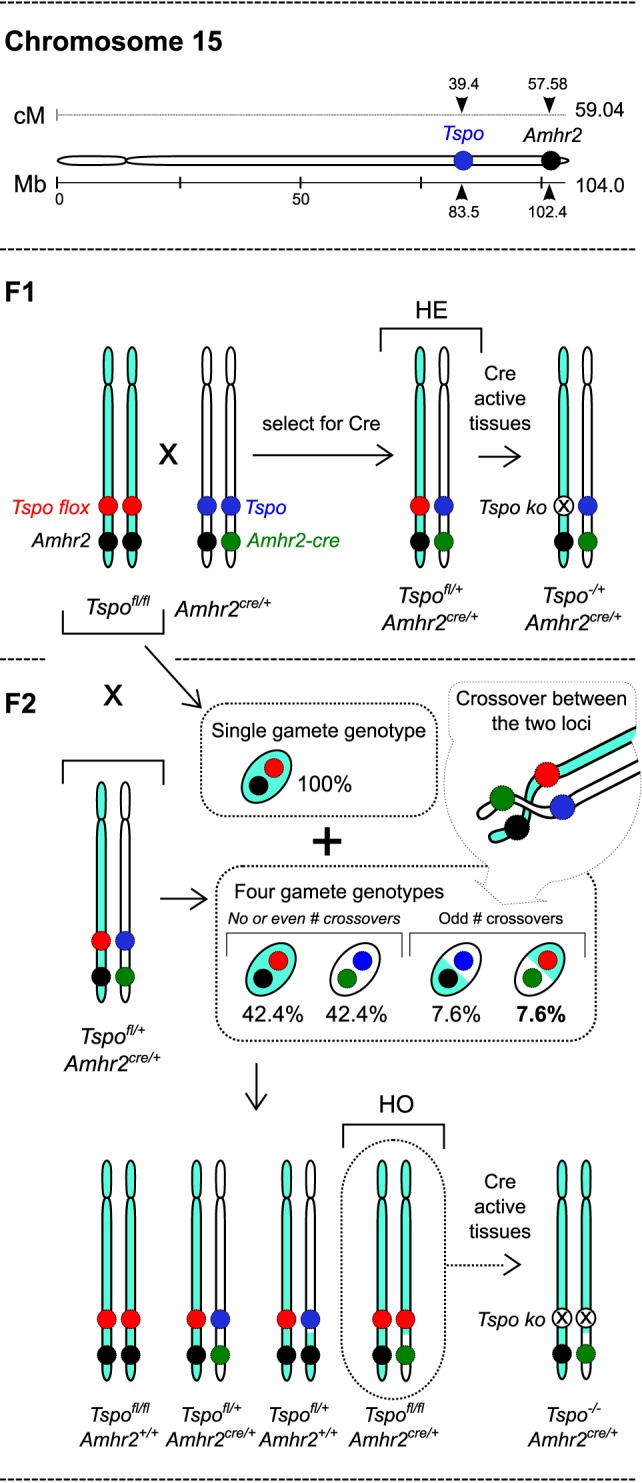
“Embryonic lethality” based on a miscalculation: inheritance of the Tspo and Amhr2 gene loci in chromosome 15 with respective floxed and knock-in cre alleles. Murine chromosome 15 showing the physical positions (in megabases – Mb) and genetic positions (in centimorgans – cM) of Tspo and Amhr2 genes (drawn to scale). F1: breeding between Tspofl/flAmhr2+/+ and Tspo+/+Amhr2Cre/+ can produce cre positive heterozygous Tspofl/+Amhr2Cre/+ (HE) offspring and Tspofl/+Amhr2+/+ offspring (not shown). With tissue-specific cre drivers, there is recombination in cre expressing cells leading to Tspo−/+Amhr2Cre/+ HE mono-allelic knockout cells. F2: HE mice are backcrossed with Tspofl/flAmhr2+/+ mice in order to generate Tspofl/fl, Amhr2Cre/+ (HO) mice. The Tspofl/flAmhr2+/+ mice produce only one gamete genotype, whereas HE mice produce four gamete genotypes, the ratio of which depends on the frequency of odd number of crossovers that occur between the Tspo and Amhr2 loci, and not through independent assortment, because they are in the same chromosome. Consequently, the gamete genotype necessary for generating HO offspring occurs at a calculated frequency of 7.6%. This is much lower than the classic Mendelian ratio of 25% because Tspo and Amhr2 gene loci are closely spaced in chromosome 15, and are, therefore, linked and inherited together at a high frequency. The experimental value of 4.4% observed by Fan et al. (7), is anticipated and indicates the biological value for that particular mouse strain. Therefore, interpretation of embryonic lethality in HO mice based on an incorrect expectation of 25% by Fan et al. (7) is seriously flawed.
Comment on
-
Conditional steroidogenic cell-targeted deletion of TSPO unveils a crucial role in viability and hormone-dependent steroid formation.Proc Natl Acad Sci U S A. 2015 Jun 9;112(23):7261-6. doi: 10.1073/pnas.1502670112. Epub 2015 May 26. Proc Natl Acad Sci U S A. 2015. PMID: 26039990 Free PMC article.
References
Publication types
LinkOut - more resources
Full Text Sources
Other Literature Sources
