Measurement Error as Alternative Explanation for the Observation that CrCl/GFR Ratio is Higher at Lower GFR
- PMID: 27489301
- PMCID: PMC5012489
- DOI: 10.2215/CJN.12821215
Measurement Error as Alternative Explanation for the Observation that CrCl/GFR Ratio is Higher at Lower GFR
Abstract
Background and objectives: Overestimation of GFR by urinary creatinine clearance (CrCl) at lower levels of GFR has long been attributed to enhanced creatinine secretion. However, this does not take into consideration the contribution of errors in measured GFR (and CrCl) due to short-term biologic variability or test imprecision.
Design, setting, participants, & measurements: We analyzed cross-sectional data among 1342 participants from the Chronic Renal Insufficiency Cohort study with baseline measurement of GFR by iothalamate clearance (iGFR) and CrCl by 24-hour urine collection. We examined the CrCl/iGFR ratio classified by categories of iGFR and also by categories of CrCl.
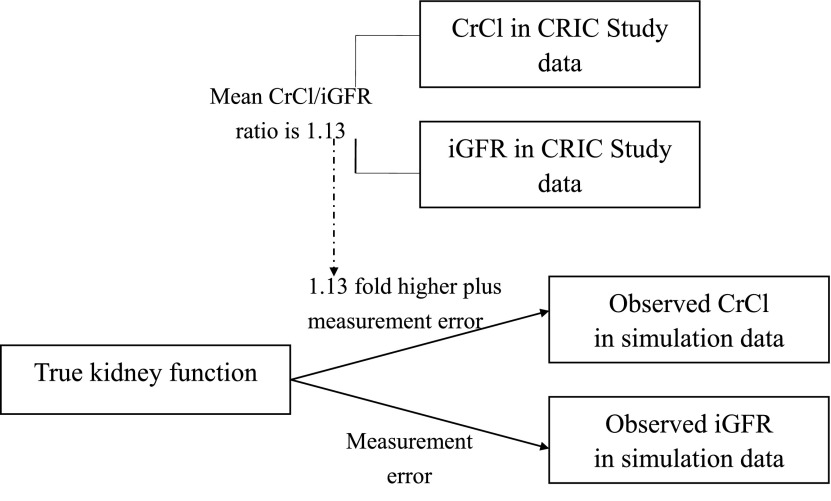
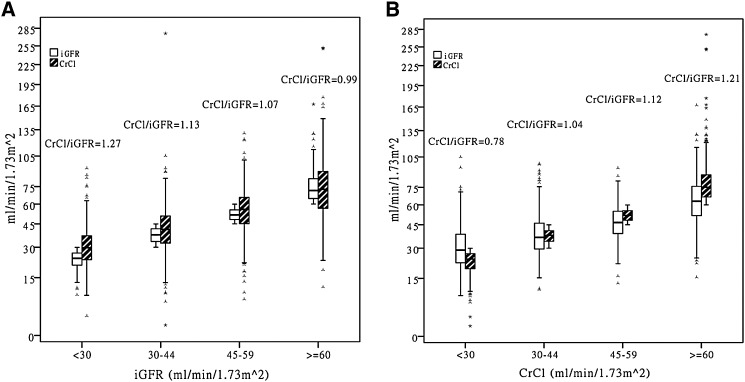
Results: Overall, mean CrCl/iGFR ratio was 1.13. CrCl/iGFR ratio was higher at lower iGFR categories. In contrast, this ratio was lower at lower CrCl levels. We hypothesize these relationships could be due to measurement error, which is bolstered by replicating these trends in a simulation and modeling exercise in which there was no variation in the ratio of CrCl/iGFR with true kidney function but taking into account the effect of measurement error in both CrCl and iGFR (of magnitudes previously described in the literature). In our simulated data, the observed CrCl/iGFR ratio was higher at lower observed iGFR levels when patients were classified by categories of observed iGFR. When the same patients were classified by categories of observed CrCl, the observed CrCl/iGFR ratio was lower at lower observed CrCl levels.
Conclusions: The combined empirical and modeling results suggest that measurement errors (in both CrCl and iGFR) should be considered as an alternative explanation for the longstanding observation that the ratio of CrCl to iGFR gets larger as iGFR decreases.
Copyright © 2016 by the American Society of Nephrology.
Figures
Comment in
-
What Is the Correct Approach for Comparing GFR by Different Methods across Levels of GFR?Clin J Am Soc Nephrol. 2016 Sep 7;11(9):1518-1521. doi: 10.2215/CJN.07530716. Epub 2016 Aug 3. Clin J Am Soc Nephrol. 2016. PMID: 27489300 Free PMC article. No abstract available.
References
-
- Inker LA, Perrone RD: Assessment of kidney function, 2014. Available at: http://www.uptodate.com/contents/assessment-of-kidney-function. Accessed February 10, 2016
-
- Inker LA, Perrone RD: Calculation of the creatinine clearance, 2015. Available at: http://www.uptodate.com/contents/calculation-of-the-creatinine-clearance. Accessed February 10, 2016
-
- Israni AK, Kasiske BL: Laboratory assessment of kidney disease: glomerular filtration rate, urinalysis, and proteinuria. In: Brenner & Rector’s The kidney, edited by Brenner BM, 9th Ed., Philadelphia, Elsevier Saunders, 2011, pp 872–873
-
- Lafyette RA, Perrone RD, Levey AS: Laboratory Evaluation of Renal Function. In: Diseases of the Kidney, edited by Schrier RW, Gottschalk CW, 6th Ed., Philadelphia, Lippincott Williams & Wilkins, 1996, pp 307–354
-
- Levey AS, Perrone RD, Madias NE: Serum creatinine and renal function. Annu Rev Med 39: 465–490, 1988 - PubMed
Publication types
MeSH terms
Substances
Grants and funding
LinkOut - more resources
Full Text Sources
Other Literature Sources
Medical