. 2016 Oct 1;116(4):1848-1858.
doi: 10.1152/jn.00339.2016. Epub 2016 Aug 3.

Losing touch: age-related changes in plantar skin sensitivity, lower limb cutaneous reflex strength, and postural stability in older adults

Affiliations

Losing touch: age-related changes in plantar skin sensitivity, lower limb cutaneous reflex strength, and postural stability in older adults

Ryan M Peters et al. J Neurophysiol. .

Abstract

Age-related changes in the density, morphology, and physiology of plantar cutaneous receptors negatively impact the quality and quantity of balance-relevant information arising from the foot soles. Plantar perceptual sensitivity declines with age and may predict postural instability; however, alteration in lower limb cutaneous reflex strength may also explain greater instability in older adults and has yet to be investigated. We replicated the age-related decline in sensitivity by assessing monofilament and vibrotactile (30 and 250 Hz) detection thresholds near the first metatarsal head bilaterally in healthy young and older adults. We additionally applied continuous 30- and 250-Hz vibration to drive mechanically evoked reflex responses in the tibialis anterior muscle, measured via surface electromyography. To investigate potential relationships between plantar sensitivity, cutaneous reflex strength, and postural stability, we performed posturography in subjects during quiet standing without vision. Anteroposterior and mediolateral postural stability decreased with age, and increases in postural sway amplitude and frequency were significantly correlated with increases in plantar detection thresholds. With 30-Hz vibration, cutaneous reflexes were observed in 95% of young adults but in only 53% of older adults, and reflex gain, coherence, and cumulant density at 30 Hz were lower in older adults. Reflexes were not observed with 250-Hz vibration, suggesting this high-frequency cutaneous input is filtered out by motoneurons innervating tibialis anterior. Our findings have important implications for assessing the risk of balance impairment in older adults.

Keywords: aging; balance; cutaneous; psychophysics; reflex.


Figures

Fig. 1.
Fig. 1.
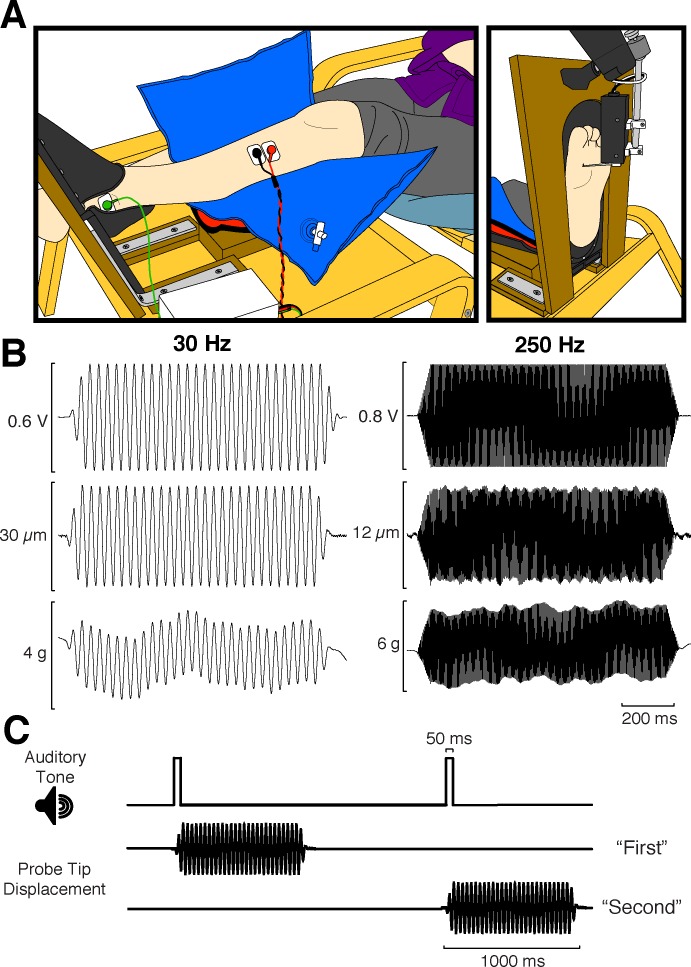
Experimental setup, vibratory stimuli, and 2IFC trial timeline. A: side schematic view of a participant's leg in the footrest/leg support setup (left) and front view of the exposed plantar surface of the foot, as well as the motor used for delivering vibrations (right). B: sample traces of 30-Hz (left) and 250-Hz vibrations (right). Top, voltage command sent to the motor; middle, probe tip displacement; bottom, contact force. C: timeline depicting the series of events that occurred on each 2IFC vibrotactile trial. The participant was presented with sequential 50-ms auditory tones denoting the 2 stimulus intervals. A 1-s vibration was delivered randomly during either the first or second interval, and the participant was required to determine which interval contained the stimulus.
Fig. 2.
Fig. 2.
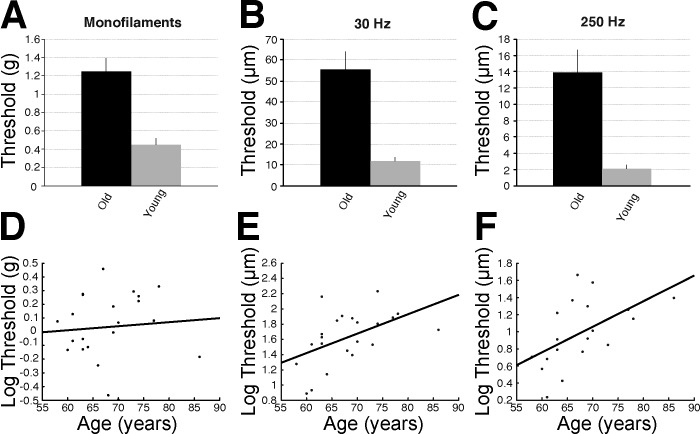
Summary of sensory testing data. A–C: bar graphs showing the raw mean (±SE) difference between young and older adults in monofilament thresholds (A) and vibrotactile thresholds at 30 and 250 Hz (B and C, respectively). D–F: scatterplots depicting the age-related decline in log monofilament (D) and vibrotactile thresholds at 30 and 250 Hz (E and F, respectively) within the older adult group.
Fig. 3.
Fig. 3.
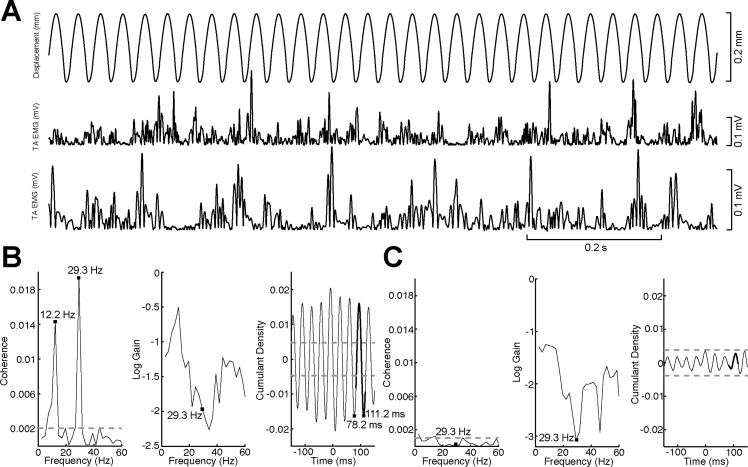
Summary of cutaneous reflex data set. A: segment of the continuous time series data used in the spectral analysis. Top, probe tip displacement; middle and bottom, full-wave rectified EMG recorded from TA used in B and C. Participants held a 10–15% maximal voluntary contraction dorsiflexion of TA throughout the measurement. B: example from a young adult (22-yr-old female) with a strong reflex response at 30 Hz. Coherence (left), log gain (center), and cumulant density (right) were computed over the entire 600 s of concatenated data. Black squares in coherence and gain graphs denote the value that was extracted for the data analysis (29.3 Hz). The additional black square at 12.2 Hz denotes a commonly observed artifact resulting from the EMG driving changes in position due to small foot movements during the reflex protocol. Black squares in the cumulant density graph show that the oscillation is occurring at the vibratory stimulus frequency. C: example from an older adult (61-yr-old male) with nonsignificant coherence and cumulant density values calculated over 1,200 s of concatenated data; however, weak oscillations at ∼30 Hz still can be observed in the cumulant density graph. Bold black line segments overlaid on the cumulant density plots show the portion of data centered on t = 100 ms that was used in the data analysis.
Fig. 4.
Fig. 4.
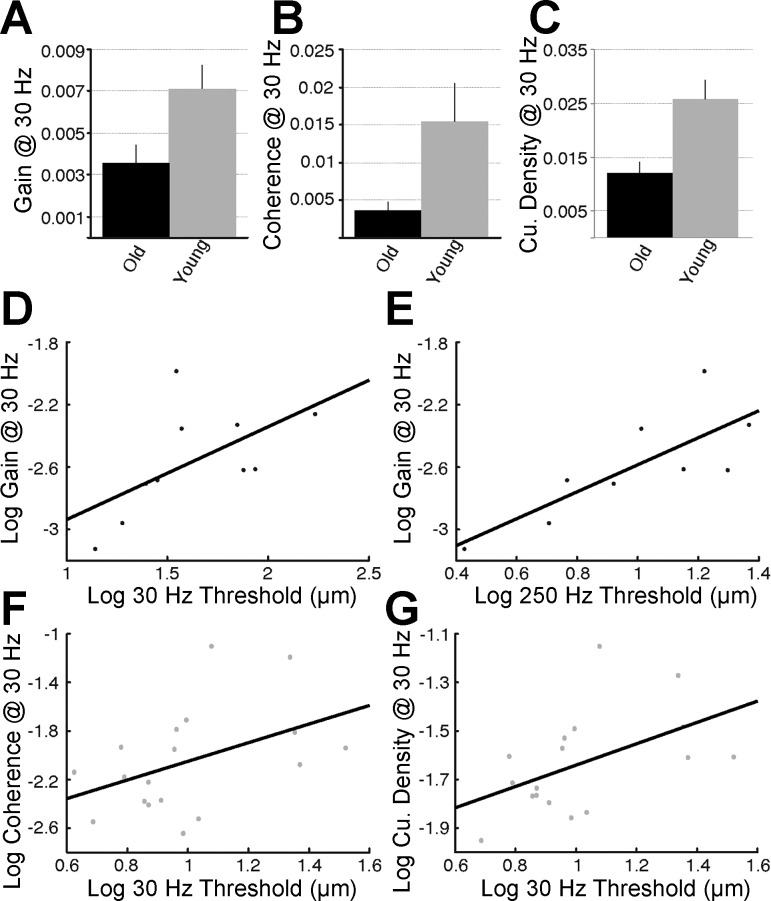
Age-related change in cutaneous reflexes and its relationship with plantar sensitivity. A–C: bar graphs showing the raw mean (±SE) difference between young and older adults in cutaneous reflex gain (A), coherence (B), and cumulant density (C) with 30-Hz continuous vibration as the input stimulus. D and E: correlations between log gain at 30 Hz and log 30-Hz (D) and log 250-Hz vibrotactile thresholds (E) observed within the older adults (black data points). F and G: correlations between log 30-Hz vibrotactile thresholds and log coherence (F) and log cumulant density (G) at 30 Hz observed within the young adults (gray data points). Cu., cumulative.
Fig. 5.
Fig. 5.
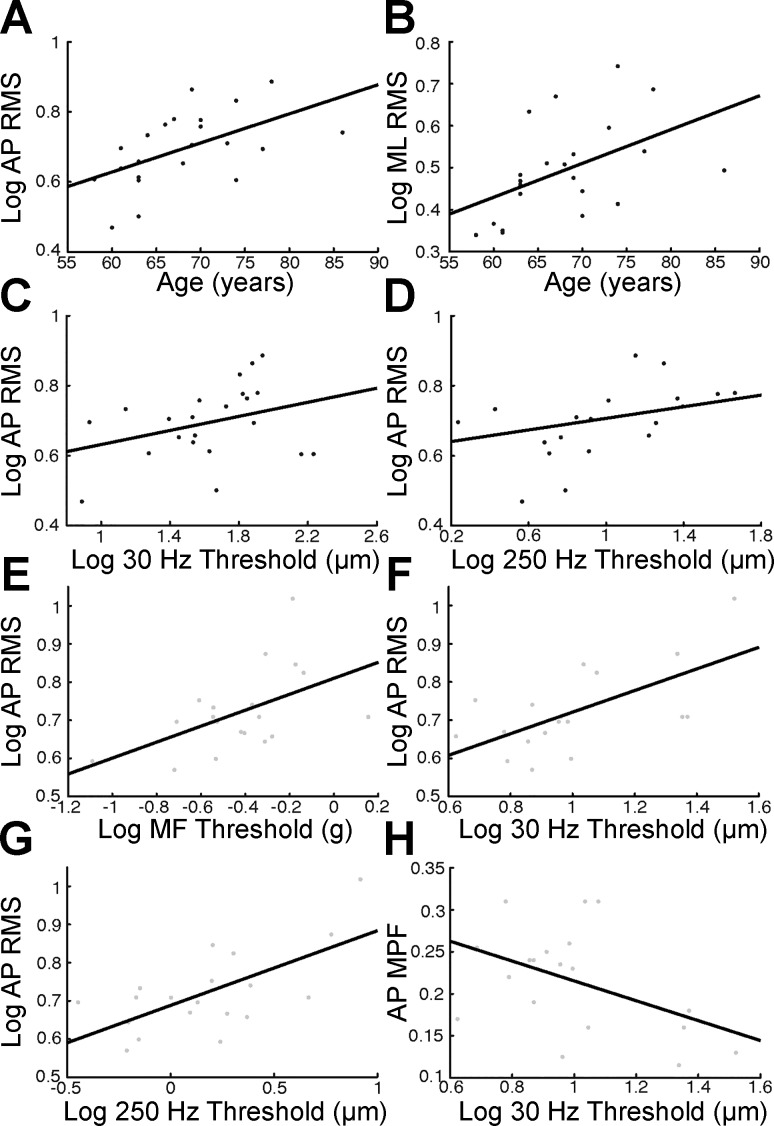
Relationship between age-related decline in plantar sensitivity and postural instability. A and B: scatterplots depicting the age-related increase in log CoP RMS amplitude observed in both the AP (A) and ML planes (B) for older adults (black data points). C and D: scatterplots showing correlations between log AP CoP RMS amplitude and log 30-Hz (C) and log 250-Hz vibrotactile thresholds (D) in older adults. E–G: scatterplots showing correlations between log AP CoP RMS amplitude and log monofilament (E), log 30-Hz (F), and log 250-Hz detection thresholds (G) in young adults (gray data points). H: scatterplot displaying the relationship observed between AP CoP MPF and log 30-Hz vibrotactile thresholds in the young.

References

    1. Aniss AM, Gandevia SC, Burke D. Reflex responses in active muscles elicited by stimulation of low-threshold afferents from the human foot. J Neurophysiol 67: 1375–1384, 1992. - PubMed
    1. Bent LR, Lowrey CR. Single low-threshold afferents innervating the skin of the human foot modulate ongoing muscle activity in the upper limbs. J Neurophysiol 109: 1614–1625, 2013. - PubMed
    1. Bent LR, Strzalkowski ND. Cutaneous afferent sensitivity and perceptual threshold in the human foot sole. 2014 International Society for Posture and Gait Research World Congress (Oral Abstract O.2.5), Vancouver, BC, Canada, June 29-July 3, 2014.
    1. Bolanowski SJ Jr, Gescheider GA, Verrillo RT, Checkosky CM. Four channels mediate the mechanical aspects of touch. J Acoust Soc Am 84: 1680–1694, 1988. - PubMed
    1. Bolton CF, Winkelmann R, Dyck PJ. A quantitative study of Meissner's corpuscles in man. Neurology 16: 1–1, 1966. - PubMed

Publication types

LinkOut - more resources