


Designing for Safety: Implications of a Fifteen Year Review of Swallowed and Aspirated Dentures
- PMID: 27489607
- PMCID: PMC4970503
- DOI: 10.5037/jomr.2016.7203
Designing for Safety: Implications of a Fifteen Year Review of Swallowed and Aspirated Dentures
Abstract
Objectives: Dentures are worn by around 20% of the population, yet if they become displaced they may enter the gastrointestinal or respiratory system, sometimes with grave consequences. The aim of this study was to review recent published literature in order to identify the epidemiology of patients and characteristics of swallowed and aspirated dental prostheses, and propose strategies to minimise these risks.
Material and methods: A fifteen year retrospective of published case series and case reports was carried out. Photographs, radiographs and descriptions of the dental prostheses were gathered, as well as the patient's presenting complaint, the anatomical site where the denture was caught and the procedure required to remove the denture.
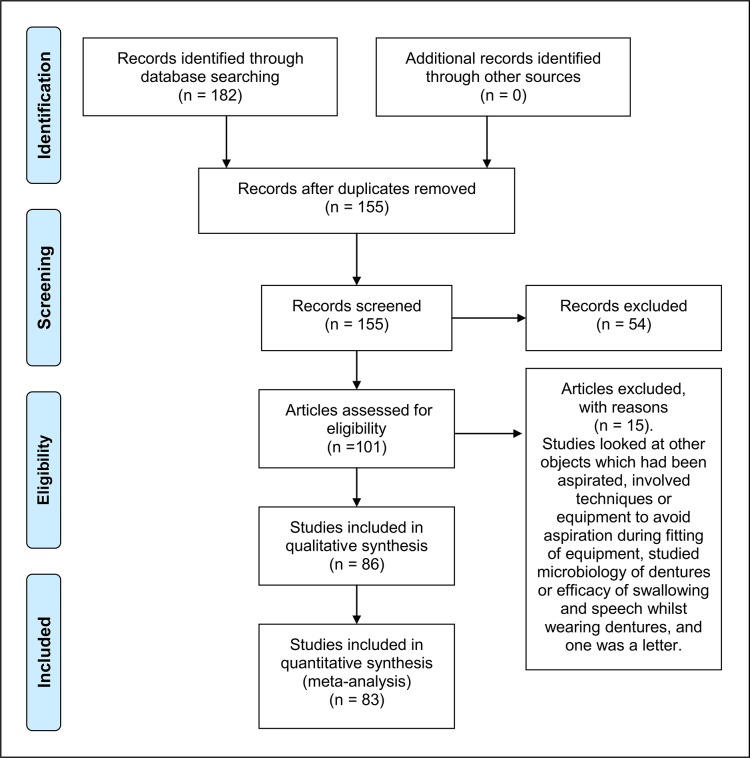
Results: Ninety one separate events of swallowed or aspirated dentures were identified from 83 case reports and series from 28 countries. Average age was 55 years, and these were 74% male. Photographs were retrieved for 49 of these dentures. Clasps were present in 25 of the dentures. There was no significant difference between clasped and unclasped dentures for perforation rates, need for open surgery and spontaneously passed dentures.
Conclusions: We discuss the implications of this study regarding denture designs, specifically the importance of using a radiopaque acrylic, using clasps when required even if there is a risk of aspiration, advising patients to return if a denture is loose or damaged, and finally that all patients who wear a denture are at risk of aspiration and swallowing events, and associated morbidity and mortality.
Keywords: deglutition; dental prosthesis design; denture design; dentures; respiratory aspiration.
References
-
- Steele J, O'Sullivan I. Executive summary: adult dental health survey 2009. London: The Health and Social Care Information Centre. 2009. URL: http://www.hscic.gov.uk/catalogue/PUB01086/adul-dent-heal-surv-summ-them....
-
- Shillingburg HT Jr, Sather DA, Wilson EL Jr, Cain JR, Mitchell DL, Blanco LJ, Kessler JC. Principles of tooth preparations. In: Shillingburg HT Jr, Sather DA, editors. Fundamentals of fixed prosthodontics. 4th ed. Chicago: Quintessence Publishing Co. Ltd.; 2012. p. 131-18.
-
- Ellis H. Anatomy of the oesophagus. Surg. 2011 Nov;29(11):537-40. - DOI
-
- Candia-de la Rosa RF, Candia-García R, Pérez-Martínez MC. Intestinal obstruction due to foreign body in a patient with adenocarcinoma of the colon: case report. Cir Cir. 2010 Jan-Feb;78(1):87-91. - PubMed
Publication types
LinkOut - more resources
Full Text Sources
Other Literature Sources