Review
. 2016 Aug 1;17(8):1232.
doi: 10.3390/ijms17081232.

Circulating Organ-Specific MicroRNAs Serve as Biomarkers in Organ-Specific Diseases: Implications for Organ Allo- and Xeno-Transplantation

Affiliations
Review

Circulating Organ-Specific MicroRNAs Serve as Biomarkers in Organ-Specific Diseases: Implications for Organ Allo- and Xeno-Transplantation

Ming Zhou et al. Int J Mol Sci. .

Abstract

Different cell types possess different miRNA expression profiles, and cell/tissue/organ-specific miRNAs (or profiles) indicate different diseases. Circulating miRNA is either actively secreted by living cells or passively released during cell death. Circulating cell/tissue/organ-specific miRNA may serve as a non-invasive biomarker for allo- or xeno-transplantation to monitor organ survival and immune rejection. In this review, we summarize the proof of concept that circulating organ-specific miRNAs serve as non-invasive biomarkers for a wide spectrum of clinical organ-specific manifestations such as liver-related disease, heart-related disease, kidney-related disease, and lung-related disease. Furthermore, we summarize how circulating organ-specific miRNAs may have advantages over conventional methods for monitoring immune rejection in organ transplantation. Finally, we discuss the implications and challenges of applying miRNA to monitor organ survival and immune rejection in allo- or xeno-transplantation.

Keywords: allotransplantation; biomarker; circulating; immune rejection; miRNA; xenotransplantation.


Figures
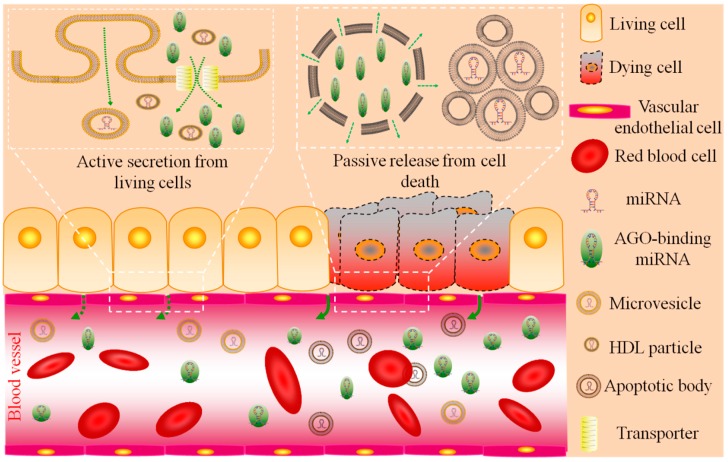
Figure 1
Figure 1
A schematic model of sources of circulating miRNAs. Circulating miRNAs can be actively secreted from living cells, mainly in the form of microvesicles and AGO-binding miRNA derived from the exosome pathway and transmembrane transporter, respectively. They can also be passively released from dying cells in the form of necrosis lysate or apoptotic bodies. All the cell-free miRNAs finally diffuse into body fluids, such as the blood. Solid and broken green arrows between vascular endothelial cells indicate large-scale and micro-scale release of circulating miRNA, respectively. All the source materials were obtained from a web-accessible software plugin of PowerPoint: Science Slide 5.
Figure 2
Figure 2
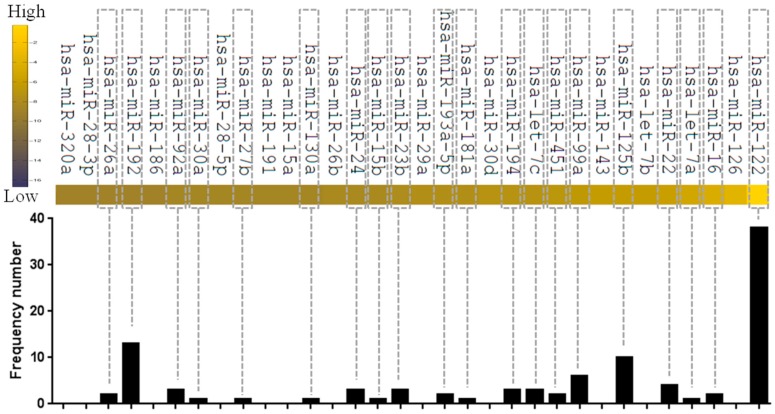
Circulating liver-specific/enriched miRNAs serve as biomarkers for different liver diseases. Expression profiles of liver miRNAs were obtained from a web-accessible database (http://www.mirz.unibas.ch/), of which miRNA expression was determined by small RNA library sequencing [13]. The frequencies of circulating miRNAs as biomarkers were determined from 65 published papers.

References

    1. Buchman T.G. Multiple organ failure. Curr. Opin. Gen. Surg. 1993:26–31. - PubMed
    1. Cooper D.K., Ekser B., Tector A.J. Immunobiological barriers to xenotransplantation. Int. J. Surg. 2015;23:211–216. doi: 10.1016/j.ijsu.2015.06.068. - DOI - PMC - PubMed
    1. Williams W.W., Taheri D., Tolkoff-Rubin N., Colvin R.B. Clinical role of the renal transplant biopsy. Nat. Rev. Nephrol. 2012;8:110–121. doi: 10.1038/nrneph.2011.213. - DOI - PMC - PubMed
    1. Snyder T.M., Khush K.K., Valantine H.A., Quake S.R. Universal noninvasive detection of solid organ transplant rejection. Proc. Natl. Acad. Sci. USA. 2011;108:6229–6234. doi: 10.1073/pnas.1013924108. - DOI - PMC - PubMed
    1. Sood S., Testro A.G. Immune monitoring post liver transplant. World J. Transplant. 2014;4:30–39. doi: 10.5500/wjt.v4.i1.30. - DOI - PMC - PubMed

LinkOut - more resources