. 2016 Sep 30;44(17):8065-72.
doi: 10.1093/nar/gkw683. Epub 2016 Aug 4.

Backmasking in the yeast genome: encoding overlapping information for protein-coding and RNA degradation

Affiliations

Backmasking in the yeast genome: encoding overlapping information for protein-coding and RNA degradation

S Aylin Cakiroglu et al. Nucleic Acids Res. .

Abstract

Backmasking is a recording technique used to hide a sound or message in a music track in reverse, meaning that it is only audible when the record is played backwards. Analogously, the compact yeast genome encodes for diverse sources of information such as overlapping coding and non-coding transcripts, and protein-binding sites on the two complementary DNA strands. Examples are the consensus binding site sequences of the RNA-binding proteins Nrd1 and Nab3 that target non-coding transcripts for degradation. Here, by examining the overlap of stable (SUTs, stable unannotated transcripts) and unstable (CUTs, cryptic unstable transcripts) transcripts with protein-coding genes, we show that the predicted Nrd1 and Nab3-binding site sequences occur at differing frequencies. They are always depleted in the sense direction of protein-coding genes, thus avoiding degradation of the transcript. However in the antisense direction, predicted binding sites occur at high frequencies in genes with overlapping unstable ncRNAs (CUTs), so limiting the availability of non-functional transcripts. In contrast they are depleted in genes with overlapping stable ncRNAs (SUTs), presumably to avoid degrading the non-coding transcript. The protein-coding genes maintain similar amino-acid contents, but they display distinct codon usages so that Nrd1 and Nab3-binding sites can arise at differing frequencies in antisense depending on the overlapping transcript type. Our study demonstrates how yeast has evolved to encode multiple layers of information-protein-coding genes in one strand and the relative chance of degrading antisense RNA in the other strand-in the same regions of a compact genome.


Figures

Figure 1.
Figure 1.
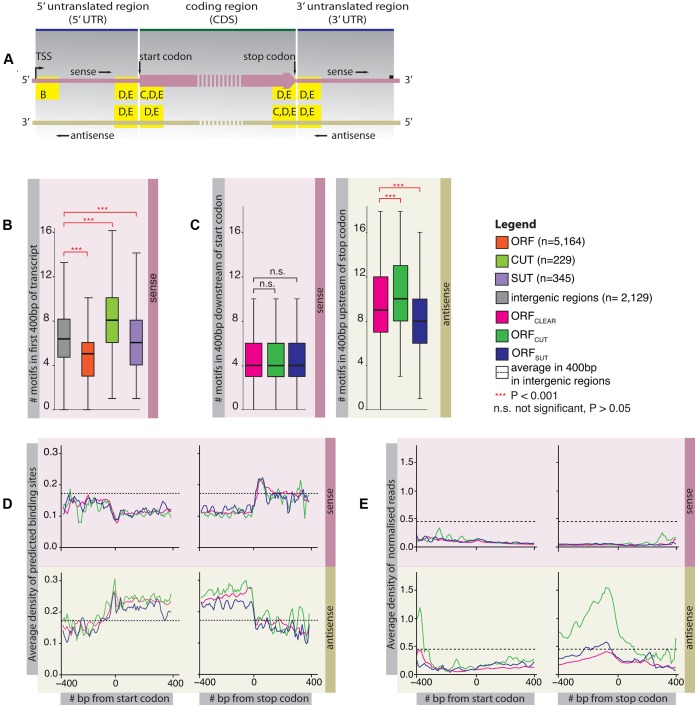
Frequency of Nrd1 and Nab3 binding site sequences in different transcripts. (A) Schematic showing regions of interest inside ORF transcripts in the sense and antisense directions for panels B to E. (B) Boxplot showing the numbers of predicted binding sites 400 bp downstream of the transcription start site (TSS) in the sense direction of ORF transcripts, CUTs and SUTs. The number of predicted binding sites in 400 bp intergenic regions is shown as a control. The distributions of the numbers of predicted binding sites for different transcript types were compared using the two-sided Wilcoxon rank sum test. All comparisons between the transcript types and the control were statistically significant (alpha = 0.001) and are indicated in red. CUTs contain the most predicted binding sites, followed by SUTs and ORF transcripts. (C) Boxplot showing the numbers of predicted binding sites in ORF transcripts 400 bp downstream of the start codon in sense and 400 bp upstream of the stop codon in the antisense direction. ORFs are separated into those with no overlapping transcript (ORFCLEAR, n = 4229), those overlapping with a CUT in antisense (ORFCUT, n = 470) and a SUT in antisense (ORFSUT, n = 430). The distributions of the numbers of predicted sites for different transcript types were compared using the two-sided Wilcoxon rank sum test. All statistically significant comparisons are indicated in red (alpha = 0.001), the others in black. Occurrences of predicted binding sites are almost identical in the sense direction, but differ greatly in antisense depending on the overlapping transcript type. (D) Average densities of predicted binding sites in the sense and antisense directions ±400 bp of the start and stop codons of ORFs. Numbers of predicted sites were binned in 10 bp windows and normalised by the total number of transcripts that are long enough to contribute to the bin. As a control for each the 400 bp regions, we show the mean of the average densities of predicted sites in 400 bp in intergenic regions (n = 2129). Densities differ between ORF types only in the antisense direction inside coding regions, with ORFCUT (n = 470) displaying the highest densities, followed by ORFCLEAR (n = 4229) and ORFSUT (n = 430). (E) Average densities of PAR-CLIP reads ±400 bp of the start and stop codons of ORFCLEAR (n = 4198), ORFCUT (n = 468) and ORFSUT (n = 426) (excluded are ORFs whose sequences did not begin with a start codon and those that overlapped with each other by more than 10 bp). Reads were binned in 10 bp windows; the number of reads in each bin was normalised by the sense and antisense expression level of the transcript. We further normalised average expression-normalised PAR-CLIP occupancy in each bin by dividing by the total number of transcripts long enough to contribute to the bin. As a control for each of the 400 bp-long regions, we show the average of the binned average number of reads (normalised for expression) in 400 bp in intergenic regions (n = 2129). The differences in the occurrences of predicted binding sites are reflected in differences in protein binding.
Figure 2.
Figure 2.
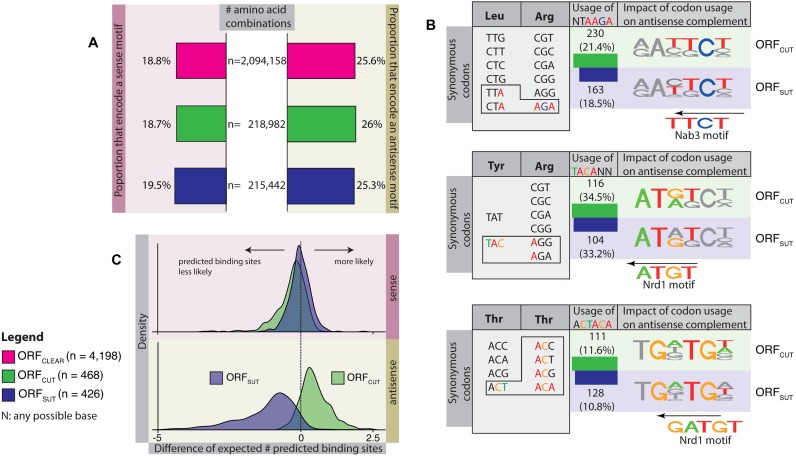
Comparison of amino acid and codon usage in different ORF types. (A) Bar plots showing the proportions of amino-acid pairs and triplets that encode Nrd1 or Nab3 motifs in the sense and antisense directions. There is no difference in amino-acid pair and triplet content in the different ORF types. (B) Examples of variable codon usage for amino acid pairs in different ORF types. Bar plots show the use of codon combinations in ORFSUT and ORFCUT that encode a binding motif. Although amino acid content is the same across all ORF types, there is a small difference in codon pair usage that affects the occurrence of predicted antisense binding sites. ORFCUT tend to use more codon pairs encoding a motif than ORFSUT. (C) Distributions of the expected numbers of predicted binding sites in ORFCUT and ORFSUT given the underlying codon usage normalised by the expected numbers of predicted sites given the background codon usage for ORFCLEAR. Positive values indicate a larger number of predicted sites than expected (given the background usage), and vice versa for negative values. The distributions for ORFSUT and ORFCUT in the sense direction are centred on 0 (mean = −0.28 and s.d. = 0.5 for ORFCUT; mean = 0.00 and s.d. = 0.39 for ORFSUT), indicating similar numbers of sites as ORFCLEAR. The antisense distribution shows that ORFSUT favour a codon usage pattern that yields fewer predicted binding sites than ORFCLEAR or ORFCUT (mean = 0.48 and s.d. = 0.56 for ORFCUT; and mean = −1.15 and s.d. = 1.07 for ORFSUT).

References

    1. David L., Huber W., Granovskaia M., Toedling J., Palm C.J., Bofkin L., Jones T., Davis R.W., Steinmetz L.M. A high-resolution map of transcription in the yeast genome. Proc. Natl. Acad. Sci. U.S.A. 2006;103:5320–5325. - PMC - PubMed
    1. Hani J., Feldmann H. tRNA genes and retroelements in the yeast genome. Nucleic Acids Res. 1998;26:689–696. - PMC - PubMed
    1. Murray S.C., Serra Barros A., Brown D.A., Dudek P., Ayling J., Mellor J. A pre-initiation complex at the 3′-end of genes drives antisense transcription independent of divergent sense transcription. Nucleic Acids Res. 2012;40:2432–2444. - PMC - PubMed
    1. Yassour M., Pfiffner J., Levin J.Z., Adiconis X., Gnirke A., Nusbaum C., Thompson D.-A., Friedman N., Regev A. Strand-specific RNA sequencing reveals extensive regulated long antisense transcripts that are conserved across yeast species. Genome Biol. 2010;11:R87. - PMC - PubMed
    1. Camblong J., Iglesias N., Fickentscher C., Dieppois G., Stutz F. Antisense RNA stabilization induces transcriptional gene silencing via histone deacetylation in S. cerevisiae. Cell. 2007;131:706–717. - PubMed

MeSH terms

LinkOut - more resources