


Depression Screening Using Daily Mental-Health Ratings from a Smartphone Application for Breast Cancer Patients
- PMID: 27492880
- PMCID: PMC4990716
- DOI: 10.2196/jmir.5598
Depression Screening Using Daily Mental-Health Ratings from a Smartphone Application for Breast Cancer Patients
Abstract
Background: Mobile mental-health trackers are mobile phone apps that gather self-reported mental-health ratings from users. They have received great attention from clinicians as tools to screen for depression in individual patients. While several apps that ask simple questions using face emoticons have been developed, there has been no study examining the validity of their screening performance.
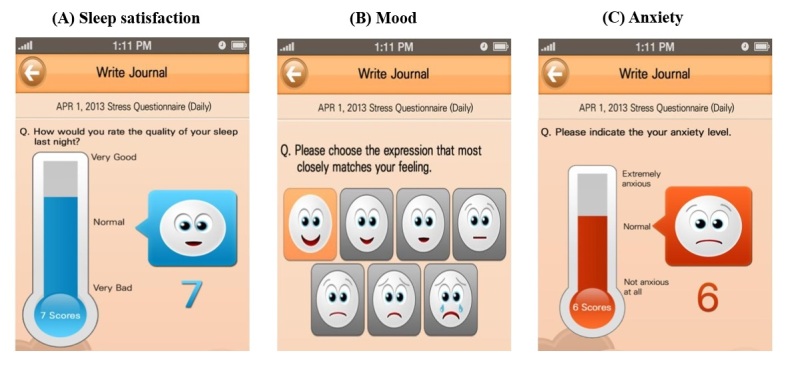
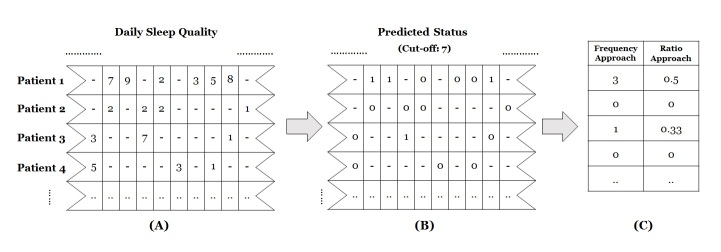
Objective: In this study, we (1) evaluate the potential of a mobile mental-health tracker that uses three daily mental-health ratings (sleep satisfaction, mood, and anxiety) as indicators for depression, (2) discuss three approaches to data processing (ratio, average, and frequency) for generating indicator variables, and (3) examine the impact of adherence on reporting using a mobile mental-health tracker and accuracy in depression screening.
Methods: We analyzed 5792 sets of daily mental-health ratings collected from 78 breast cancer patients over a 48-week period. Using the Patient Health Questionnaire-9 (PHQ-9) as the measure of true depression status, we conducted a random-effect logistic panel regression and receiver operating characteristic (ROC) analysis to evaluate the screening performance of the mobile mental-health tracker. In addition, we classified patients into two subgroups based on their adherence level (higher adherence and lower adherence) using a k-means clustering algorithm and compared the screening accuracy between the two groups.
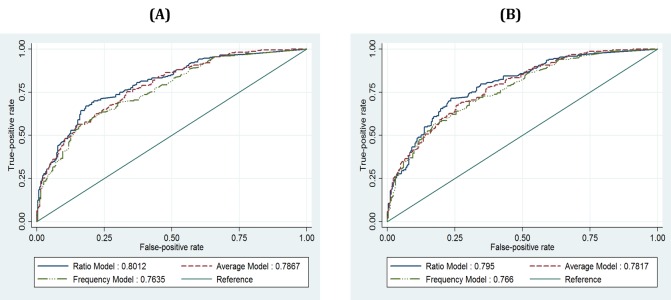
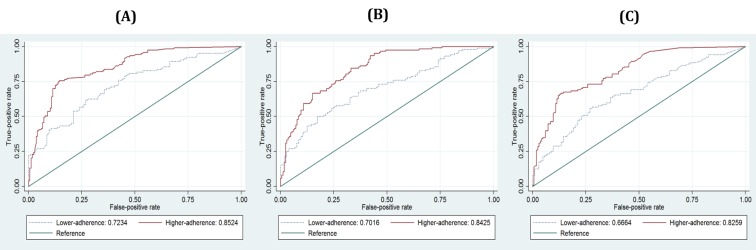
Results: With the ratio approach, the area under the ROC curve (AUC) is 0.8012, indicating that the performance of depression screening using daily mental-health ratings gathered via mobile mental-health trackers is comparable to the results of PHQ-9 tests. Also, the AUC is significantly higher (P=.002) for the higher adherence group (AUC=0.8524) than for the lower adherence group (AUC=0.7234). This result shows that adherence to self-reporting is associated with a higher accuracy of depression screening.
Conclusions: Our results support the potential of a mobile mental-health tracker as a tool for screening for depression in practice. Also, this study provides clinicians with a guideline for generating indicator variables from daily mental-health ratings. Furthermore, our results provide empirical evidence for the critical role of adherence to self-reporting, which represents crucial information for both doctors and patients.
Keywords: breast cancer (neoplasms); depression; mental health; smartphone applications.
Conflict of interest statement
Conflicts of Interest: None declared.
Figures
References
-
- Jacobsen PB. Screening for psychological distress in cancer patients: challenges and opportunities. J Clin Oncol. 2007 Oct 10;25(29):4526–4527. doi: 10.1200/JCO.2007.13.1367. http://jco.ascopubs.org/cgi/pmidlookup?view=long&pmid=17846452 JCO.2007.13.1367 - DOI - PubMed
-
- Stommel M, Given BA, Given CW. Depression and functional status as predictors of death among cancer patients. Cancer. 2002 May 15;94(10):2719–2727. http://onlinelibrary.wiley.com/resolve/openurl?genre=article&sid=nlm:pub... - PubMed
-
- Trask PC, Paterson AG, Hayasaka S, Dunn RL, Riba M, Johnson T. Psychosocial characteristics of individuals with non-stage IV melanoma. J Clin Oncol. 2001 Jun 1;19(11):2844–2850. - PubMed
-
- Gessler S, Low J, Daniells E, Williams R, Brough V, Tookman A, Jones L. Screening for distress in cancer patients: is the distress thermometer a valid measure in the UK and does it measure change over time? A prospective validation study. Psychooncology. 2008 Jun;17(6):538–547. doi: 10.1002/pon.1273. - DOI - PubMed
-
- Gil F, Grassi L, Travado L, Tomamichel M, Gonzalez Jr, Southern European Psycho-Oncology Study Group Use of distress and depression thermometers to measure psychosocial morbidity among southern European cancer patients. Support Care Cancer. 2005 Aug;13(8):600–606. doi: 10.1007/s00520-005-0780-0. - DOI - PubMed
MeSH terms
LinkOut - more resources
Full Text Sources
Other Literature Sources
Medical
