. 2016 Jul 21:7:1045.
doi: 10.3389/fpls.2016.01045. eCollection 2016.

Geminivirus-Mediated Genome Editing in Potato (Solanum tuberosum L.) Using Sequence-Specific Nucleases

Affiliations

Geminivirus-Mediated Genome Editing in Potato (Solanum tuberosum L.) Using Sequence-Specific Nucleases

Nathaniel M Butler et al. Front Plant Sci. .

Abstract

Genome editing using sequence-specific nucleases (SSNs) is rapidly being developed for genetic engineering in crop species. The utilization of zinc finger nucleases (ZFNs), transcription activator-like effector nucleases (TALENs), and clustered regularly interspaced short palindromic repeats/CRISPR-associated systems (CRISPR/Cas) for inducing double-strand breaks facilitates targeting of virtually any sequence for modification. Targeted mutagenesis via non-homologous end-joining (NHEJ) has been demonstrated extensively as being the preferred DNA repair pathway in plants. However, gene targeting via homologous recombination (HR) remains more elusive but could be a powerful tool for directed DNA repair. To overcome barriers associated with gene targeting, a geminivirus replicon (GVR) was used to deliver SSNs targeting the potato ACETOLACTATE SYNTHASE1 (ALS1) gene and repair templates designed to incorporate herbicide-inhibiting point mutations within the ALS1 locus. Transformed events modified with GVRs held point mutations that were capable of supporting a reduced herbicide susceptibility phenotype, while events transformed with conventional T-DNAs held no detectable mutations and were similar to wild-type. Regeneration of transformed events improved detection of point mutations that supported a stronger reduced herbicide susceptibility phenotype. These results demonstrate the use of geminiviruses for delivering genome editing reagents in plant species, and a novel approach to gene targeting in a vegetatively propagated species.

Keywords: CRISPR/Cas; TALEN; ZFN; acetolactate synthase; bean yellow dwarf virus; gene replacement; gene targeting; homologous recombination.


Figures
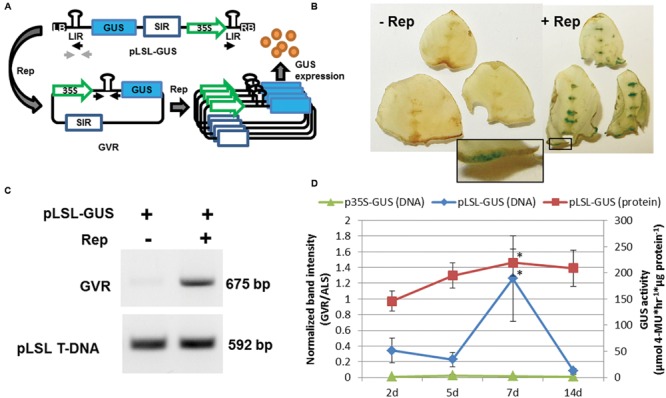
FIGURE 1
FIGURE 1
Delivery of the geminivirus replicon (GVR) to potato leaf explants. (A) Schematic of pLSL-GUS T-DNA used for Agrobacterium-mediated delivery of GVRs to potato leaf tissues. Replicase (Rep) is delivered on a separate p35S T-DNA binary vector (not shown). LB and RB; left and right T-DNA borders, respectively. SIR and LIR; short and long intergenic regions, respectively. 35S; cauliflower mosaic virus promoter. Blue rectangle; GUS coding sequence. Black and light gray arrows; priming sites used for PCR detection of circularized GVRs and pLSL T-DNA, respectively. (B) GUS staining of potato leaf explants transformed with pLSL-GUS. Potato leaf explants were transformed with pLSL-GUS in the presence (+Rep) or absence (-Rep) of Rep, and stained for GUS activity 7 days post-inoculation (dpi). Inset is magnification of wounded areas (open black rectangle). Images are from Désirée. (C) PCR detection of circularized GVRs in potato leaf explants transformed with pLSL-GUS. Leaf explants transformed with pLSL-GUS in the presence (+) or absence (-) of Rep were sampled for PCR detection of circularized GVRs (675 bp), and the pLSL T-DNA (592 bp) using priming sites from panel (A). Images are from Désirée. (D) Time-course of GVRs in potato leaf explants constitutively expressing Rep. Leaf explants prepared from a mutant potato line, D52 (Supplementary Figure S2) were transformed with pLSL-GUS and control p35S-GUS T-DNAs, and sampled after 2, 5, 7, and 14 dpi for quantitative end-point PCR of circularized GVRs (DNA; primary axis) and GUS activity quantification (protein; secondary axis). Error bars represent standard deviations from three biological replications. P < 0.05; 2 dpi.
FIGURE 2
FIGURE 2
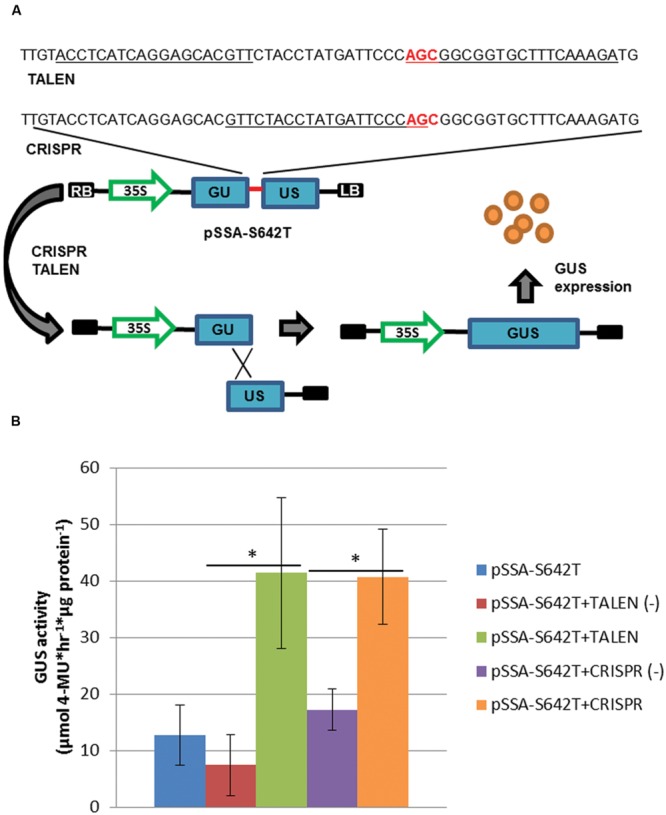
Sequence-specific nuclease (SSN) activity in potato leaf explants. (A) Single-strand annealing assay (SSA) incorporating the S642T target site from the potato ALS1 gene (red line; sequence) delivered on a T-DNA (pSSA-S642T). The SSA reporter cassette was constructed with the GUS coding sequence (GUS) disrupted by a 60 bp S642T target sequence, and a 250 bp direct repeat of the GUS coding sequence (blue rectangles). Binding sites for the p35S-TALEN (TALEN) and -CRISPR/Cas (CRISPR) reagents targeting S642T are underlined with the S642T codon in red. LB and RB; left and right T-DNA borders, respectively. 35S; cauliflower mosaic virus promoter. (B) GUS activity quantification of potato leaf explants transformed with pSSA-S642T and SSN reagents. Leaf explants were prepared from X914-10 and transformed with the pSSA-S642T reporter, and TALEN and CRISPR SSN reagents targeting the S642T target site, or negative control p35S-TALEN [TALEN(-)] and -CRISPR/Cas [CRISPR(-)] reagents targeting a heterogeneous potato ALS1 target site. Error bars represent standard deviations from three biological replications. P < 0.05; negative control.
FIGURE 3
FIGURE 3
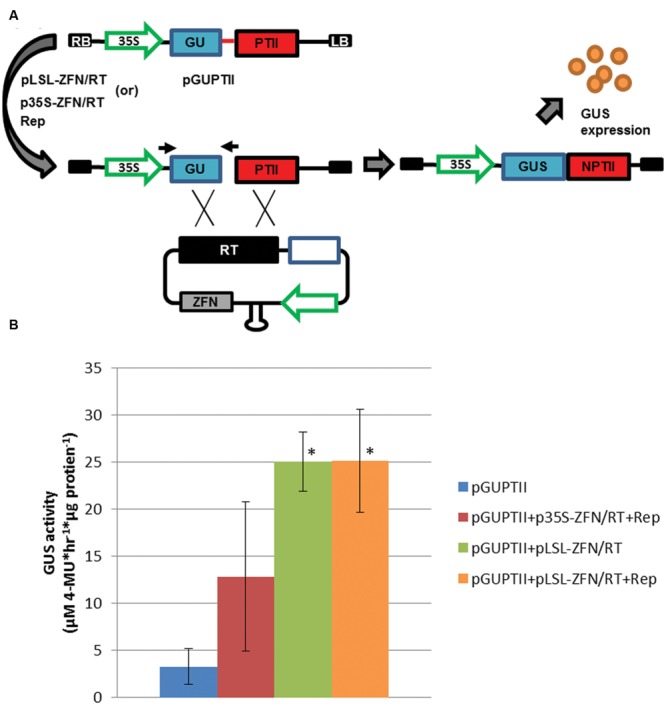
Gene targeting efficiency in potato leaf explants. (A) GUPTII reporter assay incorporating the Zif268 target site delivered on a T-DNA (pGUPTII). The GUPTII reporter cassette was constructed with the GUS:NptII translational fusion coding sequence (GUSNptII) disrupted by a 600 bp deletion (blue and red rectangles) and a 60 bp Zif268 target site (red line; Wright et al., 2005). pLSL and p35S T-DNAs incorporating the Zif268 SSN coding sequence (ZFN), and a repair template (RT) incorporating the 600 bp missing sequence and flanking sequence homologous to the GUPTII reporter (black rectangle; Baltes et al., 2014). LB and RB, left and right T-DNA borders, respectively. 35S; cauliflower mosaic virus promoter. Open blue rectangle; short intergenic region (SIR). Gray rectangle; Zif268 coding sequence (ZFN). Black arrows; priming sites used for PCR detection of the repaired pGUPTII reporter (GUSNptII). (B) GUS activity quantification of potato leaf explants transformed with pGUPTII and gene targeting reagents. Leaf explants were prepared from Désirée and transformed with the pGUPTII reporter, and p35S and pLSL-ZFN T-DNA gene targeting reagents (p35S-ZFN/RT and pLSL-ZFN/RT) in the presence (+Rep) or absence of Rep/RepA. Rep/RepA was delivered on a 35S T-DNA (Rep). Error bars represent standard deviations from three biological replications. P < 0.05; pGUPTII.
FIGURE 4
FIGURE 4
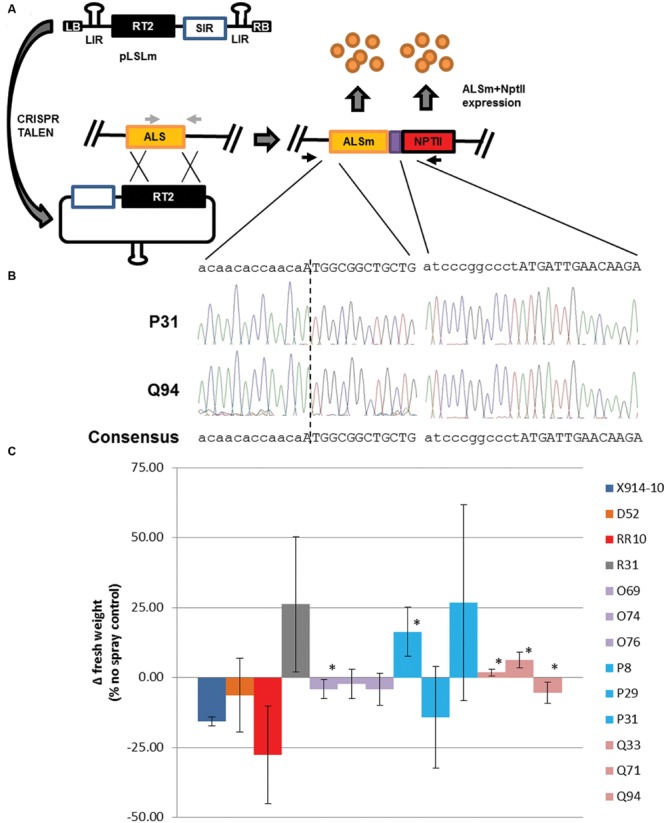
Geminivirus replicon-mediated gene targeting of the potato ALS1 gene and herbicide susceptibility in secondary events. (A) Gene targeting modification of the potato ALS1 gene (ALS; orange rectangle) using GVRs with (pLSL; Figure 1A) or without (pLSLm) SSNs. LB and RB; left and right T-DNA borders, respectively. RT2; ALS1 repair template. ALSm; modified ALS1 locus with W563L and S642T mutations and T2A:NptII fusion (purple and red rectangles). SIR and LIR; short and long intergenic regions, respectively. Black arrows; priming sites used for PCR detection (Supplementary Figure S5) and cloning (B) of the modified ALS1 locus. Light gray arrows; priming sites used for PCR detection of the endogenous ALS1 (Supplementary Figure S2), and gene targeting modification digest assays (Supplementary Figure S4). (B) Cloned gene targeting modifications of the ALS1 gene in secondary events. PCR was used to clone the locus-template junction (left sequences), both W563L and S642T mutations (not shown), and incorporated T2A:NptII (right sequences). Dotted line; locus-template junction. Uppercase sequence: coding sequences for ALSm (left) and NptII (right). Sequencing traces; P31 (top) and Q94 (bottom). (C) Herbicide susceptibility in secondary events. An herbicide spray assay was used to determine herbicide susceptibility in wild-type (X914-10), primary (D, R lines), and secondary events (RR, O, P, Q lines). Primary events were generated by transforming X914-10 with Rep (D52) or the ALS1 transgene (R31), and applying hygromycin selection. Secondary events were generated by transforming D52 with p35S-TALEN/RT2 (RR10), pLSLm+CRISPR (O69, O74, O76), pLSLm+TALEN (P8, P29, P31), or pLSL-TALEN/RT2 (Q33, Q71, Q94) and applying 50 mg/L kanamycin (Kan50) selection. Change in fresh weight (Δ fresh weight) was calculated as a percentage of the no spray controls for each line. Error bars represent standard deviations from three biological replications. P < 0.05; X914-10.
FIGURE 5
FIGURE 5
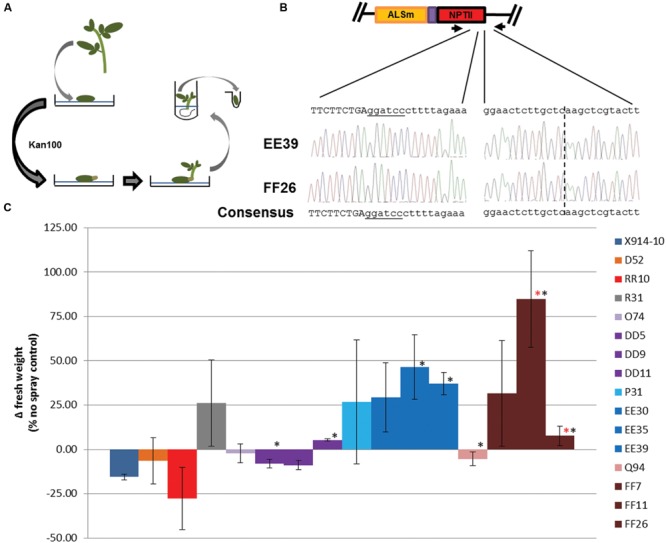
Regeneration of events on high kanamycin selection and herbicide susceptibility in regenerated events. (A) Regeneration of secondary events on high kanamycin selection. Individual events were used for regeneration on kanamycin 100 mg/L (Kan100) selection media. Regenerated events capable of rooting in Kan100 where used for cloning the gene targeting modified ALS1 locus, (B) and in herbicide susceptibility experiments (C). ALSm; modified ALS1 locus with W563L and S642T mutations and T2A:NptII fusion (purple and red rectangles). (B) Cloned gene targeting modifications of the ALS1 gene in regenerated events. Primers specific to the gene targeting modified ALS1 locus (black arrows) were used for PCR (Supplementary Figure S6), and to clone the template-locus junction (right sequences) and incorporated NptII (left sequences). Dotted line; template-locus junction. Uppercase sequence; NptII coding sequence. Underlined sequence; BamH1 site. Sequencing traces; EE39 (top) and FF26 (bottom; C) Herbicide susceptibility in regenerated events. An herbicide spray assay was used to determine herbicide susceptibility in wild-type (X914-10), secondary (D52, RR10, R31, O74, P31, Q94), and regenerated events (DD, EE, FF lines). Wild-type, primary and secondary events data comes from Figure 4. Regenerated events originated from O74 (DD5, DD9, DD11), P31 (EE30, EE35, EE39), and Q94 (FF7, FF11, FF26) secondary events. Error bars represent standard deviations from three biological replications. P < 0.05; X914-10. P < 0.05; Q94.

References

    1. Ali Z., Abul-faraj A., Li L., Ghosh N., Piatek M., Mahjoub A., et al. (2015). Efficient virus-mediated genome editing in plants using the CRISPR/Cas9 system. Mol. Plant 8 1288–1291. 10.1016/j.molp.2015.02.011 - DOI - PubMed
    1. Ascencio-Ibáñez J. T., Sozzani R., Lee T.-J., Chu T.-M., Wolfinger R. D., Cella R., et al. (2008). Global analysis of Arabidopsis gene expression uncovers a complex array of changes impacting pathogen response and cell cycle during geminivirus infection. Plant Physiol. 148 436–454. 10.1104/pp.108.121038 - DOI - PMC - PubMed
    1. Baltes N. J., Gil-Humanes J., Cermak T., Atkins P. A., Voytas D. F. (2014). DNA replicons for plant genome engineering. Plant Cell 26 151–163. 10.1105/tpc.113.119792 - DOI - PMC - PubMed
    1. Bibikova M., Beumer K., Trautman J. K., Carroll D. (2003). Enhancing gene targeting with designed zinc finger nucleases. Science 300:764 10.1126/science.1079512 - DOI - PubMed
    1. Brigneti G., Martín-Hernández A. M., Jin H., Chen J., Baulcombe D. C., Baker B., et al. (2004). Virus-induced gene silencing in Solanum species. Plant J. 39 264–272. 10.1111/j.1365-313X.2004.02122.x - DOI - PubMed