Cardiovascular disease risk factors in relation to smoking behaviour and history: a population-based cohort study
- PMID: 27493759
- PMCID: PMC4947752
- DOI: 10.1136/openhrt-2015-000358
Cardiovascular disease risk factors in relation to smoking behaviour and history: a population-based cohort study
Abstract
Objective: To investigate how individual risk factors for cardiovascular disease (CVD) (blood pressure, lipid levels, body mass index, waist and hip circumference, use of antihypertensive or hypolipidemic medication, and diagnosed diabetes) differ in people aged 46 years with different smoking behaviour and history.
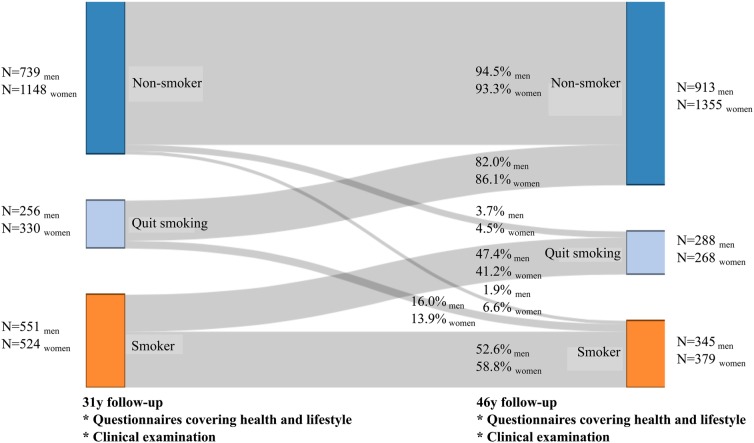
Methods: This population-based cohort study is based on longitudinal data from the Northern Finland Birth Cohort 1966 project. Data were collected at the 31-year and 46-year follow-ups, when a total of 5038 and 5974 individuals participated in clinical examinations and questionnaires. Data from both follow-ups were available for 3548 participants. In addition to individual CVD risk factors, Framingham and Systematic Coronary Risk Evaluation (SCORE) algorithms were used to assess the absolute risk of a CVD event within the next decade.
Results: The differences in individual risk factors for CVD reached statistical significance for some groups, but the differences were not consistent or clinically significant. There were no clinically significant differences in CVD risk as measured by Framingham or SCORE algorithms between never smokers, recent quitters and former smokers (7.5%, 7.4%, 8.1% for men; 3.3%, 3.0%, 3.2% for women; p<0.001).
Conclusions: The effect of past or present smoking on individual CVD risk parameters such as blood pressure and cholesterol seems to be of clinically minor significance in people aged 46 years. In other words, smoking seems to be above all an independent risk factor for CVD in the working-age population. Quitting smoking in working age may thus reduce calculated CVD risk nearly to the same level with people who have never smoked.
Figures


References
-
- WHO Report on the Global Tobacco Epidemic 2013. (accessed 31 Dec 2014). http://www.who.int/tobacco/global_report/2013/en/
Publication types
LinkOut - more resources
Full Text Sources
Other Literature Sources
Miscellaneous