


Next generation multi-scale biophysical characterization of high precision cancer particle radiotherapy using clinical proton, helium-, carbon- and oxygen ion beams
- PMID: 27494855
- PMCID: PMC5302944
- DOI: 10.18632/oncotarget.10996
Next generation multi-scale biophysical characterization of high precision cancer particle radiotherapy using clinical proton, helium-, carbon- and oxygen ion beams
Abstract
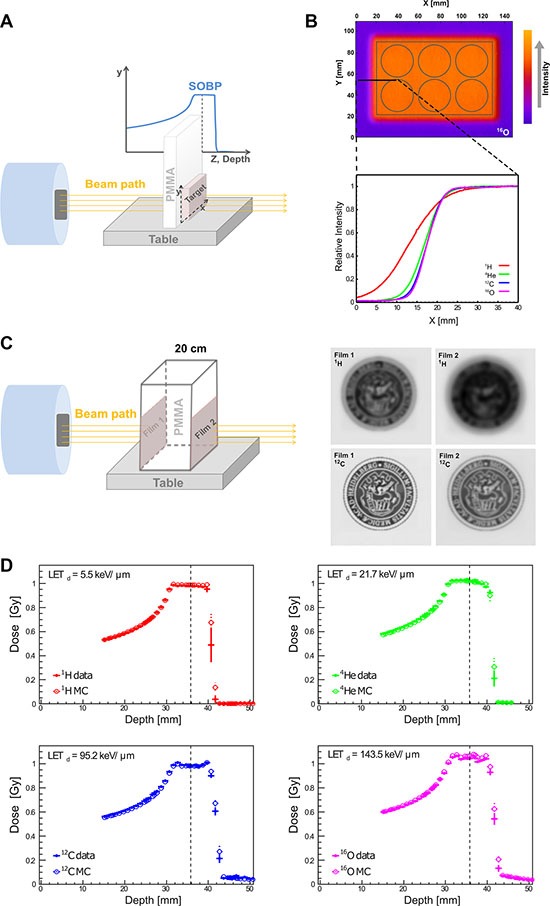
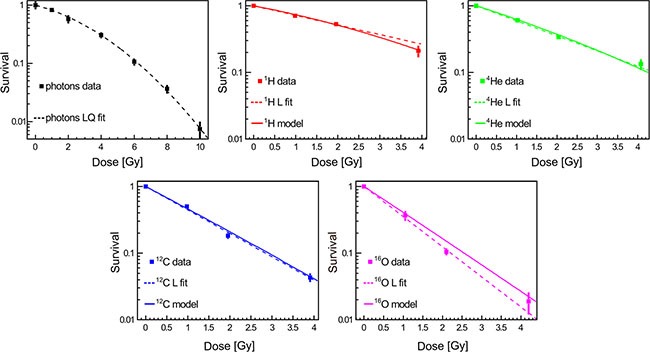
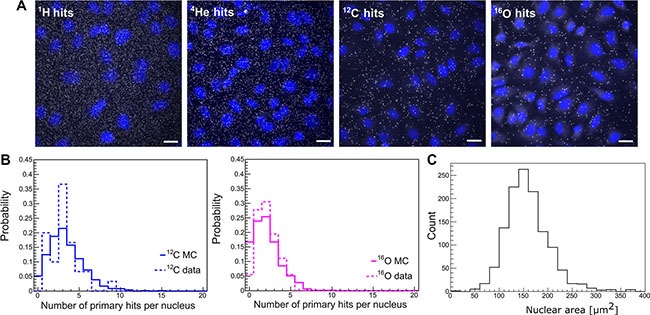
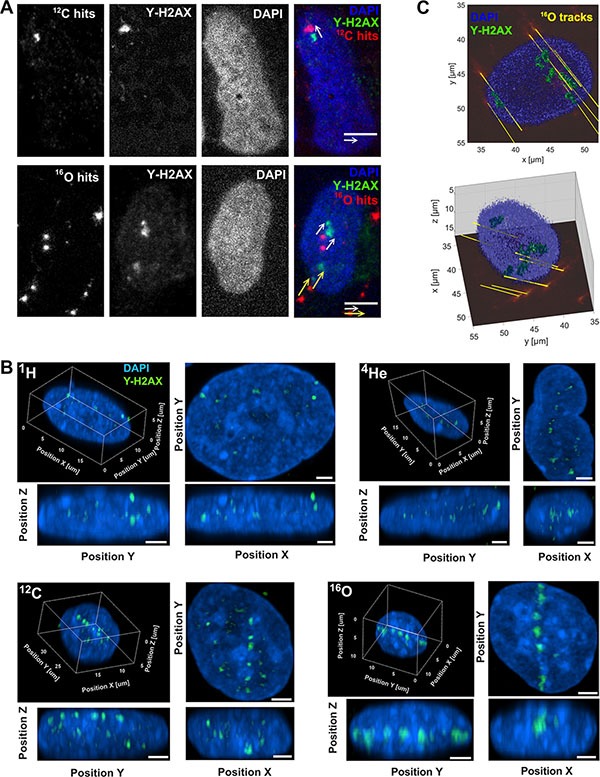
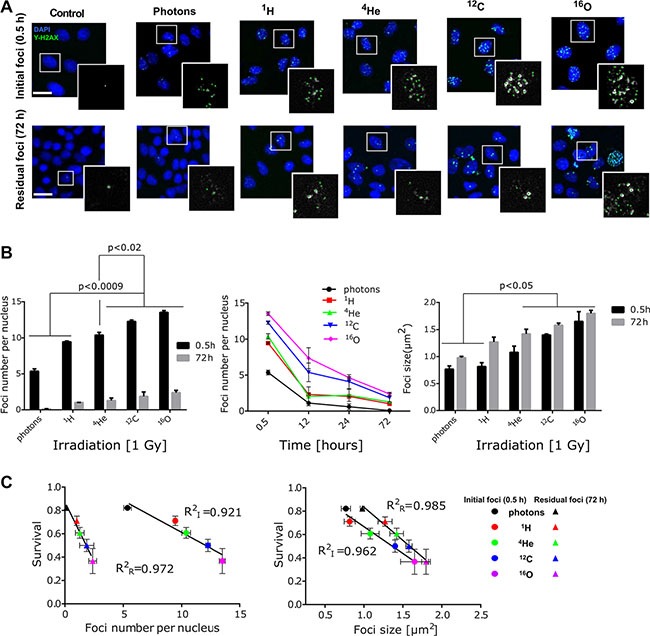
The growing number of particle therapy facilities worldwide landmarks a novel era of precision oncology. Implementation of robust biophysical readouts is urgently needed to assess the efficacy of different radiation qualities. This is the first report on biophysical evaluation of Monte Carlo simulated predictive models of prescribed dose for four particle qualities i.e., proton, helium-, carbon- or oxygen ions using raster-scanning technology and clinical therapy settings at HIT. A high level of agreement was found between the in silico simulations, the physical dosimetry and the clonogenic tumor cell survival. The cell fluorescence ion track hybrid detector (Cell-Fit-HD) technology was employed to detect particle traverse per cell nucleus. Across a panel of radiobiological surrogates studied such as late ROS accumulation and apoptosis (caspase 3/7 activation), the relative biological effectiveness (RBE) chiefly correlated with the radiation species-specific spatio-temporal pattern of DNA double strand break (DSB) formation and repair kinetic. The size and the number of residual nuclear γ-H2AX foci increased as a function of linear energy transfer (LET) and RBE, reminiscent of enhanced DNA-damage complexity and accumulation of non-repairable DSB. These data confirm the high relevance of complex DSB formation as a central determinant of cell fate and reliable biological surrogates for cell survival/ RBE. The multi-scale simulation, physical and radiobiological characterization of novel clinical quality beams presented here constitutes a first step towards development of high precision biologically individualized radiotherapy.
Keywords: DNA-double strand breakages; biophysical hybrid detectors; complex DNA damage; monte carlo simulations; radiobiology.
Conflict of interest statement
The authors declare that no competing interests exist.
Figures
References
-
- Marx V. Cancer treatment: Sharp shooters. Nature. 2014;508:133–138. - PubMed
-
- Castro JR. Results of Heavy-Ion Radiotherapy. Radiat Environ Biophys. 1995;34:45–48. - PubMed
-
- Parodi K, Mairani A, Brons S, Hasch BG, Sommerer F, Naumann J, Jakel O, Haberer T, Debus J. Monte Carlo simulations to support start-up and treatment planning of scanned proton and carbon ion therapy at a synchrotron-based facility. Phys Med Biol. 2012;57:3759–3784. - PubMed
-
- Karger CP, Jakel O, Palmans H, Kanai T. Dosimetry for ion beam radiotherapy. Phys Med Biol. 2010;55:R193–R234. - PubMed
-
- Baumann M, Krause M, Hill R. Clonogens and cancer stem cells. Nat Rev Cancer. 2008:8. - PubMed
MeSH terms
Substances
LinkOut - more resources
Full Text Sources
Other Literature Sources
Research Materials
