. 2016 Oct;22(10):1492-9.
doi: 10.1261/rna.056937.116. Epub 2016 Aug 5.

Gld2-catalyzed 3' monoadenylation of miRNAs in the hippocampus has no detectable effect on their stability or on animal behavior

Affiliations

Gld2-catalyzed 3' monoadenylation of miRNAs in the hippocampus has no detectable effect on their stability or on animal behavior

Fernanda Mansur et al. RNA. 2016 Oct.

Abstract

Gld2, a noncanonical cytoplasmic poly(A) polymerase, interacts with the RNA binding protein CPEB1 to mediate polyadenylation-induced translation in dendrites of cultured hippocampal neurons. Depletion of Gld2 from the hippocampus leads to a deficit in long-term potentiation evoked by theta burst stimulation. At least in mouse liver and human primary fibroblasts, Gld2 also 3' monoadenylates and thereby stabilizes specific miRNAs, which enhance mRNA translational silencing and eventual destruction. These results suggest that Gld2 would be likely to monoadenylate and stabilize miRNAs in the hippocampus, which would produce measurable changes in animal behavior. We now report that using Gld2 knockout mice, there are detectable alterations in specific miRNA monoadenylation in the hippocampus when compared to wild type, but that these modifications produce no detectable effect on miRNA stability. Moreover, we surprisingly find no overt change in animal behavior when comparing Gld2 knockout to wild-type mice. These data indicate that miRNA monoadenylation-mediated stability is cell type-specific and that monoadenylation has no measurable effect on higher cognitive function.

Keywords: Gld2; behavior; hippocampus; miRNA; monoadenylation.


Figures

FIGURE 1.
FIGURE 1.
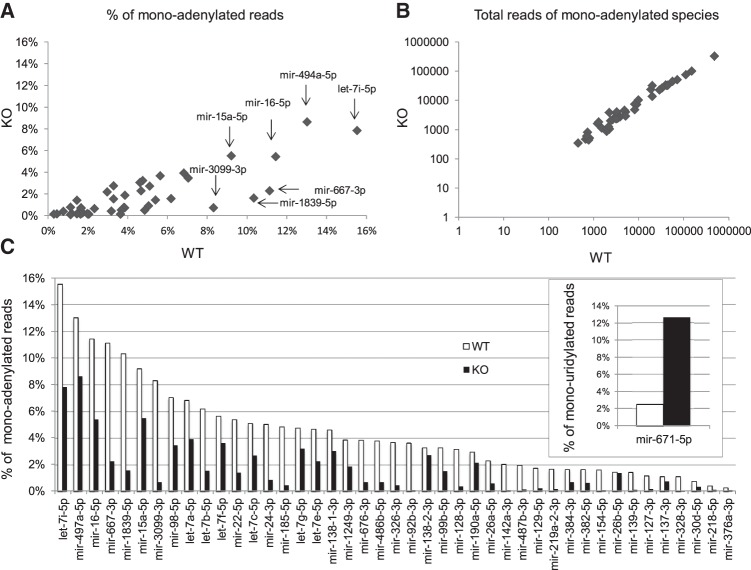
Gld2 controls miRNA monoadenylation. (A) Scatter plot of mean percentages of 3′ monoadenylated counts for 43 miRNAs in six WT and six Gld2 KO hippocampi. (B) Scatter plot on log scale of the steady-state levels (average read counts) of 43 specific hippocampal miRNAs that are differentially 3′ monoadenylated in WT and Gld2 KO mice as identified in panel A. (C) Bar plot representation of panel A showing mean percentages of 43 specific miRNAs that are differentially monoadenylated in WT and Gld2 KO hippocampus (all have a P-value <0.05; Mann-Whitney U-test). (C, inset) Mean percentages of mir-671-5p that are monouridylated in Gld2 KO hippocampus (P-value <0.05).
FIGURE 2.
FIGURE 2.
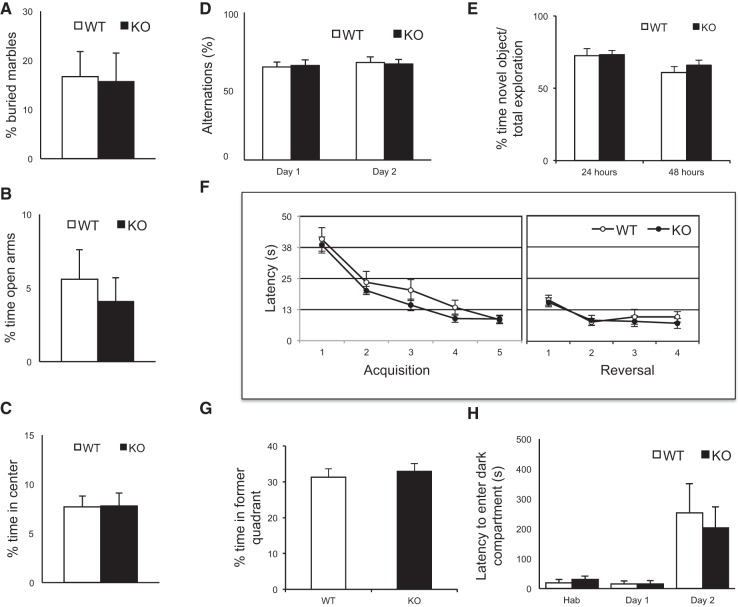
WT and Gld2 KO mice exhibit similar behaviors. (A) Marble burying test to measure obsessive-compulsive behavior and aversion to new objects (WT = 12 mice; Gld2 KO = 14 mice; P > 0.05, unpaired t-test). All error bars in the figure refer to SEM. (B) Elevated plus maze used to assess anxiety objects (WT = 11 mice; Gld2 KO = 11 mice; P < 0.05, unpaired t-test). (C) Open field test to measure anxiety (WT = 12 mice; Gld2 KO = 12 mice; P < 0.05, unpaired t-test). (D) T-maze assay of spontaneous alternation used to assess working memory (WT = 11 mice; Gld2 KO = 12 mice; P < 0.05, unpaired t-test). (E) Novel object recognition as a memory and object recognition test (WT = 12 mice; Gld2 KO = 14 mice; P < 0.05, unpaired t-test). (F) Morris water maze to investigate spatial learning and memory; left panel depicts acquisition (WT = 12 mice; Gld2 KO = 13 mice; P < 0.05, unpaired t-test) and right panel depicts reversal (WT = 12 mice; Gld2 KO = 13 mice; P < 0.05, unpaired t-test). (G) Morris water maze probe trial after acquisition phase (WT = 12 mice; Gld2 KO = 13 mice; P < 0.05, unpaired t-test). (H) Passive avoidance test used to assess learning and memory (WT = 3 mice; Gld2 KO = 3 mice; P < 0.05, unpaired t-test). (Hab) Habituation.

References

    1. Anders S, Huber W. 2010. Differential expression analysis for sequence count data. Genome Biol 11: R106. - PMC - PubMed
    1. Barnard DC, Ryan K, Manley JL, Richter JD. 2004. Symplekin and xGLD-2 are required for CPEB-mediated cytoplasmic polyadenylation. Cell 119: 641–651. - PubMed
    1. Berger-Sweeney J, Zearfoss NR, Richter JD. 2006. Reduced extinction of hippocampal-dependent memories in CPEB knockout mice. Learn Mem 13: 4–7. - PubMed
    1. Boele J, Persson H, Shin JW, Ishizu Y, Newie IS, Søkilde R, Hawkins SM, Coarfa C, Ikeda K, Takayama K, et al. 2014. PAPD5-mediated 3′ adenylation and subsequent degradation of miR-21 is disrupted in proliferative disease. Proc Natl Acad Sci 111: 11467–11472. - PMC - PubMed
    1. Bolger AM, Lohse M, Usadel B. 2014. Trimmomatic: a flexible trimmer for Illumina sequence data. Bioinformatics 30: 2114–2120. - PMC - PubMed

Publication types