


Rationale and design of the multicenter randomized trial investigating the effects of levosimendan pretreatment in patients with low ejection fraction (≤40 %) undergoing CABG with cardiopulmonary bypass (LICORN study)
- PMID: 27496105
- PMCID: PMC4974786
- DOI: 10.1186/s13019-016-0530-z
Rationale and design of the multicenter randomized trial investigating the effects of levosimendan pretreatment in patients with low ejection fraction (≤40 %) undergoing CABG with cardiopulmonary bypass (LICORN study)
Abstract
Background: Patients with a left ventricular ejection fraction (LVEF) of less than 40 % are at high risk of developing postoperative low cardiac output syndrome (LCOS). Despite actual treatments (inotropic agents and/or mechanical assist devices), the mortality rate of such patients remains very high (13 to 24 %). The LICORN trial aims at assessing the efficacy of a preoperative infusion of levosimendan in reducing postoperative LCOS in patients with poor LVEF undergoing coronary artery bypass grafting (CABG).
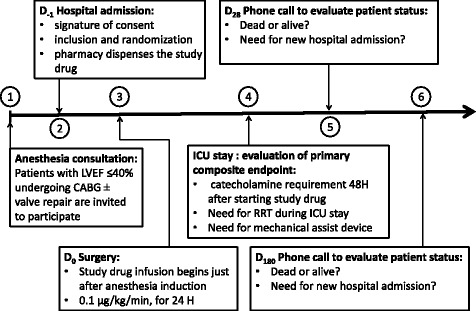
Methods/design: LICORN study is a multicenter, randomized double-blind, placebo-controlled trial in parallel groups. 340 patients with LVEF ≤40 %, undergoing CABG will be recruited from 13 French hospitals. The study drug will be started after anaesthesia induction and infused over 24 h (0.1 μg/kg/min). The primary outcome (postoperative LCOS) is evaluated using a composite criterion composed of: 1) need for inotropic agents beyond 24 h following discontinuation of the study drug; 2) need for post-operative mechanical assist devices or failure to wean from these techniques when inserted pre-operatively; 3) need for renal replacement therapy. Secondary outcomes include: 1) mortality at Day 28 and Day 180; 2) each item of the composite criterion of the primary outcome; 3) the number of "ventilator-free" days and "out of intensive care unit" days at Day 28.
Discussion: The usefulness of levosimendan in the perioperative period has not yet been documented with a high level of evidence. The LICORN study is the first randomized controlled trial evaluating the clinical value of preoperative levosimendan in high risk cardiac surgical patients undergoing CABG.
Trial registration number: NCT02184819 (ClinicalTrials.gov).
Keywords: Cardiac surgery; Coronary artery bypass graft; High risk surgical patient; Levosimendan; Low cardiac output syndrome; Perioperative management.
Figures
References
-
- Algarni KD, Maganti M, Yau TM. Predictors of low cardiac output syndrome after isolated coronary artery bypass surgery: trends over 20 years. Ann Thorac Surg. 2011;92:1678–84. - PubMed
-
- Landoni G, Bove T, Crivellari M, Poli D, Fochi O, Marchetti C, et al. Acute renal failure after isolated CABG surgery: six years of experience. Minerva Anestesiol. 2007;73:559–65. - PubMed
Publication types
MeSH terms
Substances
Associated data
LinkOut - more resources
Full Text Sources
Other Literature Sources
Medical
