. 2016 Dec;88(5):775-793.
doi: 10.1111/tpj.13295. Epub 2016 Sep 27.

Integrating metabolomics and transcriptomics data to discover a biocatalyst that can generate the amine precursors for alkamide biosynthesis

Affiliations

Integrating metabolomics and transcriptomics data to discover a biocatalyst that can generate the amine precursors for alkamide biosynthesis

Ludmila Rizhsky et al. Plant J. 2016 Dec.

Abstract

The Echinacea genus is exemplary of over 30 plant families that produce a set of bioactive amides, called alkamides. The Echinacea alkamides may be assembled from two distinct moieties, a branched-chain amine that is acylated with a novel polyunsaturated fatty acid. In this study we identified the potential enzymological source of the amine moiety as a pyridoxal phosphate-dependent decarboxylating enzyme that uses branched-chain amino acids as substrate. This identification was based on a correlative analysis of the transcriptomes and metabolomes of 36 different E. purpurea tissues and organs, which expressed distinct alkamide profiles. Although no correlation was found between the accumulation patterns of the alkamides and their putative metabolic precursors (i.e., fatty acids and branched-chain amino acids), isotope labeling analyses supported the transformation of valine and isoleucine to isobutylamine and 2-methylbutylamine as reactions of alkamide biosynthesis. Sequence homology identified the pyridoxal phosphate-dependent decarboxylase-like proteins in the translated proteome of E. purpurea. These sequences were prioritized for direct characterization by correlating their transcript levels with alkamide accumulation patterns in different organs and tissues, and this multi-pronged approach led to the identification and characterization of a branched-chain amino acid decarboxylase, which would appear to be responsible for generating the amine moieties of naturally occurring alkamides.

Keywords: Echinacea purpurea; alkamides; amines; fatty acids; metabolomics; specialized metabolism; transcriptomics.


Figures

Figure 1
Figure 1
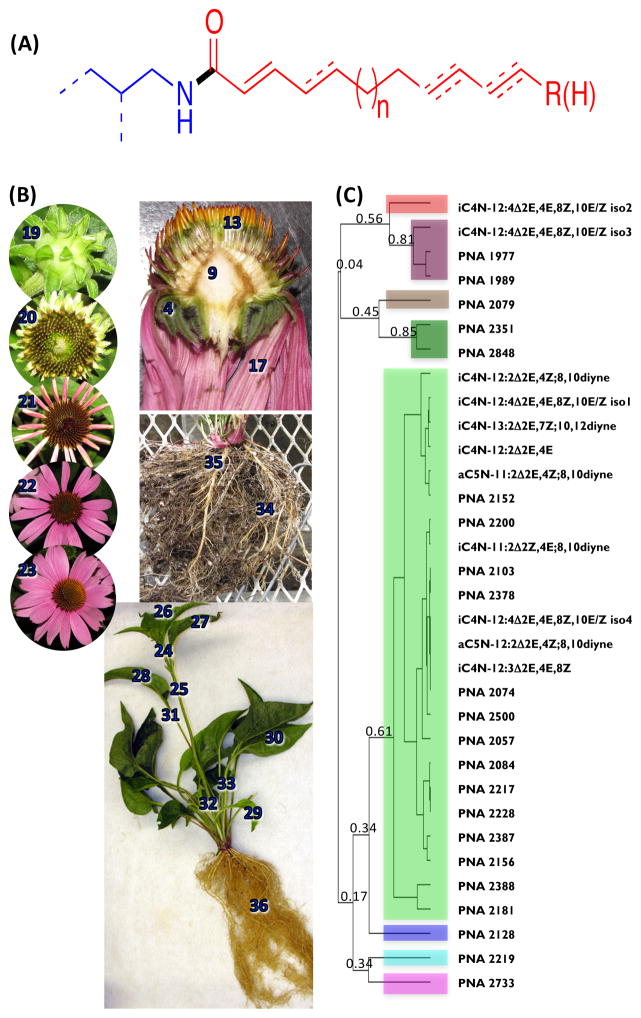
Alkamides of Echinacea. (A) Generalized chemical structure of Echinacea alkamides. An alkyl amine (blue chemical structure), with variable branching indicated by dashes, and a diversity of unsaturated fatty acids (red chemical structure) are connected via an amide bond (black). The common locations of carbon-carbon double and triple bonds are indicated by dashes. (B) Echinacea purpurea organs and tissues used for the transcriptomic and metabolomic analyses. Numbers identify each organ and tissue that was profiled and these are defined in Data S1. Sample #1–23, 34 and 35 were obtained from accessions PI 631313, and sample #24–33 and 36 were obtained from accession PI 633670. (C) Hierarchical clustering analysis of the distribution of alkamides among different E. purpurea organs and tissues. The dendrogram was generated with Java Treeview (Saldanha 2004), based upon the Pearson correlations of the relative accumulation patterns of 33 alkamide metabolites among 36 different E. purpurea organs and tissues.
Figure 2
Figure 2
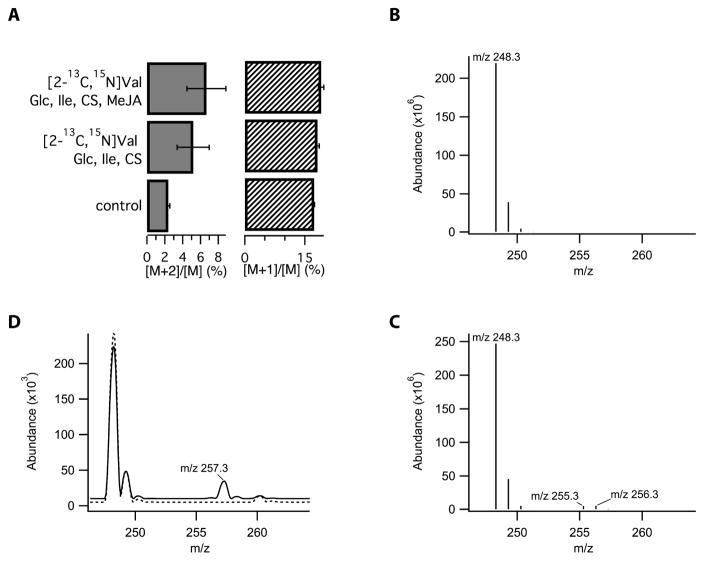
Enhanced isotopologue ratios in i4N-12:4Δ2E,4E,8Z,10E resulting from feeding of E. purpurea seedlings with isotopically labeled precursors. (A) Feeding of [2-13C/15N] valine significantly increased the abundance of M+2 versus M+1 species, indicating the retention of the C-N bond of the precursor, corrected for background Val transamination. MeJA and the presence of additional carbon sources, such as glucose (Glc), isoleucine (Ile), and chlorsulfuron (CS) had no significant effect on isotope incorporation. Isotopic envelope revealed by full-scan QqQ mass spectroscopy of i4N-12:4Δ2E,4E,8Z,10E isolated from seedlings incubated with (A) natural abundance valine and isoleucine and (B) media supplemented with [2H8]valine, unlabeled isoleucine, and in the presence of chlorsulfuron. Ions with m/z 256 and 255 correspond to the M+8 and M+7 ions resulting from incorporation of eight deuterium atoms from the decarboxylated form of [2H8]valine or the incorporation of seven deuterium atoms following the metabolic exchange of [2H8]valine with 2-ketoisopentanoate via transamination that results in the loss of one of the deuterium atoms. (C) Isotopic envelope from plants cultured in standard media (dashed line) or media supplemented with [2H9]isobutylamine hydrochloride (solid line); the M+9 ion at m/z 257 indicates that this precursor is incorporated into the alkamide without loss of any deuterium atoms.
Figure 3
Figure 3
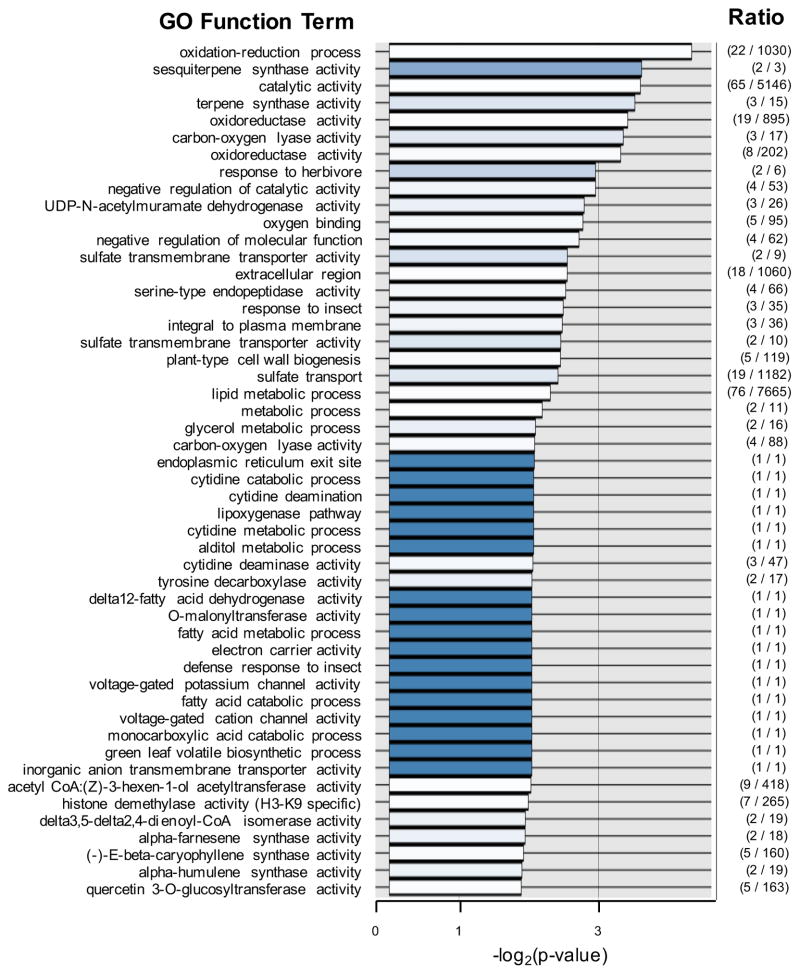
Functional annotation analysis of the transcriptome of E. purpurea in relation to the accumulation of alkamides. The transcriptomes of 20 different E. purpurea organs and tissues were sequenced in collaboration with the Medicinal Plant Genomics Resource (http://medicinalplantgenomics.msu.edu). Transcript sequences were annotated with GO functional annotations based on sequence homology with Arabidopsis genome annotations. The relative abundance of each, 13,431 unique E. purpurea reference transcripts was correlated with the abundance of the “anchor” alkamide, i4N-12:4Δ2E,4E,8Z,10E among the 20 different E. purpurea organs and tissues subjected to RNA-Seq analysis. The top 50 GO Molecular Function terms, and Biological Processes and Cellular Components terms were gathered from this correlation matrix, and the abundance of these terms was compared to their abundance in the entire 13,431-member reference transcriptome of E. purpurea. The enrichment of these GO functional terms in the alkamide-correlation matrix are sorted by increasing p-values (the order on the y-axis), and the x-axis plots the value of -log2(p-value). The blue-color gradient in each data-bar is proportional to the ratio of the genes annotation with the identified GO term in the alkamide-correlation matrix in relation to the number of genes with that GO term in the entire reference transcriptome (the absolute value of this ratio is shown in the last column).
Figure 4
Figure 4
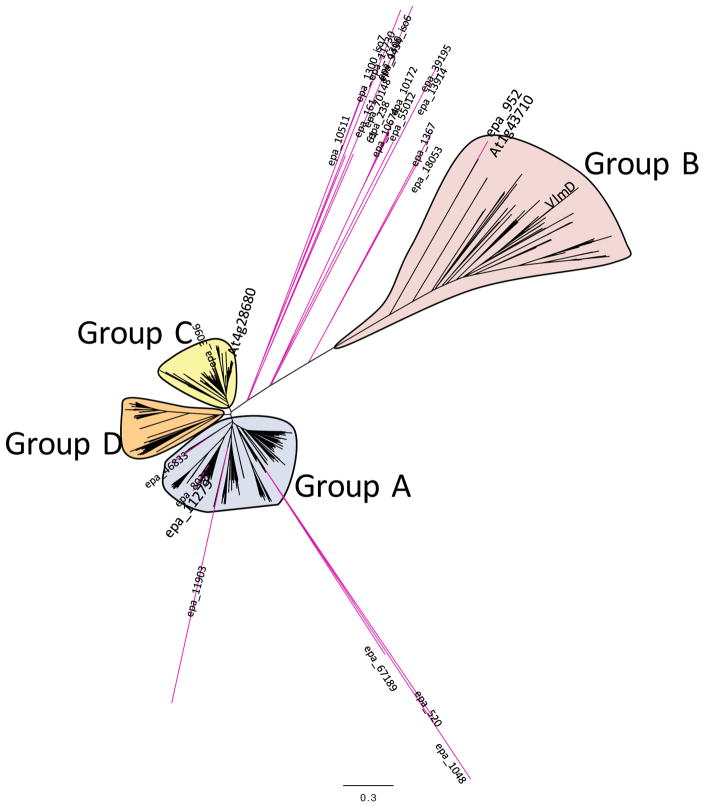
Molecular phylogenetic analysis of putative PLP-dependent amino acid decarboxylases encoded by the E. purpurea transcriptome. The translated amino acid sequences of each E. purpurea contig are provided in Data S4. The biochemically authenticated bacterial valine decarboxylase (VlmD) and Arabidopsis serine decarboxylase encoded by locus At1g43710 is positioned within the Group B clade; this clade contains the protein encoded by E. purpurea contig epa_952 that was characterized as a serine decarboxylase. The E. purpurea contig epa_11279, whose transcript abundance positively correlates with the “anchor” alkamide, i4N-12:4Δ2E,4E,8Z,10E, is positioned in the Group A clade. The branch lengths of the tree represent the evolutionary distance among the sequences, calculated from 500 bootstrap trials, and the scale for this divergence distance unit is indicated.
Figure 5
Figure 5
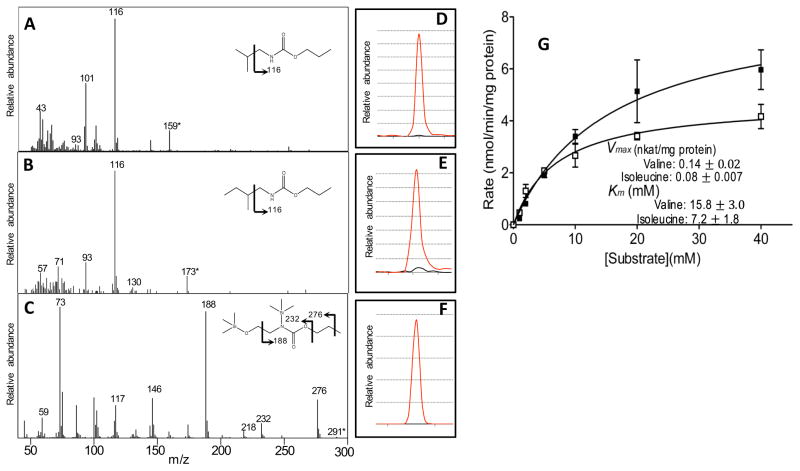
Enzymatic characterization of recombinant PLP-dependent amino acid decarboxylases identified in the E. purpurea transcriptome (Epa_11279 and Epa_952). GC-MS identification of the enzymatic products of recombinant protein encoded by Epa_11279 incubated with valine or isoleucine, which led to the time-dependent appearance of isobutylamine (A) and 2-methybutylamine (B), respectively (all products were derivatized with propyl chloroformate prior to GC-MS analysis). The analogous incubation with serine of the recombinant protein encoded by Epa_952, led to the appearance of ethanolamine, which was derivatized with propyl chloroformate and silylated prior to GC-MS analysis (C). The abundance-trace of the molecular ion of each product (D–F), extracted from the corresponding GC-chromatogram (red-line), and the trace from the negative enzyme-control incubation (black-line). (G) Kinetic characterization of the recombinant E. purpurea BCAA decarboxylase (encoded by Epa_11279). Michaelis-Menten kinetic constants (Km and Vmax) for the BCAA decarboxylase were deduced using valine (■) or isoleucine (□) as the substrate. Data represents average of 3 determinations ± the standard error (see Methods for detail).
Figure 6
Figure 6
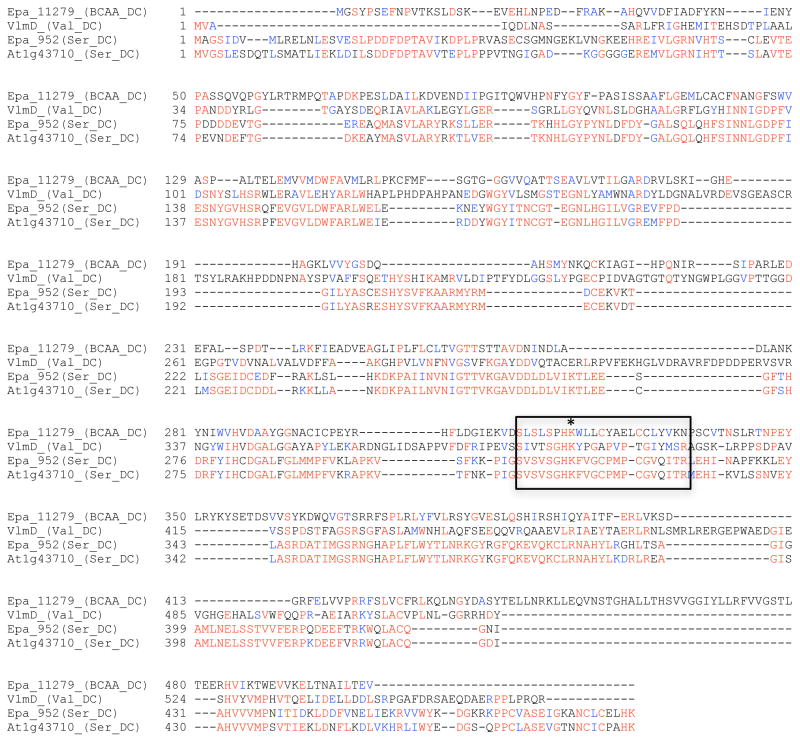
Sequence comparison of the biochemically characterized E. purpurea PLP-dependent enzymes with closely homologous decarboxylases. Identical residues are identified in red font and conservative substitutions are in blue font. The asterisk identifies the lysine residue, which forms an internal aldimine bond between the protein and the PLP cofactor, and this residue resides in the midst of an eight residue conserved motif that is a structural characteristic of Group II amino acid decarboxylases.
Figure 7
Figure 7
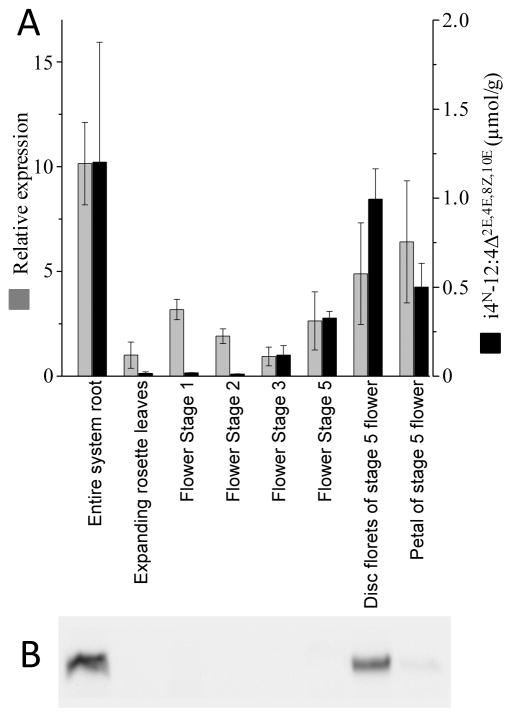
Temporal and spatial expression of BCAA decarboxylase during E. purpurea growth and development. (A) The expression of the BCAA decarboxylase mRNA (Epa_11279) was measured by quantitative RT-PCR analysis, normalized relative to ubiquitin E2 mRNA (encoded by Epa_locus_12798). The accumulation of the anchor alkamide (i4N-12:4Δ2E,4E,8Z,10E) was determined GC-MS analysis. (B) Western blot analysis of the BCAA decarboxylase protein in extracts from the indicated organs and tissues.

References

    1. Bauer R, Foster S. Analysis of alkamides and caffeic acid derivatives from Echinacea simulata and E. paradoxa roots. Planta Med. 1991;57:447–449. - PubMed
    1. Bauer R, Khan IA, Wagner H. TLC and HPLC Analysis of Echinacea pallida and E. angustifolia Roots1. Planta Med. 1988a;54:426–430. - PubMed
    1. Bauer R, Remiger P. TLC and HPLC Analysis of Alkamides in Echinacea Drugs1,2. Planta Med. 1989;55:367–371. - PubMed
    1. Bauer R, Remiger P, Wagner H. Alkamides from the roots of Echinacea purpurea. Phytochemistry. 1988b;27:2339–2342.
    1. Bauer R, Remiger P, Wagner H. Alkamides from the roots of Echinacea angustifolia. Phytochemistry. 1989;28:505–508.

Publication types