


State of inequality in diphtheria-tetanus-pertussis immunisation coverage in low-income and middle-income countries: a multicountry study of household health surveys
- PMID: 27497954
- PMCID: PMC4985563
- DOI: 10.1016/S2214-109X(16)30141-3
State of inequality in diphtheria-tetanus-pertussis immunisation coverage in low-income and middle-income countries: a multicountry study of household health surveys
Abstract
Background: Immunisation programmes have made substantial contributions to lowering the burden of disease in children, but there is a growing need to ensure that programmes are equity-oriented. We aimed to provide a detailed update about the state of between-country inequality and within-country economic-related inequality in the delivery of three doses of the combined diphtheria, tetanus toxoid, and pertussis-containing vaccine (DTP3), with a special focus on inequalities in high-priority countries.
Methods: We used data from the latest available Demographic and Health Surveys and Multiple Indicator Cluster Surveys done in 51 low-income and middle-income countries. Data for DTP3 coverage were disaggregated by wealth quintile, and inequality was calculated as difference and ratio measures based on coverage in richest (quintile 5) and poorest (quintile 1) household wealth quintiles. Excess change was calculated for 21 countries with data available at two timepoints spanning a 10 year period. Further analyses were done for six high-priority countries-ie, those with low national immunisation coverage and/or high absolute numbers of unvaccinated children. Significance was determined using 95% CIs.
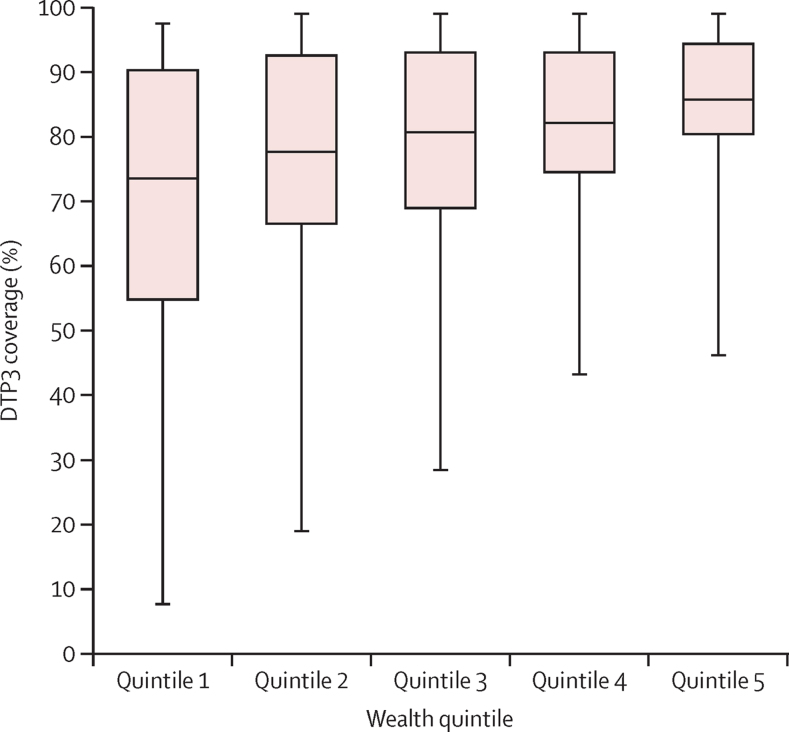
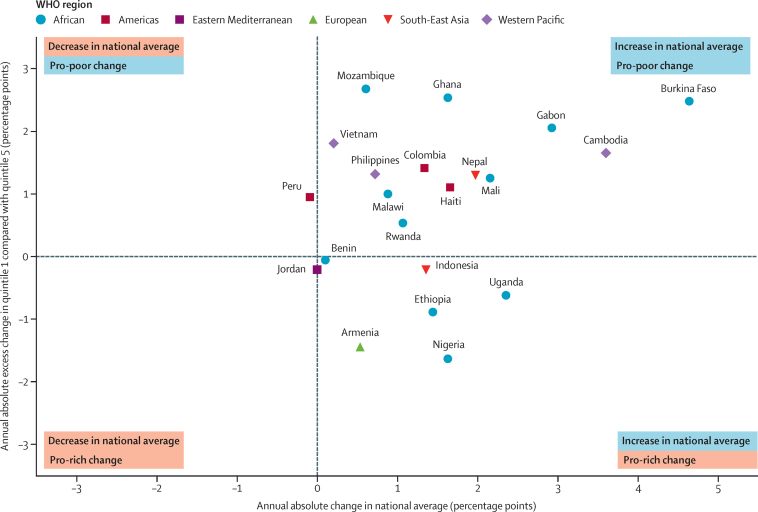
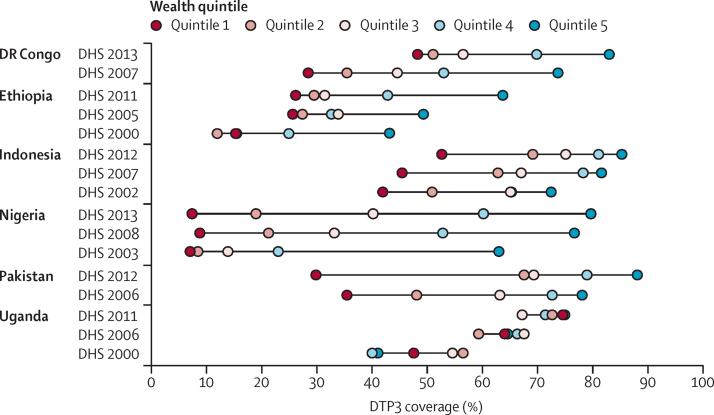
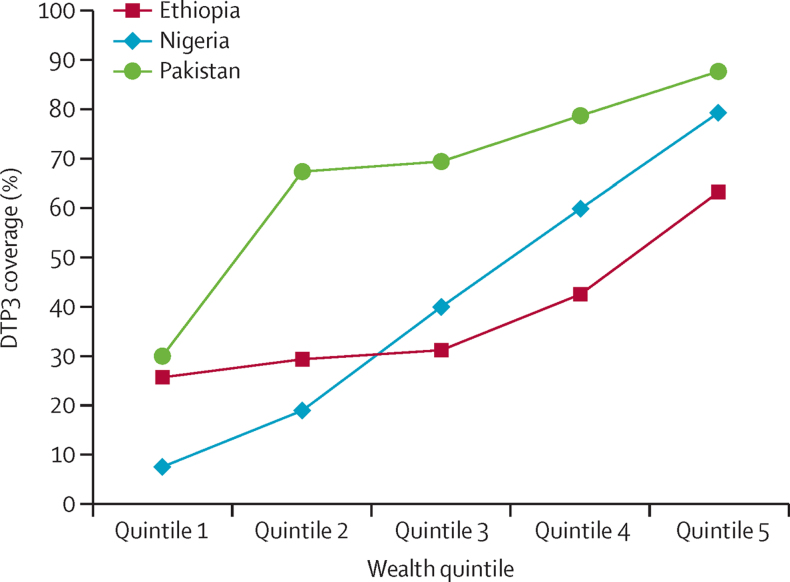
Findings: National DTP3 immunisation coverage across the 51 study countries ranged from 32% in Central African Republic to 98% in Jordan. Within countries, the gap in DTP3 immunisation coverage suggested pro-rich inequality, with a difference of 20 percentage points or more between quintiles 1 and 5 for 20 of 51 countries. In Nigeria, Pakistan, Laos, Cameroon, and Central African Republic, the difference between quintiles 1 and 5 exceeded 40 percentage points. In 15 of 21 study countries, an increase over time in national coverage of DTP3 immunisation was realised alongside faster improvements in the poorest quintile than the richest. For example, in Burkina Faso, Cambodia, Gabon, Mali, and Nepal, the absolute increase in coverage was at least 2·0 percentage points per year, with faster improvement in the poorest quintile. Substantial economic-related inequality in DTP3 immunisation coverage was reported in five high-priority study countries (DR Congo, Ethiopia, Indonesia, Nigeria, and Pakistan), but not Uganda.
Interpretation: Overall, within-country inequalities in DTP3 immunisation persist, but seem to have narrowed over the past 10 years. Monitoring economic-related inequalities in immunisation coverage is warranted to reveal where gaps exist and inform appropriate approaches to reach disadvantaged populations.
Funding: None.
Copyright © World Health Organization. This is an Open Access article published under the CC BY 3.0 IGO license which permits unrestricted use, distribution, and reproduction in any medium, provided the original work is properly cited. In any use of this article, there should be no suggestion that WHO endorses any specific organisation, products or services. The use of the WHO logo is not permitted. This notice should be preserved along with the article's original URL.
Figures
Comment in
-
Trends in immunisation inequity: evidence, rights, and planning.Lancet Glob Health. 2016 Sep;4(9):e582-3. doi: 10.1016/S2214-109X(16)30189-9. Epub 2016 Aug 3. Lancet Glob Health. 2016. PMID: 27497955 No abstract available.
References
-
- United Nations Open working group proposal for Sustainable Development Goals. 2015. https://sustainabledevelopment.un.org/sdgsproposal.html (accessed Sept 7, 2015).
-
- WHO . Global vaccine action plan: monitoring, evaluation & accountability 2011–2020. World Health Organization; Geneva: 2012.
-
- UN . The Millennium Development Goals report 2015. United Nations; New York: 2015.
-
- Brearley L, Eggers R, Steinglass R, Vandelaer J. Applying an equity lens in the Decade of Vaccines. Vaccine. 2013;31(suppl 2):B103–B107. - PubMed
MeSH terms
Substances
Grants and funding
LinkOut - more resources
Full Text Sources
Other Literature Sources
Medical
Miscellaneous
