. 2016 Oct:46:160-8.
doi: 10.1016/j.neurobiolaging.2016.07.001. Epub 2016 Jul 13.

The neurotrophin receptor p75 mediates gp120-induced loss of synaptic spines in aging mice

Affiliations

The neurotrophin receptor p75 mediates gp120-induced loss of synaptic spines in aging mice

Alessia Bachis et al. Neurobiol Aging. 2016 Oct.

Abstract

Human immunodeficiency virus 1 and its envelope protein gp120 reduce synaptodendritic complexity. However, the mechanisms contributing to this pathological feature are still not understood. The proneurotrophin brain-derived neurotrophic factor promotes synaptic simplification through the activation of the p75 neurotrophin receptor (p75NTR). Here, we have used gp120 transgenic (gp120tg) mice to investigate whether p75NTR has a role in gp120-mediated neurotoxicity. Old (∼10 months) gp120tg mice exhibited an increase in proneurotrophin brain-derived neurotrophic factor levels in the hippocampus as well as a decrease in the number of dendritic spines when compared to age-matched wild type. These effects were not observed in 3- or 6-month-old mice. To test if the reduction in spine density and morphology is caused by the activation of p75NTR, we crossed gp120tg mice with p75NTR null mice. We found that deletion of only 1 copy of the p75NTR gene in gp120tg mice is sufficient to normalize the number of hippocampal spines, strongly suggesting that the neurotoxic effect of gp120 is mediated by p75NTR. These data indicate that p75NTR antagonists could provide an adjunct therapy against synaptic simplification caused by human immunodeficiency virus 1.

Keywords: Aging; HIV; Hippocampus; TrkB; p75NTR; proBDNF.


Conflict of interest statement

statement The authors have no conflicts of interest to disclose.

Figures
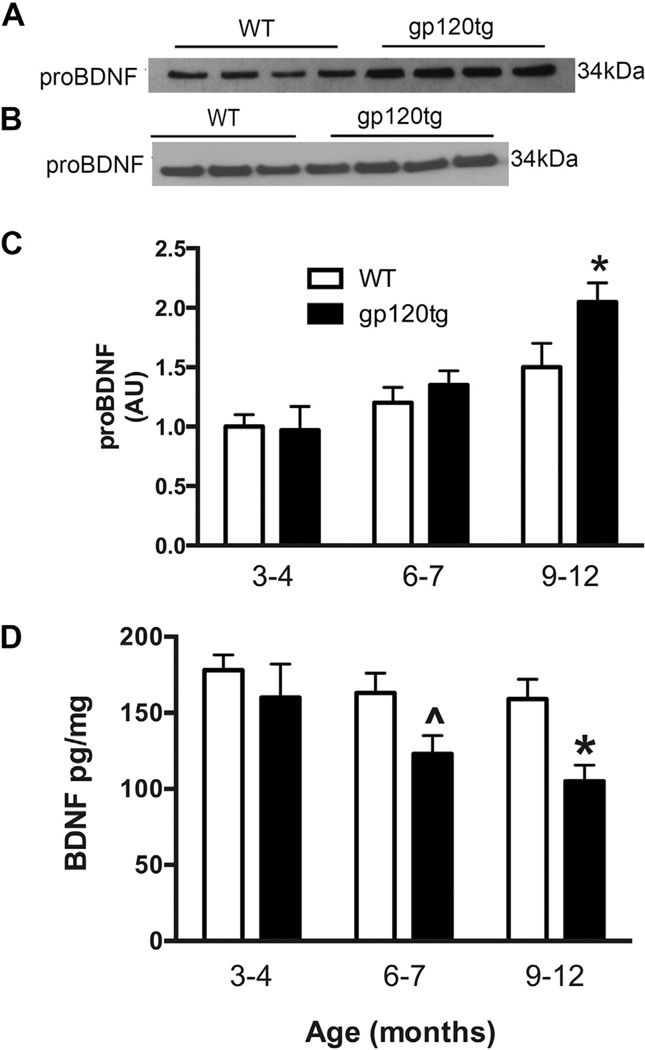
Fig. 1
Fig. 1
Gp120 causes an age-dependent increase of hippocampal proBDNF. Hippocampal lysates from 3- to 4-month-old, 6- to 7-month-old, and 9- to 12-month-old WT and gp120tg mice were analyzed for proBDNF and total BDNF. (A and B) Examples of Western blots used to determine proBDNF levels in lysates (after immunoprecipitation) from the hippocampi of 9- to 12-month-old and 6- to 7-month-old mice, respectively (see Section 2). (C) Semiquantitative analysis of proBDNF immunoreactivity. Levels of proBDNF are expressed as arbitrary units. Data are the mean ± SEM of 6 samples per group each time point. *p < 0.01 versus age-matched WT. (D) Total hippocampal BDNF was determined by ELISA. Data are the mean ± SEM of 6 samples per group.^p < 0.05, *p < 0.01 versus age-matched WT. Abbreviations: BDNF, brain-derived neurotrophic factor; ELISA, enzyme-linked immunosorbent assay; gp120tg, gp120 transgenic; proBDNF, proneurotrophin brain-derived neurotrophic factor; SEM, standard error of mean; WT, wild type.
Fig. 2
Fig. 2
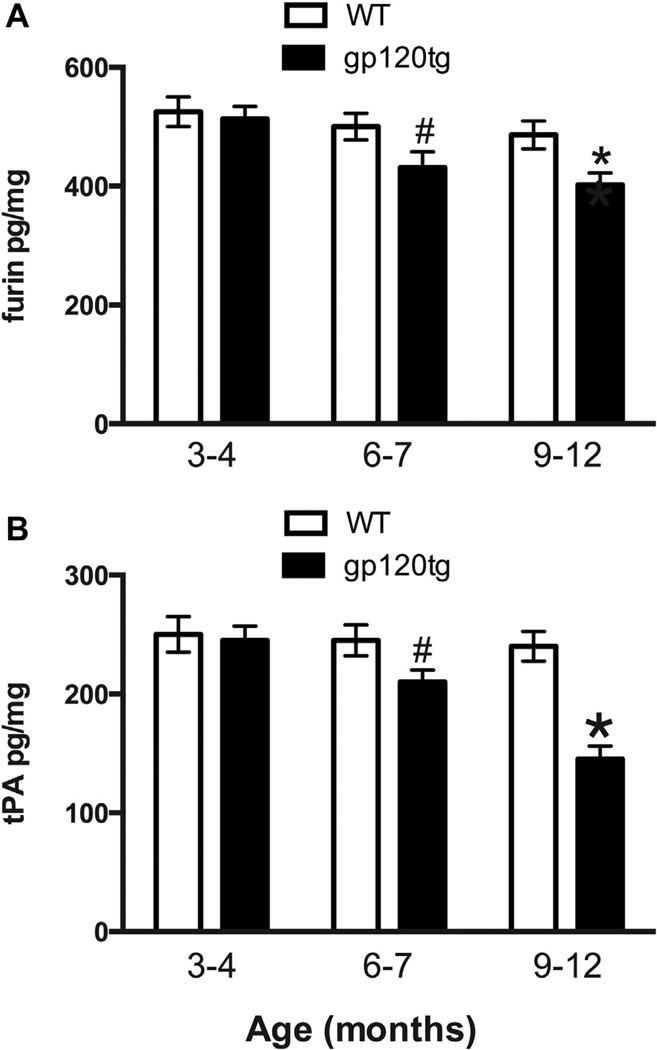
gp120 decreases furin and tPA levels. Hippocampal levels of furin (A) and tPA (B) were determined by ELISA in gp120tg and age-matched WT. Data are the mean ± SEM of 6 mice per each group. #p < 0.05, *p < 0.01 versus age-matched WT. Abbreviations: ELISA, enzyme-linked immunosorbent assay; gp120tg, gp120 transgenic; SEM, standard error of mean; tPA, tissue plasminogen activator; WT, wild type.
Fig. 3
Fig. 3
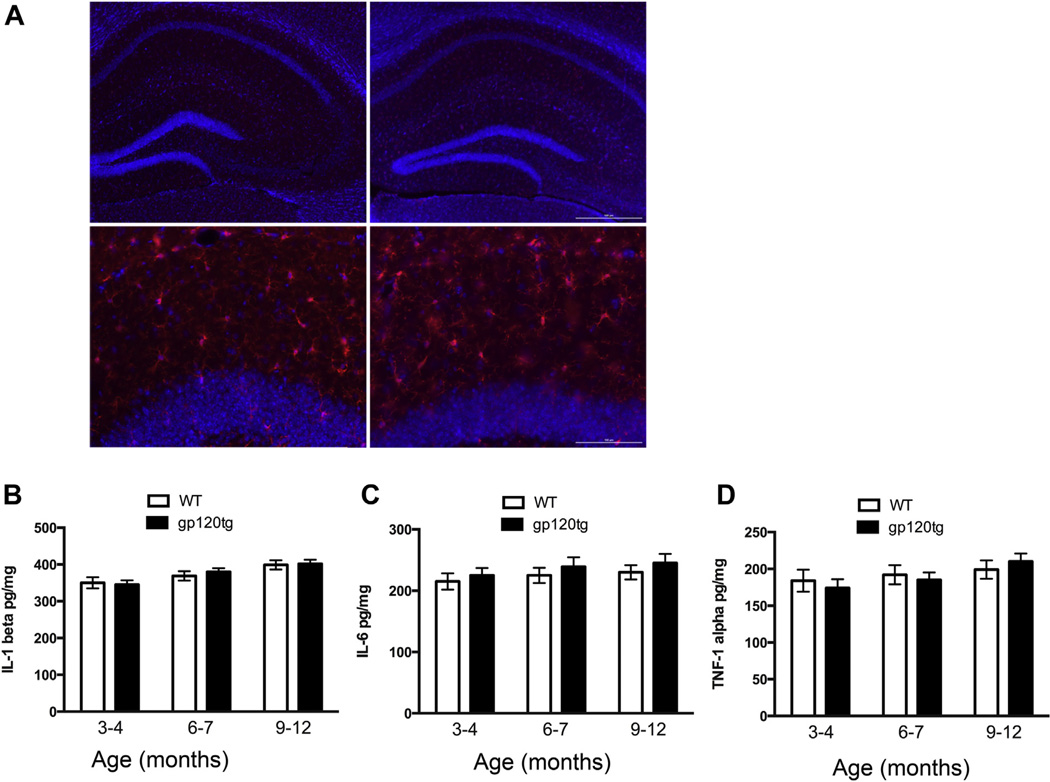
Microglia and proinflammatory cytokines are not altered in gp120tg mice. (A) Example of Iba-1 immunoreactivity (red) in hippocampal sections from 10-month-old WT (left panels) and gp120 tg mice (right panels). 4′, 6-diamidino-2-phenylindole (blue) was used to visualize nuclei. Lower panels = higher magnification (×20) of the area delimited by the white squares. Upper panel scale bar = 500 µm; lower panel scale bar = 100 µm. (B–D) IL-1β, IL-6, and TNFα levels were determined in the hippocampus of WT and gp120tg mice at the indicated ages by ELISA. Data are the mean ± SEM (n = 6 per group). Abbreviations: ELISA, enzyme-linked immunosorbent assay; gp120tg, gp120 transgenic; SEM, standard error of mean; TNFα, tumor necrosis factor α; tPA, tissue plasminogen activator; WT, wild type. (For interpretation of the references to color in this figure legend, the reader is referred to the Web version of this article.)
Fig. 4
Fig. 4
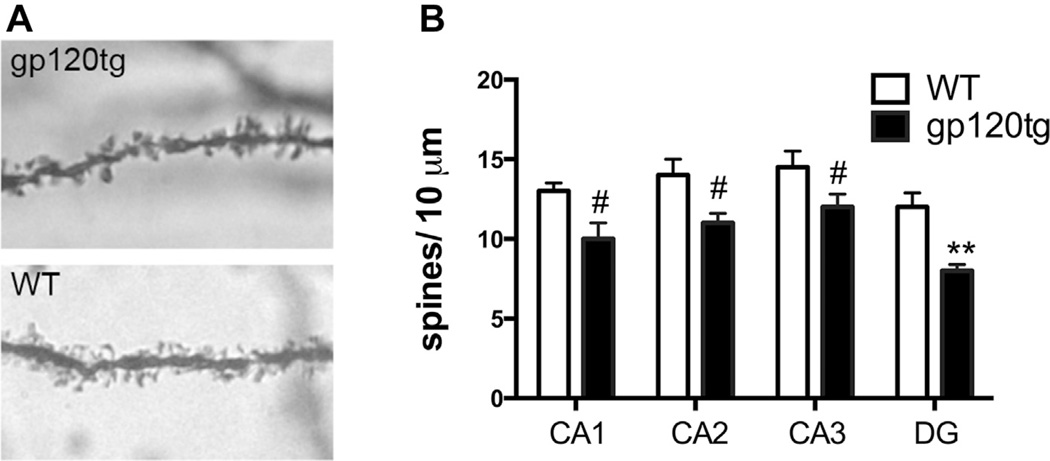
Spine count is decreased in old gp120tg mice. Golgi staining was used to label hippocampal spines in WT and 9- to 12-month-old gp120tg mice. (A) Representative images of dendritic spines in hippocampal sections taken from the CA1 region. (B) The number of spines was determined in the indicated hippocampal regions (DG) as described in Section 2 on an average of 32 neurons per animal. #p < 0.05, **p < 0.01 versus WT (n = 6 animals per group). Abbreviations: DG, dentate gyrus; gp120tg, gp120 transgenic; TNFα, tumor necrosis factor α; WT, wild type.
Fig. 5
Fig. 5
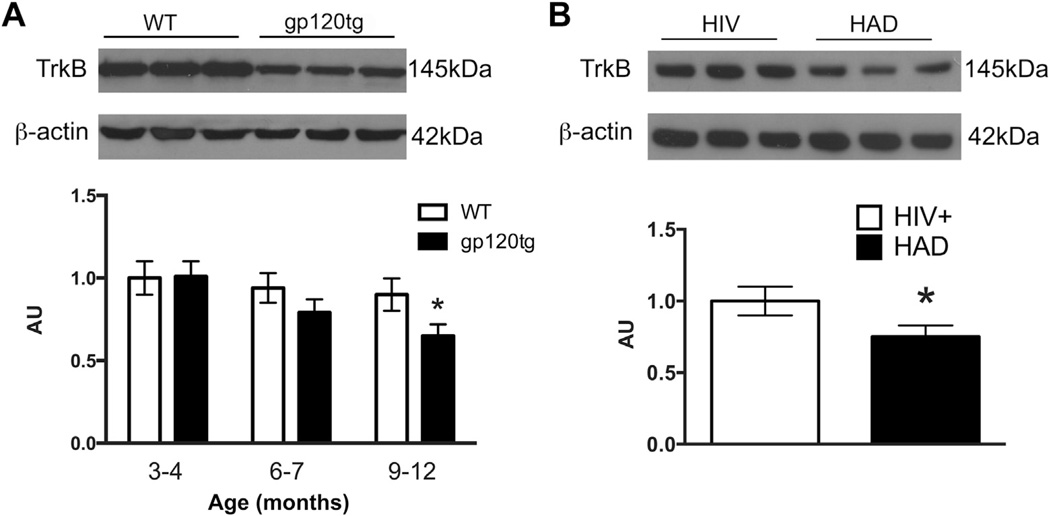
TrkB levels are decreased in gp120tg mice and HAD. Hippocampal lysates were prepared from WT and gp120tg mice or frozen human samples and analyzed by Western blot. (A and B) Examples of blots of lysates from mice (A) or human tissues (B) using a TrkB antibody that recognizes both mice and human TrkB. Semiquantitative determination of TrkB levels was done by densitometric analysis using β-actin as loading control (see Section 2). Data, expressed in arbitrary units, are the mean ± SEM of 6 mice each group or 5 human samples per condition. (A) *p < 0.01 versus WT. (B) HIV+ = subjects with no cognitive impairment, HAD = HIV+ subjects with dementia. *p < 0.05 versus HIV+. Abbreviations: gp120tg, gp120 transgenic; HAD, HIV-associated dementia; HIV, human immunodeficiency virus 1; SEM, standard error of mean; TrkB, tropomyosin-related kinase receptor B; WT, wild type.
Fig. 6
Fig. 6
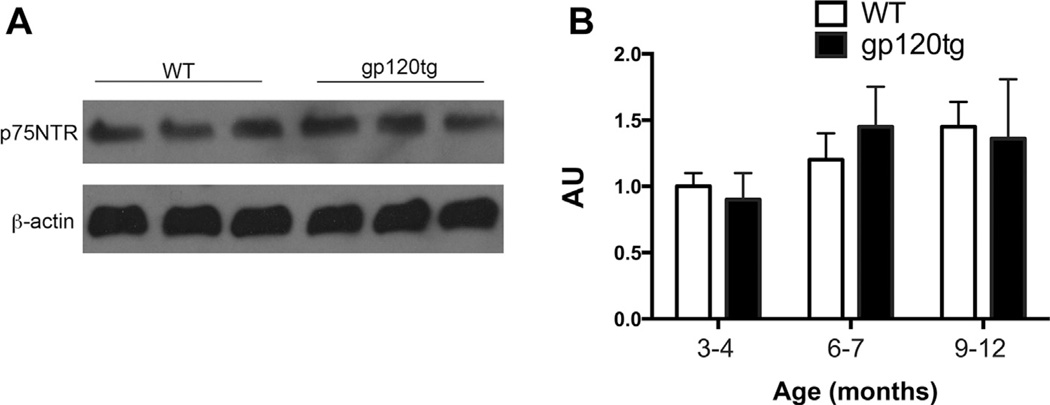
p75NTR does not change in gp120tg mice. Hippocampal lysates from WT and gp120tg mice were analyzed for p75NTR by Western blot. (A) Example of a blot of lysates from 9- to -12-month-old mice. β-actin was used as loading control. (B) Levels of p75NTR were determined by densitometry and expressed in arbitrary units (AU). Data are the mean ± SEM of 5 samples each group per condition. Abbreviations: p75NTR, p75 neurotrophin receptor; SEM, standard error of mean; WT, wild type.
Fig. 7
Fig. 7
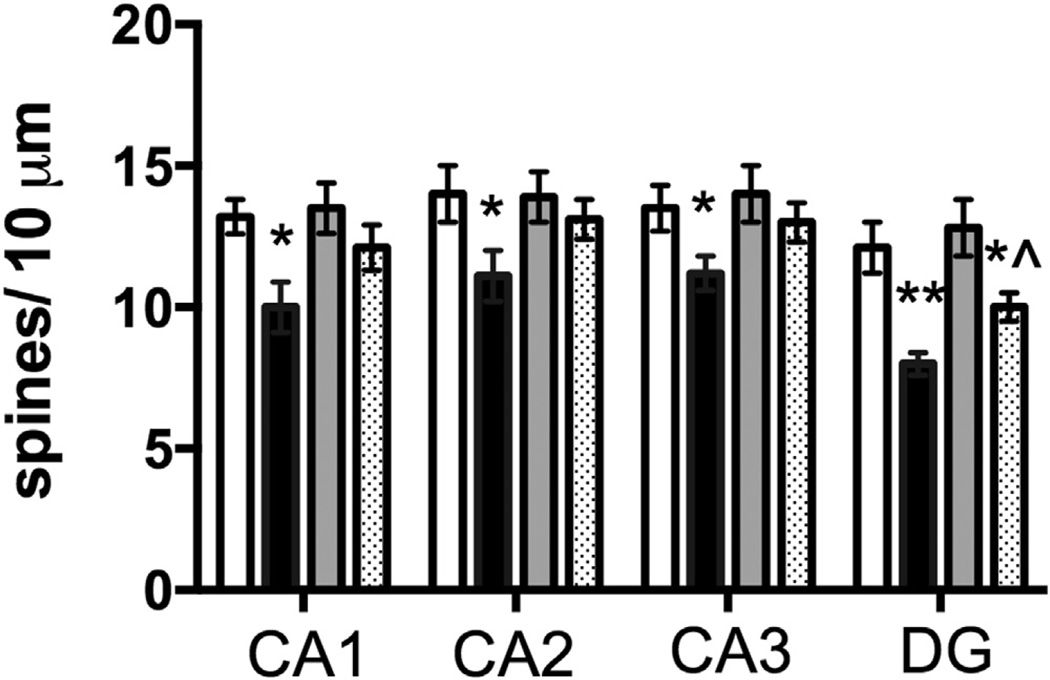
Reduction of p75NTR rescues gp120-mediated loss of hippocampal spines. All groups of mice were maintained for 9–12 months. Spine count was performed in hippocampal sections containing the indicated subregions as described in Section 2. Data are the mean ± SEM of 6 animals per group. *p < 0.05 versus WT; **p < 0.01 versus WT; *^p < 0.05 versus gp120tg. Abbreviations: DG, dentate gyrus; p75NTR, p75 neurotrophin receptor; SEM, standard error of mean; WT, wild type.

References

    1. Avdoshina V, Taraballi F, Dedoni S, Corbo C, Paige M, Saygideger Kont Y, Uren A, Tasciotti E, Mocchetti I. Identification of a binding site of the human immunodeficiency virus envelope protein gp120 to neuronal specific tubulin. J. Neurochem. 2016;137:287–298. - PMC - PubMed
    1. Bachis A, Aden SA, Nosheny RL, Andrews PM, Mocchetti I. Axonal transport of human immunodeficiency virus type 1 envelope protein glycoprotein 120 is found in association with neuronal apoptosis. J. Neurosci. 2006;26:6771–6780. - PMC - PubMed
    1. Bachis A, Avdoshina V, Zecca L, Parsadanian M, Mocchetti I. Human immunodeficiency virus type 1 alters brain-derived neurotrophic factor processing in neurons. J. Neurosci. 2012;32:9477–9484. - PMC - PubMed
    1. Bachis A, Cruz MI, Mocchetti I. M-tropic HIV envelope protein gp120 exhibits a different neuropathological profile than T-tropic gp120 in rat striatum. Eur. J. Neurosci. 2010;32:570–578. - PMC - PubMed
    1. Campbell LA, Avdoshina V, Day C, Lim ST, Mocchetti I. Pharmacological induction of CCL5 in vivo prevents gp120-mediated neuronal injury. Neuropharmacology. 2015;92:98–107. - PMC - PubMed

Publication types

MeSH terms

Substances