


Assessing emergency obstetric care provision in low- and middle-income countries: a systematic review of the application of global guidelines
- PMID: 27498964
- PMCID: PMC4976306
- DOI: 10.3402/gha.v9.31880
Assessing emergency obstetric care provision in low- and middle-income countries: a systematic review of the application of global guidelines
Abstract
Background: Lack of timely and quality emergency obstetric care (EmOC) has contributed significantly to maternal morbidity and mortality, particularly in low- and middle-income countries (LMICs). Since 2009, the global guideline, referred to as the 'handbook', has been used to monitor availability, utilization, and quality of EmOC.
Objective: To assess application and explore experiences of researchers in LMICs in assessing EmOC.
Design: Multiple databases of peer-reviewed literature were systematically reviewed on EmOC assessments in LMICs, since 2009. Following set criteria, we included articles, assessed for quality based on a newly developed checklist, and extracted data using a pre-designed extraction tool. We used thematic summaries to condense our findings and mapped patterns that we observed. To analyze experiences and recommendations for improved EmOC assessments, we took a deductive approach for the framework synthesis.
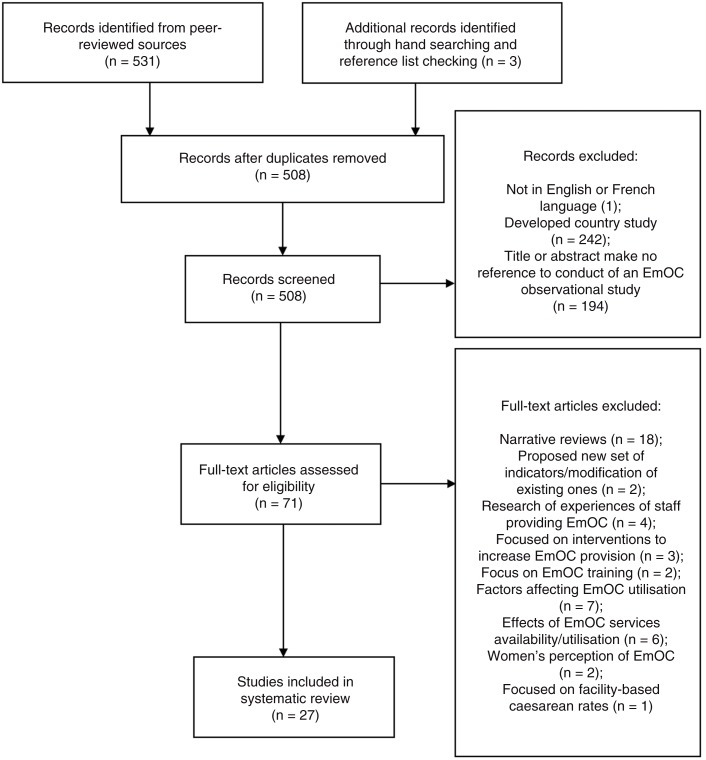
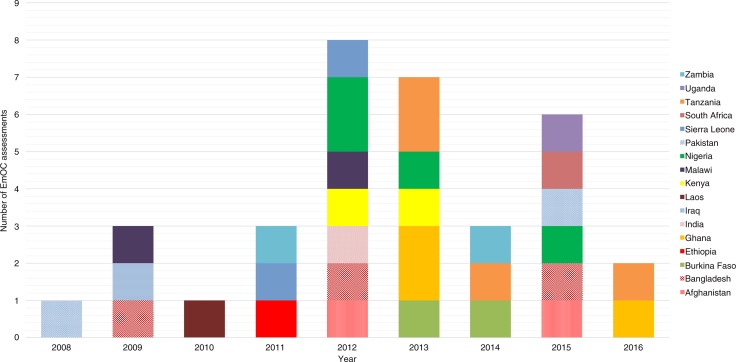
Results: Twenty-seven studies met our inclusion criteria, with 17 judged as high quality. The highest publication frequency was observed in 2015. Most assessments were conducted in Nigeria and Tanzania (four studies each) and Bangladesh and Ghana (three each). Most studies (17) were done at subnational levels with 23 studies using the 'handbook' alone, whereas the others combined the 'handbook' with other frameworks. Seventeen studies conducted facility-based surveys, whereas others used mixed methods. For different reasons, intrapartum and very early neonatal death rate and proportion of deaths due to indirect causes in EmOC facilities were the least reported indicators. Key emerging themes indicate that data quality for EmOC assessments can be improved, indicators should be refined, a holistic approach is required for EmOC assessments, and assessments should be conducted as routine processes.
Conclusions: There is clear justification to review how EmOC assessments are being conducted. Synergy between researchers, EmOC program managers, and other key stakeholders would be critical for improved assessments, which would contribute to increased accountability and ultimately service provision.
Keywords: EmOC assessment; emergency obstetric care; low- and middle-income countries; maternal health; quality of care.
Figures
References
-
- WHO. Maternal Mortality. Fact Sheet N°348 2014. Available from: http://www.who.int/mediacentre/factsheets/fs348/en/ [cited 1 March 2016]
-
- Say L, Chou D, Gemmill A, Tunçalp Ö, Moller A-B, Daniels J, et al. Global causes of maternal death: a WHO systematic analysis. Lancet Glob Health. 2014;2:e323–33. - PubMed
-
- World Bank. New country classifications. Data 2015. Available from: http://data.worldbank.org/news/new-country-classifications [cited 1 May 2015]
-
- Adegoke AA, van den Broek N. Skilled birth attendance-lessons learnt. BJOG. 2009;116(Suppl 1):33–40. - PubMed
-
- Paxton A, Maine D, Freedman L, Fry D, Lobis S. The evidence for emergency obstetric care. Int J Gynaecol Obstet. 2005;88:181–93. - PubMed
Publication types
LinkOut - more resources
Full Text Sources
Other Literature Sources
Miscellaneous
