


Concordance of In-Home "Smart" Scale Measurement with Body Weight Measured In-Person
- PMID: 27499884
- PMCID: PMC4970749
- DOI: 10.1002/osp4.41
Concordance of In-Home "Smart" Scale Measurement with Body Weight Measured In-Person
Abstract
Objective: Newer "smart" scales that transmit participants' body weights directly to data collection centers offer the opportunity to simplify weight assessment in weight management research; however, little data exist on the concordance of these data compared to weights measured at in-person assessments.
Methods: We compared the weights of 58 participants (mean±SD BMI = 31.6±4.8, age = 52.1±9.7 years, 86.2% White, 65.5% Female) measured by study staff at an in-person assessment visit to weights measured on the same day at home using BodyTrace "smart" scales. These measures occurred after 3 months of an internet-based weight management intervention.
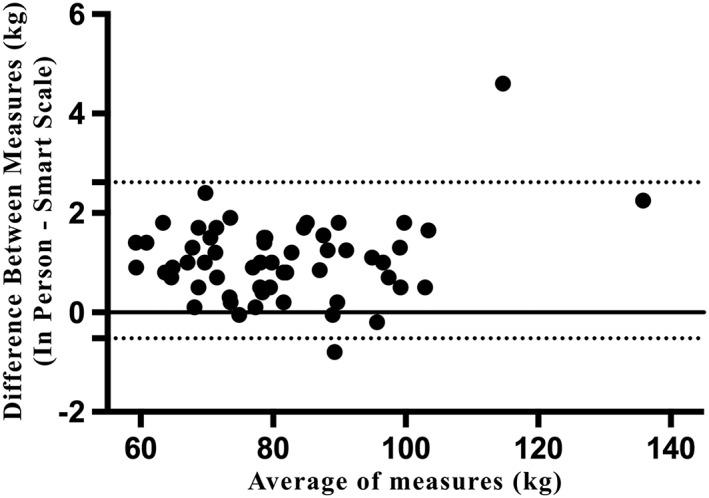
Results: Weight (mean±SD) measured at the 3-month in-person assessment visit was 81.5±14.7kg compared to 80.4±14.5kg measured on the same day using in-home body weight scales; mean bias =1.1±0.8kg, 95% limits of agreement = -0.5 to 2.6. Two outliers in the data suggest that there may be greater variability between measurements for participants weighing above 110 kg.
Conclusion: Results suggest good concordance between the measurements and support the use of the BodyTrace smart scale in weight management research. Future trials using BodyTrace scales for outcome assessment should clearly define protocols for measurement and associated instructions to participants (e.g., instruct individuals to weigh at the same time of day, similarly clothed). Finally, measure concordance should be investigated in a group of individuals weighing more than 110kg.
Keywords: Body Weight Measurement; Research Methods; Smart Scales; Weight Management.
Figures
References
-
- Thomas JG, Bond DS. Review of innovations in digital health technology to promote weight control. Curr Diab Rep 2014; 14: 1–10. - PubMed
-
- Madigan CD, Jolly K, Roalfe A, et al Study protocol: the effectiveness and cost effectiveness of a brief behavioural intervention to promote regular self‐weighing to prevent weight regain after weight loss: randomised controlled trial (The LIMIT Study). BMC Public Health 2015; 15: 1–10. - PMC - PubMed
Grants and funding
LinkOut - more resources
Full Text Sources
Other Literature Sources