


How multiple episodes of exclusive breastfeeding impact estimates of exclusive breastfeeding duration: report from the eight-site MAL-ED birth cohort study
- PMID: 27500709
- PMCID: PMC5095788
- DOI: 10.1111/mcn.12352
How multiple episodes of exclusive breastfeeding impact estimates of exclusive breastfeeding duration: report from the eight-site MAL-ED birth cohort study
Abstract
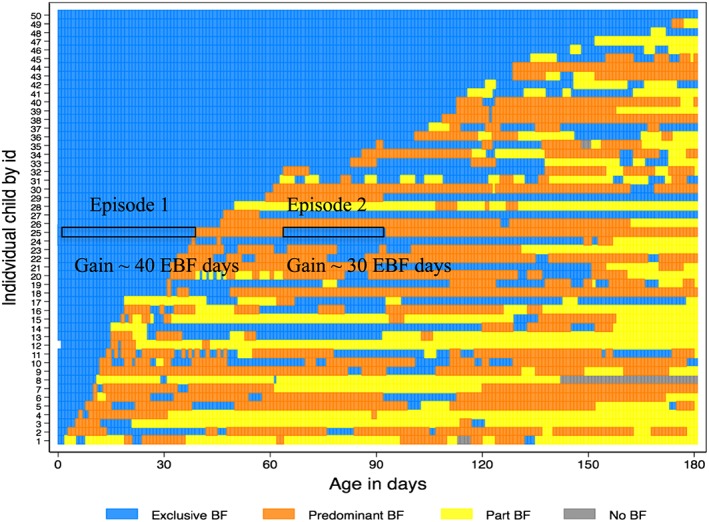
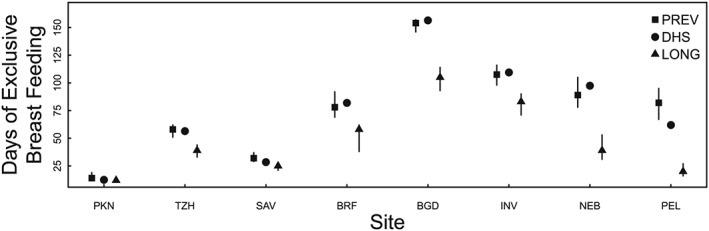
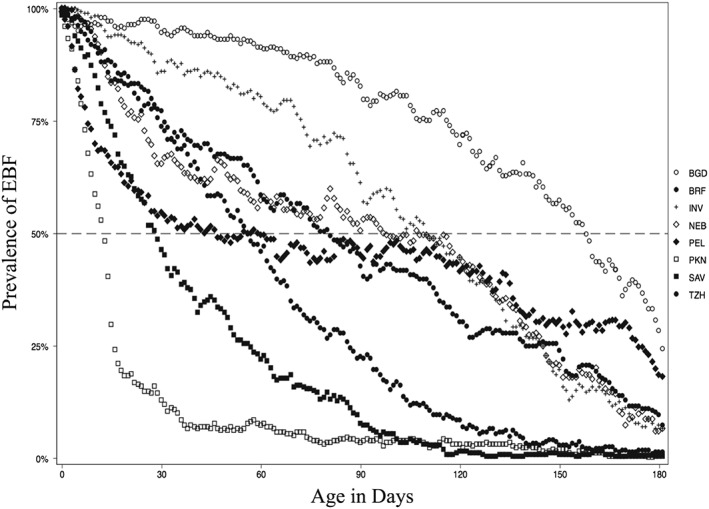
The duration of exclusive breastfeeding (EBF) is often defined as the time from birth to the first non-breast milk food/liquid fed (EBFLONG), or it is estimated by calculating the proportion of women at a given infant age who EBF in the previous 24 h (EBFDHS). Others have measured the total days or personal prevalence of EBF (EBFPREV), recognizing that although non-EBF days may occur, EBF can be re-initiated for extended periods. We compared breastfeeding metrics in the MAL-ED study; infants' breastfeeding trajectories were characterized from enrollment (median 7 days, IQR: 4, 12) to 180 days at eight sites. During twice-weekly surveillance, caretakers were queried about infant feeding the prior day. Overall, 101 833 visits and 356 764 child days of data were collected from 1957 infants. Median duration of EBFLONG was 33 days (95% CI: 32-36), compared to 49 days based on the EBFDHS. Median EBFPREV was 66 days (95% CI: 62-70). Differences were because of the return to EBF after a non-EBF period. The median number of returns to EBF was 2 (IQR: 1, 3). When mothers re-initiated EBF (second episode), infants gained an additional 18.8 days (SD: 25.1) of EBF, and gained 13.7 days (SD: 18.1) (third episode). In settings where women report short gaps in EBF, programmes should work with women to return to EBF. Interventions could positively influence the duration of these additional periods of EBF and their quantification should be considered in impact evaluation studies. © 2016 John Wiley & Sons Ltd.
Keywords: Bangladesh; Brazil; DHS; India; MAL-ED; Nepal; Pakistan; Peru; South Africa; Tanzania; duration; exclusive breastfeeding; metrics; prevalence.
© 2016 The Authors. Maternal & Child Nutrition published by John Wiley & Sons Ltd.
Figures
References
-
- Aarts C., Kylberg E., Hornell A., Hofvander Y., Gebre‐Medhin M. & Greiner T. (2000) How exclusive is exclusive breastfeeding? A comparison of data since birth with current status data. International Journal of Epidemiology Oxford University Press 29 (6), 1041–1046. DOI: 10.1093/ije/29.6.1041. - DOI - PubMed
-
- Agampodi S.B. & Agampodi T. (2009) Use of exclusive breast feeding definitions; a call for action!. Sri Lanka Journal of Child Health 38 (2), 77–78. DOI: 10.4038/sljch.v38i2.688. - DOI
-
- Ahmed, T. , Mahfuz, M. , Islam, M. M. , Mondal, D. , Hossain, M. I. , Ahmed, A. S. , Tofail, F. , Gaffar, S. A. , Haque, R. , Guerrant, R. L. and Petri, W. A. (2014) The MAL‐ED Cohort Study in Mirpur, Bangladesh, Clinical Infectious Diseases. Oxford University Press, 59 Suppl 4(suppl 4), pp. S280–6. DOI: 10.1093/cid/ciu458. - DOI - PubMed
Publication types
MeSH terms
LinkOut - more resources
Full Text Sources
Other Literature Sources
Medical
Research Materials
