. 2016 Sep;590(18):3111-21.
doi: 10.1002/1873-3468.12346. Epub 2016 Aug 23.

Analysis of biophysical and functional consequences of tropomyosin-fluorescent protein fusions

Affiliations

Analysis of biophysical and functional consequences of tropomyosin-fluorescent protein fusions

Holly R Brooker et al. FEBS Lett. 2016 Sep.

Abstract

The dynamic nature of actin polymers is modulated to facilitate a diverse range of cellular processes. These dynamic properties are determined by different isoforms of tropomyosin which are recruited to distinct subpopulations of actin polymers to differentially regulate their functional properties. This makes tropomyosin an attractive target for labelling discrete actin populations. We have assessed the effect of different fluorescent labelling strategies for this protein. Although tropomyosin-fluorescent fusions decorate actin in vivo, they are either nonfunctional or perturb regulation of actin nucleation and cell cycle timings. Thus, conclusions and physiological relevance should be carefully evaluated when using tropomyosin fusions.

Keywords: Cdc8; Schizosaccharomyces pombe; acetylation; actin cytoskeleton; fission yeast.


Figures

Figure 1
Figure 1
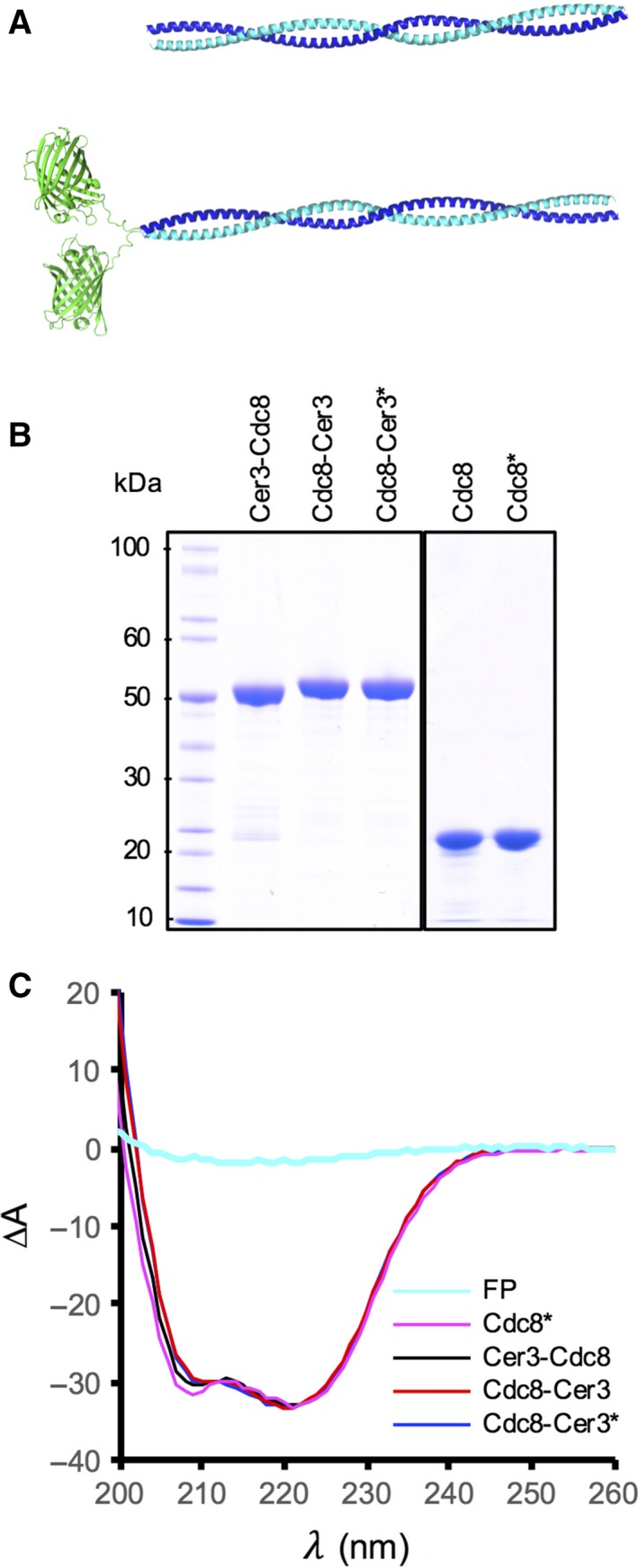
Tropomyosin proteins used in this study. (A) Predictive models of TpmCdc8 (upper panel) and Cerulean3‐TpmCdc8 (lower panel) dimers. (B) Coomassie blue‐stained SDS/PAGE analysis of purified wild‐type and Cerulean3‐tagged TpmCdc8 proteins. (C) CD Spectra of purified acetylated wt (magenta), amino‐terminally Cerulean3‐tagged (black), and both acetylated (blue) and unacetylated (red) carboxyl‐terminally Cerulean3‐tagged TpmCdc8 proteins. A CD spectrum of a fluorescent protein (cyan) is included for comparison. *Denotes amino‐terminally acetylated protein.
Figure 2
Figure 2
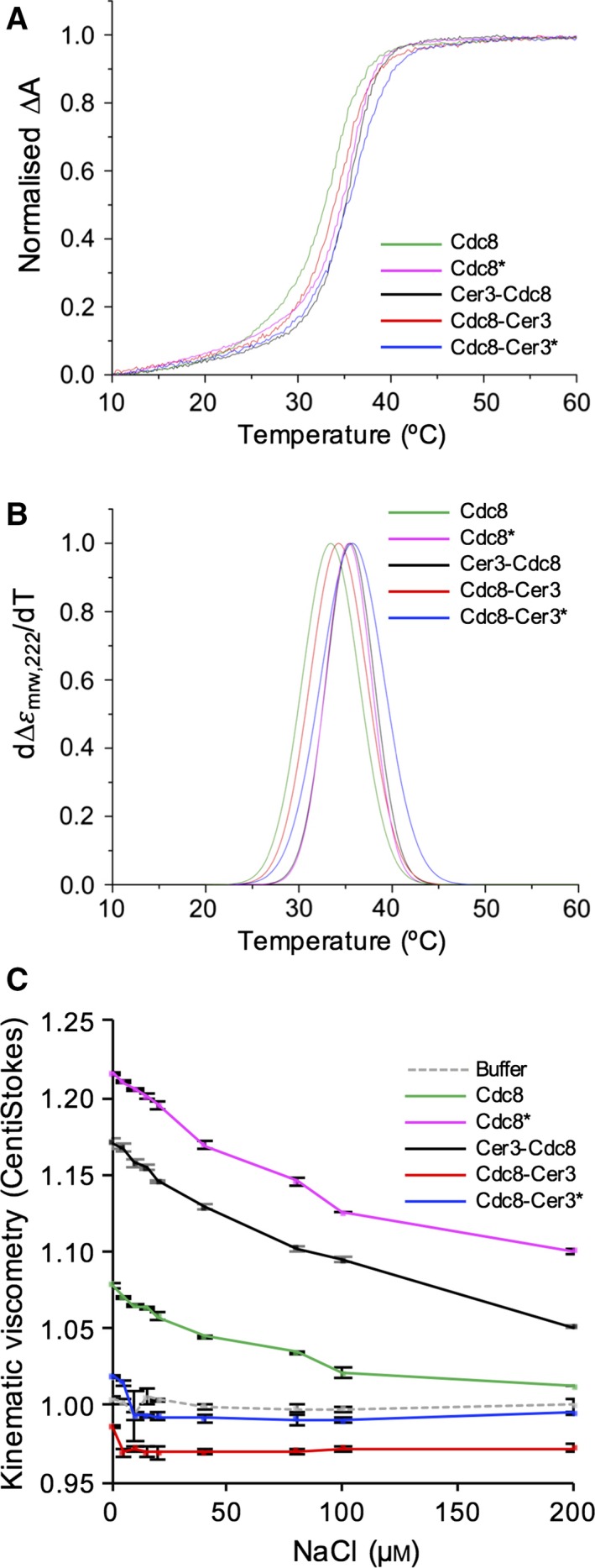
FP Fusions affect Tpm filament formation not themostability. (A) Normalised differential CD absorbance data for unacetylated TpmCdc8 (green), acetylated TpmCdc8 (magenta), Cerulean3–TpmCdc8 (black), aceteylated TpmCdc8–Cerulean3 (blue) and unaceylated TpmCdc8–Cerulean3 (red) at 222 nm. (B) First derivative plots at 222 nm of data described in (A). (C) Viscosity of 20 μm TpmCdc8 proteins and buffer (grey dashed) at increasing NaCl concentrations (0–200 mm) at 23 °C.
Figure 3
Figure 3
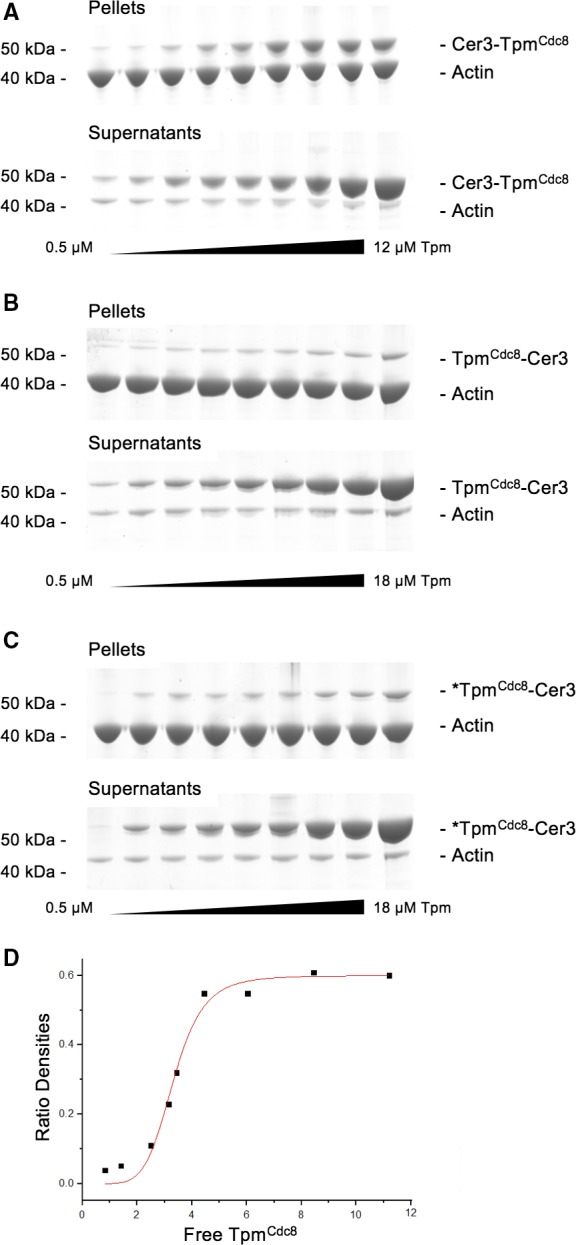
Actin‐binding assays of FP Tpm fusions. SDS/PAGE gels of pellet and supernatant fractions from cosedimentation assays of (A) Cerulean3‐TpmCdc8, (B) TpmCdc8‐Cerulean3 and (C) Nt‐acetylated TpmCdc8‐Cerulean3. (D) Binding curve of the free TpmCdc8 concentration against the ratio of density of actin, for Cerulean3‐TpmCdc8, measured by densitometry of cosedimentation SDS/PAGE gels. Curves represent Hill equation lines of best fit.
Figure 4
Figure 4
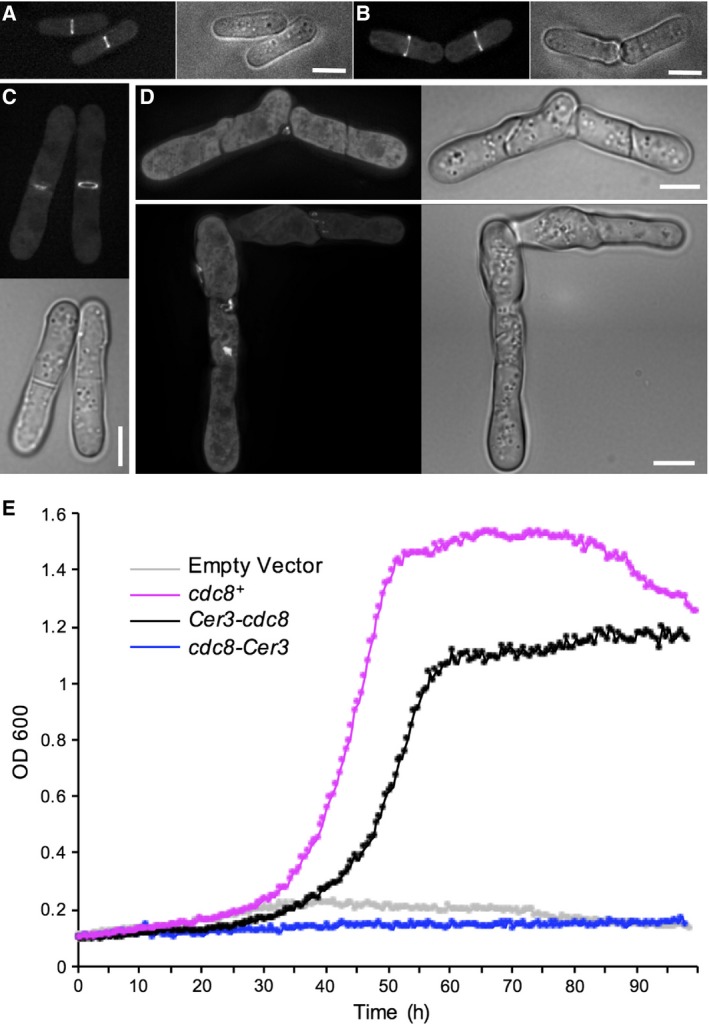
Ability of FP Tpm fusions to associate with and support CAR function. Localisation of Cerulean‐TpmCdc8 (A and C) and TpmCdc8‐Cerulean3 (B and D) in wild‐type (A and B) and cdc8.110 (C and D) cells at at 36 °C. (E) Growth curves of cdc8.110 cells containing plasmids encoding for wild‐type Tpm cdc8+ (magenta), Cerulean3‐Tpm cdc8 (black), Tpm cdc8 ‐Cerulean3 (blue) or an empty vector (grey) cultured at 36 °C. Scale bars: 5 μm.
Figure 5
Figure 5
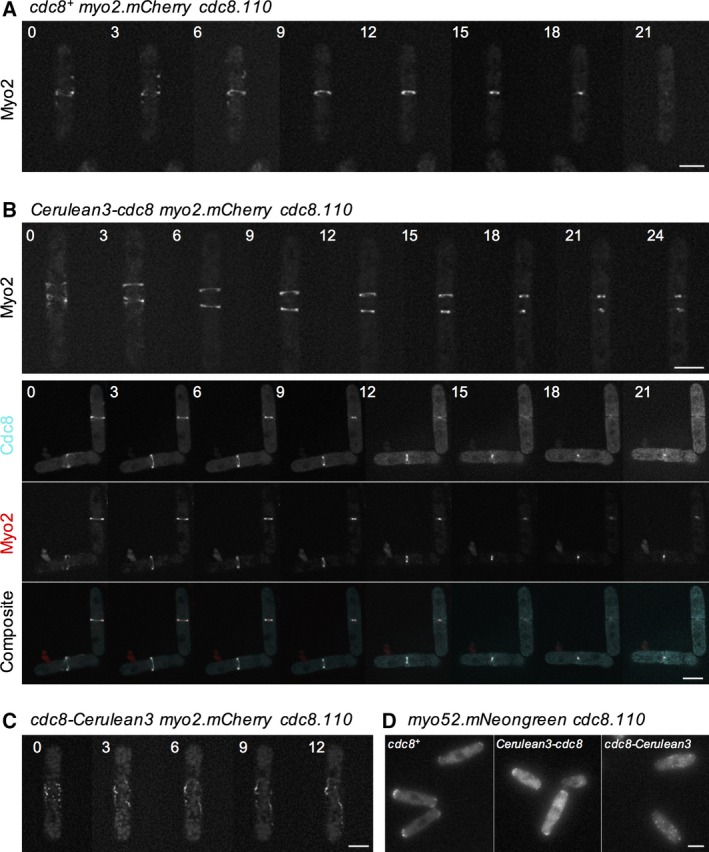
Myosin regulatory function of FP Tpm fusions. Montages of timelapse frames of (A) cdc8.110 myo2.mCherry pREP41Tpm cdc8+, (B) cdc8.110 myo2.mCherry pREP41Cerulean3‐Tpm cdc8, and (C) cdc8.110 myo2.mCherry pREP41Tpm cdc8‐Cerulean3 cells grown at 36 °C. Images show mCherry (A–C) and Cerulean (B‐lower panels) signals Timings are shown in minutes. (D) Micrographs of mNeongreen signal from cdc8.110 myo52.mNeongreen cells expressing different Tpm cdc8 constructs. Scale bars: 5 μm.

References

    1. Pollard TD, Blanchoin L and Mullins RD (2000) Molecular mechanisms controlling actin filament dynamics in nonmuscle cells. Annu Rev Biophys Biomol Struct 29, 545–576. - PubMed
    1. Gunning PW, Schevzov G, Kee AJ and Hardeman EC (2005) Tropomyosin isoforms: divining rods for actin cytoskeleton function. Trends Cell Biol 15, 333–341. - PubMed
    1. Ebashi S and Ebashi F (1964) A new protein component participating in the superprecipitation of myosin B. J Biochem 55, 604–613. - PubMed
    1. Gunning PW, Hardeman EC, Lappalainen P and Mulvihill DP (2015) Tropomyosin – master regulator of actin filament function in the cytoskeleton. J Cell Sci 128, 2965–2974. - PubMed
    1. Brown JH, Kim KH, Jun G, Greenfield NJ, Dominguez R, Volkmann N, Hitchcock‐DeGregori SE and Cohen C (2001) Deciphering the design of the tropomyosin molecule. Proc Natl Acad Sci USA 98, 8496–8501. - PMC - PubMed

MeSH terms