. 2016 Aug 9:7:12451.
doi: 10.1038/ncomms12451.

Association of variations in HLA class II and other loci with susceptibility to EGFR-mutated lung adenocarcinoma

Affiliations

Association of variations in HLA class II and other loci with susceptibility to EGFR-mutated lung adenocarcinoma

Kouya Shiraishi et al. Nat Commun. .

Abstract

Lung adenocarcinoma driven by somatic EGFR mutations is more prevalent in East Asians (30-50%) than in European/Americans (10-20%). Here we investigate genetic factors underlying the risk of this disease by conducting a genome-wide association study, followed by two validation studies, in 3,173 Japanese patients with EGFR mutation-positive lung adenocarcinoma and 15,158 controls. Four loci, 5p15.33 (TERT), 6p21.3 (BTNL2), 3q28 (TP63) and 17q24.2 (BPTF), previously shown to be strongly associated with overall lung adenocarcinoma risk in East Asians, were re-discovered as loci associated with a higher susceptibility to EGFR mutation-positive lung adenocarcinoma. In addition, two additional loci, HLA class II at 6p21.32 (rs2179920; P =5.1 × 10(-17), per-allele OR=1.36) and 6p21.1 (FOXP4) (rs2495239; P=3.9 × 10(-9), per-allele OR=1.19) were newly identified as loci associated with EGFR mutation-positive lung adenocarcinoma. This study indicates that multiple genetic factors underlie the risk of lung adenocarcinomas with EGFR mutations.


Figures
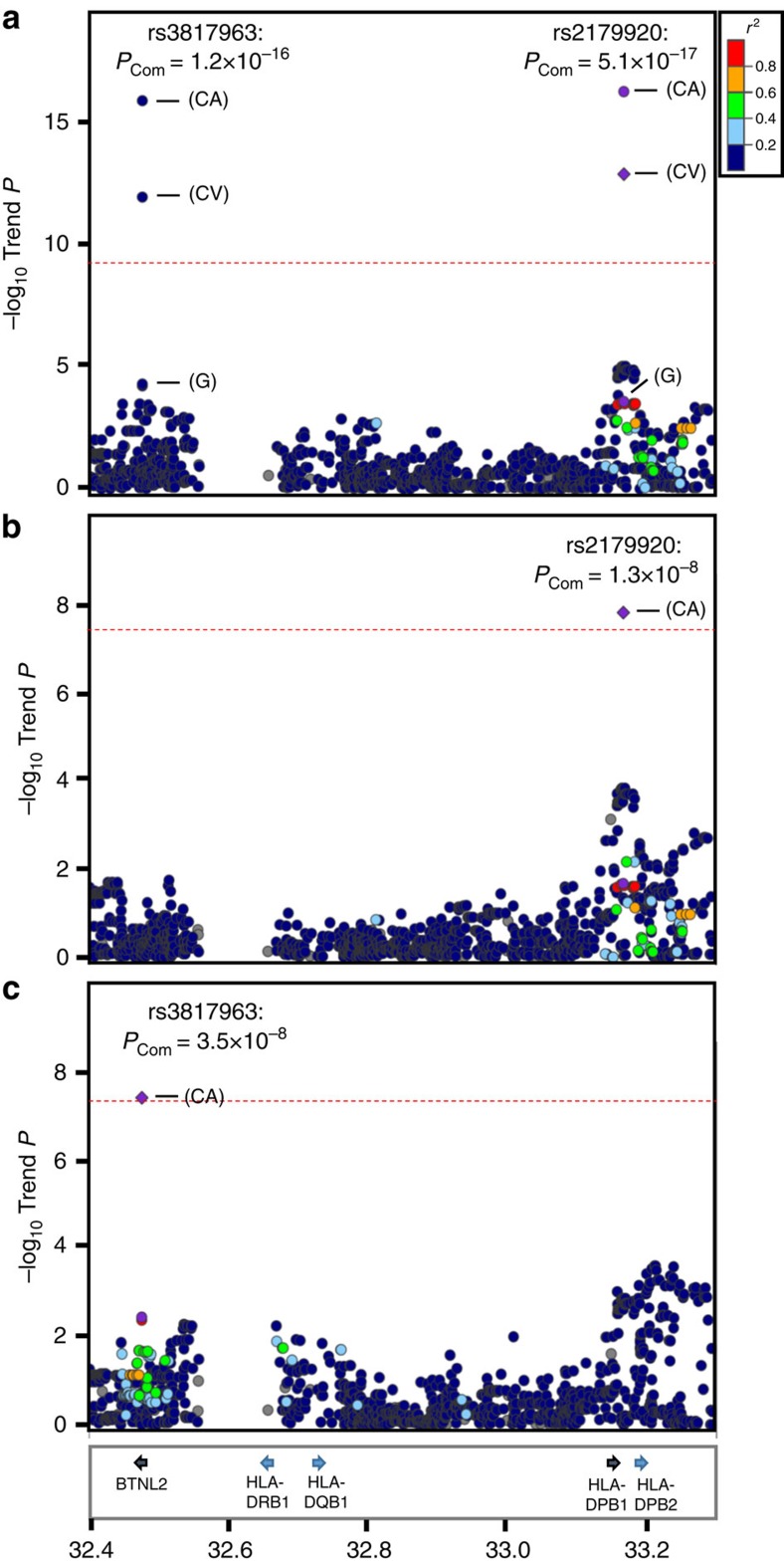
Figure 1
Figure 1. Regional plots of variations in the HLA class II region.
Plots show results of association studies of (a) nominal analysis, (b) conditioned analysis on rs3817963 and (c) conditioned analysis on rs2179920. Red line shows the level of genome-wide significance for association (PTrend<5 × 10⁻⁸). Genes within the region of interest are annotated and are indicated by arrows. The physical positions of the variants in the HLA class II region are shown at the bottom. Circles represent the location and –log10 (PTrend values) of each variant. The –log10PTrend values of the marker SNPs are shown for the GWAS (G), the combined validation study (CV) and the total combined study (CA).
Figure 2
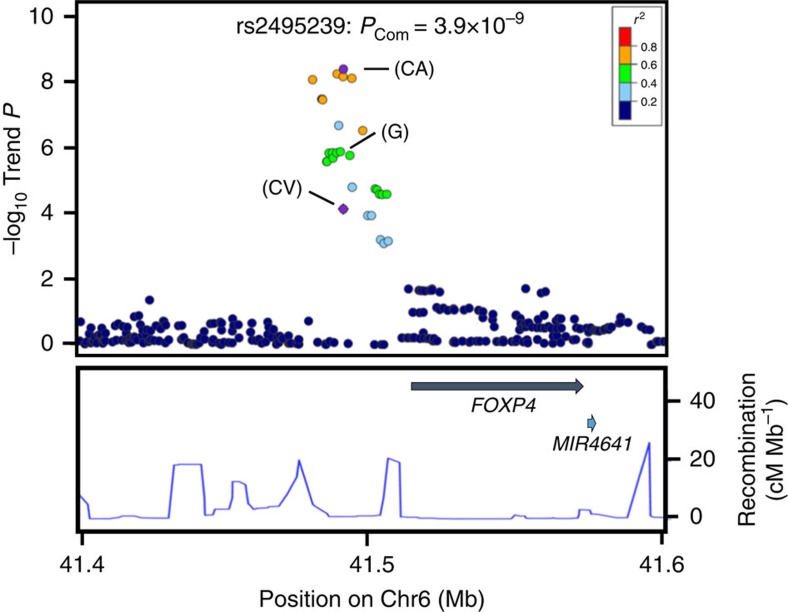
Figure 2. Regional plot of variations in the FOXP4 region.
The marker SNP is shown in purple and the r2 values for the other SNPs are indicated by different colours. Correlations were estimated using data from the 1000 Genomes Project. Genes within the region of interest are annotated and are indicated by arrows. The blue lines indicate the recombination rates in centimorgans (cM) per megabase (Mb). Circles represent the location and –log10 (PTrend values) of each variant. The –log10PTrend values of the marker SNPs are shown for the GWAS (G), the combined validation study (CV) and the total combined study (CA).

References

    1. Clinical Lung Cancer Genome P. Network Genomic M. A genomics-based classification of human lung tumors. Sci. Transl. Med. 5, 209ra153 (2013). - PMC - PubMed
    1. Cancer Genome Atlas Research N. Comprehensive molecular profiling of lung adenocarcinoma. Nature 511, 543–550 (2014). - PMC - PubMed
    1. Kohno T. et al. KIF5B-RET fusions in lung adenocarcinoma. Nat. Med. 18, 375–377 (2012). - PMC - PubMed
    1. Sun S., Schiller J. H. & Gazdar A. F. Lung cancer in never smokers—a different disease. Nat. Rev. Cancer 7, 778–790 (2007). - PubMed
    1. Kohno T. et al. Beyond ALK-RET, ROS1 and other oncogene fusions in lung cancer. Transl. Lung Cancer Res. 4, 156–164 (2015). - PMC - PubMed

Publication types

MeSH terms

Substances