


Iron intakes and status of 2-year-old children in the Cork BASELINE Birth Cohort Study
- PMID: 27501864
- PMCID: PMC6865992
- DOI: 10.1111/mcn.12320
Iron intakes and status of 2-year-old children in the Cork BASELINE Birth Cohort Study
Abstract
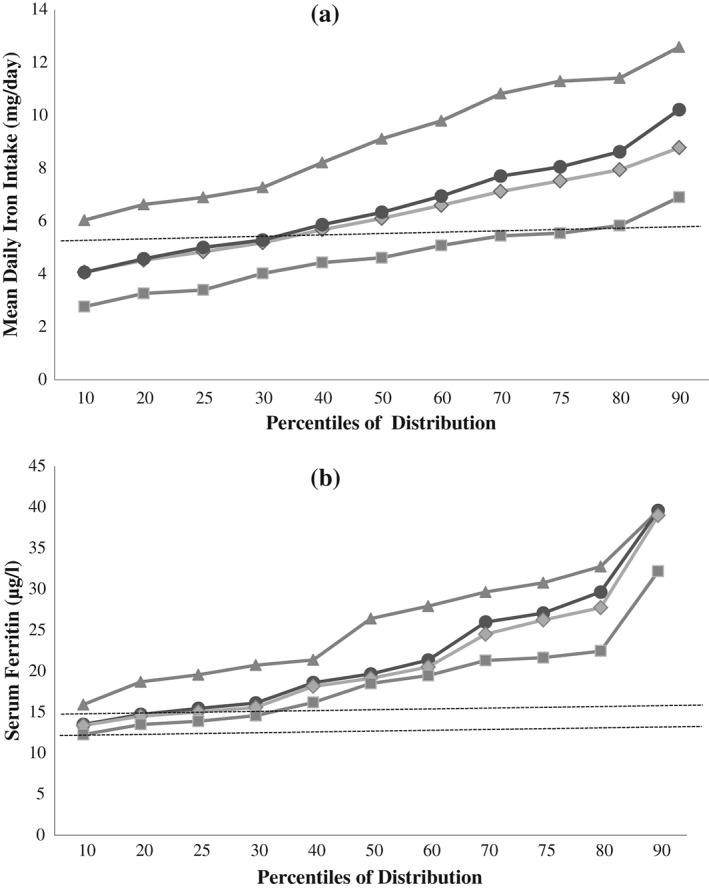
Young children are at risk of iron deficiency and subsequent anaemia, resulting in long-term consequences for cognitive, motor and behavioural development. This study aimed to describe the iron intakes, status and determinants of status in 2-year-old children. Data were collected prospectively in the mother-child Cork BASELINE Birth Cohort Study from 15 weeks' gestation throughout early childhood. At the 24-month assessment, serum ferritin, haemoglobin and mean corpuscular volume were measured, and food/nutrient intake data were collected using a 2-day weighed food diary. Iron status was assessed in 729 children (median [IQR] age: 2.1 [2.1, 2.2] years) and 468 completed a food diary. From the food diary, mean (SD) iron intakes were 6.8 (2.6) mg/day and 30% had intakes < UK Estimated Average Requirement (5.3 mg/day). Using WHO definitions, iron deficiency was observed in 4.6% (n = 31) and iron deficiency anaemia in five children (1.0%). Following an iron series workup, five more children were diagnosed with iron deficiency anaemia. Twenty-one per cent had ferritin concentrations <15 µg/L. Inadequate iron intakes (OR [95% CI]: 1.94 [1.09, 3.48]) and unmodified cows' milk intakes ≥ 400 mL/day (1.95 [1.07, 3.56]) increased the risk of low iron status. Iron-fortified formula consumption was associated with decreased risk (0.21 [0.11, 0.41] P < 0.05). In this, the largest study in toddlers in Europe, a lower prevalence of low iron status was observed than in previous reports. Compliance with dietary recommendations to limit cows' milk intakes in young children and consumption of iron-fortified products appears to have contributed to improved iron status at two years.
Keywords: anaemia; birth cohort; cows' milk consumption; food fortification; iron deficiency; iron intakes.
© 2016 John Wiley & Sons Ltd.
Conflict of interest statement
The authors declare that they have no conflict of interest.
Figures
References
-
- Bates B., Lennox A., Prentice A., Bates C., Page P., Nicholson S. et al (2014) National Diet and Nutrition Survey Results from Years 1, 2, 3 and 4 (combined) of the Rolling Programme (2008/2009 – 2011/2012), The Department of Health and Food Standards Agency.
-
- Black L.J., Ireland J., Møller A., Roe M., Walton J., Flynn A. et al. (2011) Development of an on‐line Irish food composition database for nutrients. Journal of Food Composition and Analysis 24 (7), 1017–1023.
-
- Brotanek J.M., Gosz J., Weitzman M. & Flores G. (2007) Iron deficiency in early childhood in the United States: risk factors and racial/ethnic disparities. Pediatrics 120 (3), 568–575. - PubMed
-
- Capozzi L., Russo R., Bertocco F., Ferrara D. & Ferrara M. (2010) Diet and iron deficiency in the first year of life: a retrospective study. Hematology 15 (6), 410–413. - PubMed
MeSH terms
Substances
LinkOut - more resources
Full Text Sources
Other Literature Sources
Medical
