


Nanometal Skin of Plasmonic Heterostructures for Highly Efficient Near-Field Scattering Probes
- PMID: 27502178
- PMCID: PMC4977468
- DOI: 10.1038/srep31113
Nanometal Skin of Plasmonic Heterostructures for Highly Efficient Near-Field Scattering Probes
Abstract
In this work, atomic force microscopy probes are functionalized by virtue of self-assembling monolayers of block copolymer (BCP) micelles loaded either with clusters of silver nanoparticles or bimetallic heterostructures consisting of mixed species of silver and gold nanoparticles. The resulting self-organized patterns allow coating the tips with a sort of nanometal skin made of geometrically confined nanoislands. This approach favors the reproducible engineering and tuning of the plasmonic properties of the resulting structured tip by varying the nanometal loading of the micelles. The newly conceived tips are applied for experiments of tip-enhanced Raman scattering (TERS) spectroscopy and scattering-type scanning near-field optical microscopy (s-SNOM). TERS and s-SNOM probe characterizations on several standard Raman analytes and patterned nanostructures demonstrate excellent enhancement factor with the possibility of fast scanning and spatial resolution <12 nm. In fact, each metal nanoisland consists of a multiscale heterostructure that favors large scattering and near-field amplification. Then, we verify the tips to allow challenging nongap-TER spectroscopy on thick biosamples. Our approach introduces a synergistic chemical functionalization of the tips for versatile inclusion and delivery of plasmonic nanoparticles at the tip apex, which may promote the tuning of the plasmonic properties, a large enhancement, and the possibility of adding new degrees of freedom for tip functionalization.
Figures
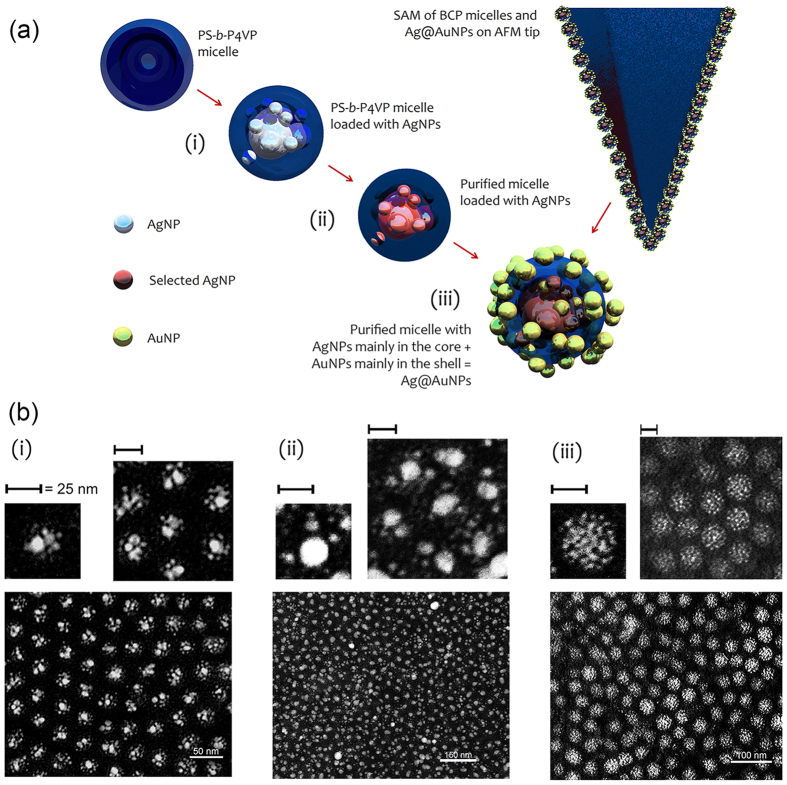
 as Ag@AuNPs). Finally, both solutions of BCP with AgNPs or Ag@AuNPs are used to coat Si-AFM tips by dip coating. (b) TEM micrographs (inverted colormap) of the three steps of the process depicted in panel (a). In particular, the modification of the size of the NPs, evident from the comparison of the consecutive SAMs spin-coated on glass, pointed out the formation of AgNPs of 15–20 nm surrounded by smaller Ag seed satellites in the P4VP core (ii). An outer shell that we ascribe to tiny AuNPs (
 nm) appears in (iii) as described in the main text. Top insets are magnified regions of the corresponding bottom scans. Scalebars are 50, 150 and 100 nm in (i), (ii) and (iii), respectively, whereas scalebar = 25 nm in all top insets.
References
-
- Stöckle R. M., Suh Y. D., Deckert V. & Zenobi R. Nanoscale chemical analysis by tip-enhanced raman spectroscopy. Chem. Phys. Lett. 318, 131–136 (2000).
-
- Zhang R. et al.. Chemical mapping of a single molecule by plasmon-enhanced Raman scattering. Nature 498, 82–86 (2013). - PubMed
-
- De Angelis F. et al.. Nanoscale chemical mapping using three-dimensional adiabatic compression of surface plasmon polaritons. Nat. Nanotech. 5, 67–72 (2010). - PubMed
-
- Van Schrojenstein Lantman E. M., Deckert-Gaudig T., Mank A. J. G., Deckert V. & Weckhuysen B. M. Catalytic processes monitored at the nanoscale with tip-enhanced Raman spectroscopy. Nat. Nanotech. 7, 583–586 (2012). - PubMed
Publication types
LinkOut - more resources
Full Text Sources
Other Literature Sources
Miscellaneous
