


The underestimated biodiversity of tropical grassy biomes
- PMID: 27502382
- PMCID: PMC4978875
- DOI: 10.1098/rstb.2015.0319
The underestimated biodiversity of tropical grassy biomes
Abstract
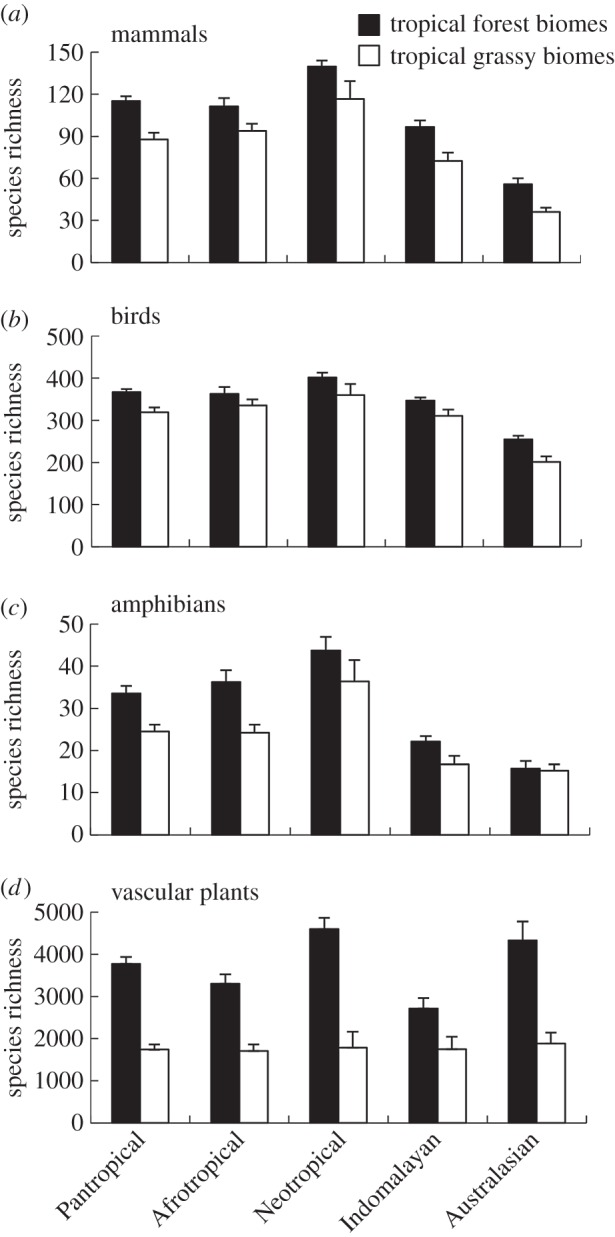
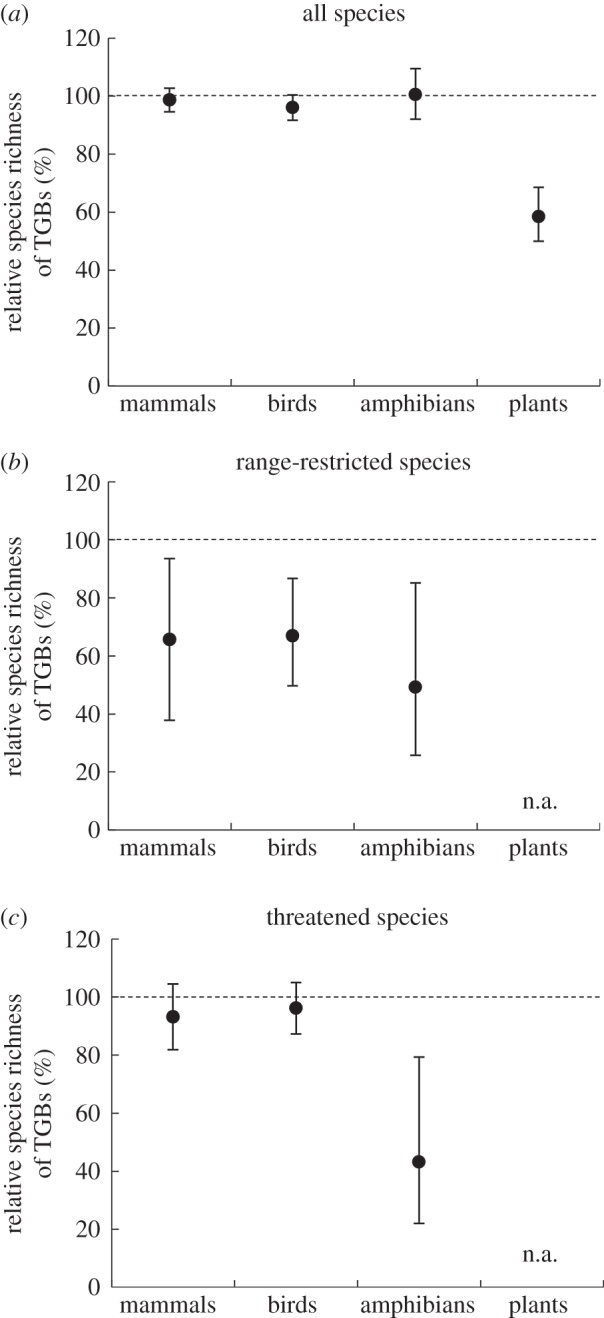
For decades, there has been enormous scientific interest in tropical savannahs and grasslands, fuelled by the recognition that they are a dynamic and potentially unstable biome, requiring periodic disturbance for their maintenance. However, that scientific interest has not translated into widespread appreciation of, and concern about threats to, their biodiversity. In terms of biodiversity, grassy biomes are considered poor cousins of the other dominant biome of the tropics-forests. Simple notions of grassy biomes being species-poor cannot be supported; for some key taxa, such as vascular plants, this may be valid, but for others it is not. Here, we use an analysis of existing data to demonstrate that high-rainfall tropical grassy biomes (TGBs) have vertebrate species richness comparable with that of forests, despite having lower plant diversity. The Neotropics stand out in terms of both overall vertebrate species richness and number of range-restricted vertebrate species in TGBs. Given high rates of land-cover conversion in Neotropical grassy biomes, they should be a high priority for conservation and greater inclusion in protected areas. Fire needs to be actively maintained in these systems, and in many cases re-introduced after decades of inappropriate fire exclusion. The relative intactness of TGBs in Africa and Australia make them the least vulnerable to biodiversity loss in the immediate future. We argue that, like forests, TGBs should be recognized as a critical-but increasingly threatened-store of global biodiversity.This article is part of the themed issue 'Tropical grassy biomes: linking ecology, human use and conservation'.
Keywords: biodiversity conservation; diversity; grassland; rainforest; tropical forest; tropical savannah.
© 2016 The Author(s).
Figures
References
-
- Udvardy M. 1975. A classification of the biogeographical provinces of the world. Morges, Switzerland: International Union for Conservation of Nature.
-
- Center for International Earth Science Information Network - CIESIN - Columbia University, a.C.I.d.A.T.-C. 2005. Gridded Population of the World, Version 3 (GPWv3): Population Density Grid. Palisades, NY: NASA Socioeconomic Data and Applications Center.
-
- World Conservation Union and UNEP World Conservation Monitoring Centre. 2016. World database on protected areas. Cambridge, UK: UNEP World Conservation Monitoring Centre.
-
- IUCN and UNEP-WCMC. 2016. The world database on protected areas (WDPA). Cambridge, UK: UNEP World Conservation Monitoring Centre.
Publication types
MeSH terms
LinkOut - more resources
Full Text Sources
Other Literature Sources
