. 2016 Aug 9:6:30169.
doi: 10.1038/srep30169.

Cranberry-derived proanthocyanidins impair virulence and inhibit quorum sensing of Pseudomonas aeruginosa

Affiliations

Cranberry-derived proanthocyanidins impair virulence and inhibit quorum sensing of Pseudomonas aeruginosa

Vimal B Maisuria et al. Sci Rep. .

Abstract

Bacteria have evolved multiple strategies for causing infections that include producing virulence factors, undertaking motility, developing biofilms, and invading host cells. N-acylhomoserine lactone (AHL)-mediated quorum sensing (QS) tightly regulates the expression of multiple virulence factors in the opportunistic pathogenic bacterium Pseudomonas aeruginosa. Thus, inhibiting QS could lead to health benefits. In this study, we demonstrate an anti-virulence activity of a cranberry extract rich in proanthocyanidins (cerPAC) against P. aeruginosa in the model host Drosophila melanogaster and show this is mediated by QS interference. cerPAC reduced the production of QS-regulated virulence determinants and protected D. melanogaster from fatal infection by P. aeruginosa PA14. Quantification of AHL production using liquid chromatography-mass spectrometry confirmed that cerPAC effectively reduced the level of AHLs produced by the bacteria. Furthermore, monitoring QS signaling gene expression revealed that AHL synthases LasI/RhlI and QS transcriptional regulators LasR/RhlR genes were inhibited and antagonized, respectively, by cerPAC. Molecular docking studies suggest that cranberry-derived proanthocyanidin binds to QS transcriptional regulators, mainly interacting with their ligand binding sites. These findings provide insights into the underlying mechanisms of action of a cerPAC to restrict the virulence of P. aeruginosa and can have implications in the development of alternative approaches to control infections.


Figures
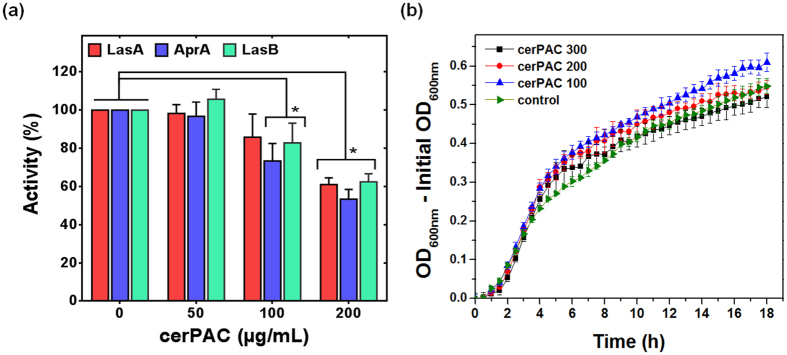
Figure 1
Figure 1
(a) Inhibition of virulence determinants and (b) growth curves of P. aeruginosa PA14 in absence or presence of different cerPAC concentrations. LasA: staphylolytic protease, LasB: elastase and AprA: alkaline protease. Results are expressed as means and standard deviations (SD) of triplicate enzyme assays (*p < 0.001). Bacterial growth (OD600) was monitored at 37 °C for 18 h in TSB medium. Error bars with average data points of growth kinetics represent the standard deviation of values obtained from four replicates. Abbreviations: cerPAC x, Cranberry extract rich in proanthocyanidins at x μg mL−1 (e.g., cerPAC 300 indicates cerPAC at 300 μg mL−1).
Figure 2
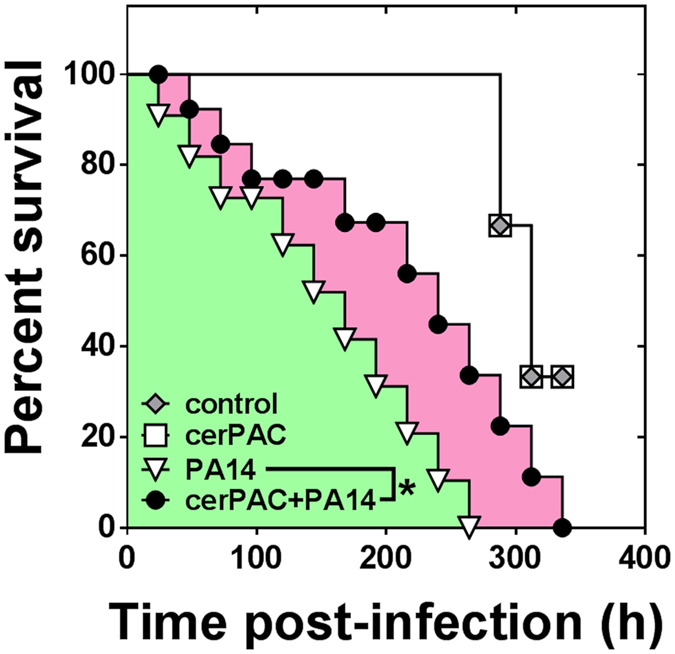
Figure 2. Virulence of P. aeruginosa PA14 towards D. melanogaster in absence or presence of cerPAC (200 μg mL−1).
Mortality was scored daily for 14 days. Results represent measurements from experiments performed with triplicates, twice (*p < 0.05).
Figure 3
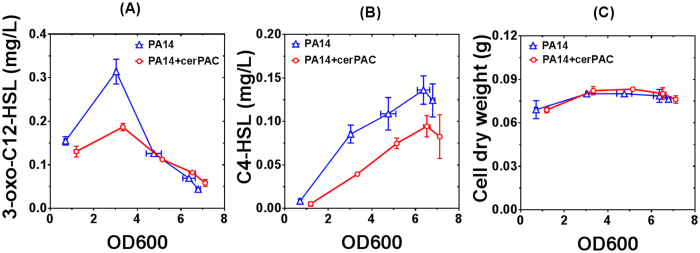
Figure 3. cerPAC (200 μg mL−1) impairs the production of AHL-type QS molecules in P. aeruginosa PA14.
Concentrations of (A) 3-oxo-dodecanoyl-homoserine lactone (3-oxo-C12-HSL), and (B) butanoyl-homoserine lactone (C4-HSL) are shown as a function of cell growth (OD600). (C) Total cell dry weight of 3 mL culture is shown as a function of cell growth (OD600). Data points represent the average of triplicate experiments and the error bars show the standard deviation.
Figure 4
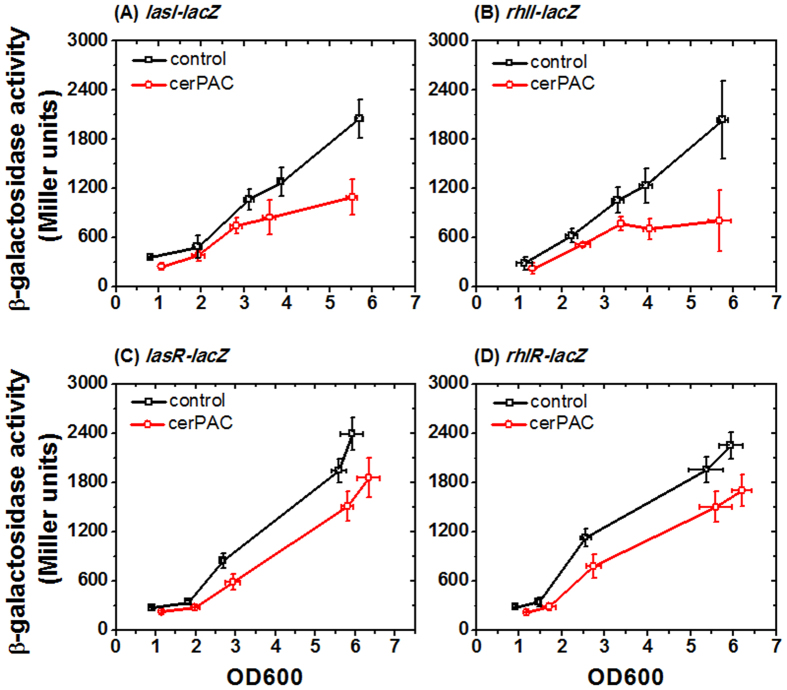
Figure 4. Effect of cerPAC on the expression of quorum sensing genes.
P. aeruginosa PA14 carrying reporter fusion plasmids (A) lasI-lacZ (B) rhlI-lacZ, (C) lasR-lacZ and (D) rhlR-lacZ were grown in TSB medium without or with 200 μg mL−1 cerPAC, and expression was quantified by measuring β-galactosidase activity. Data points represent the average of triplicate experiments. The error bars show the standard deviation.
Figure 5
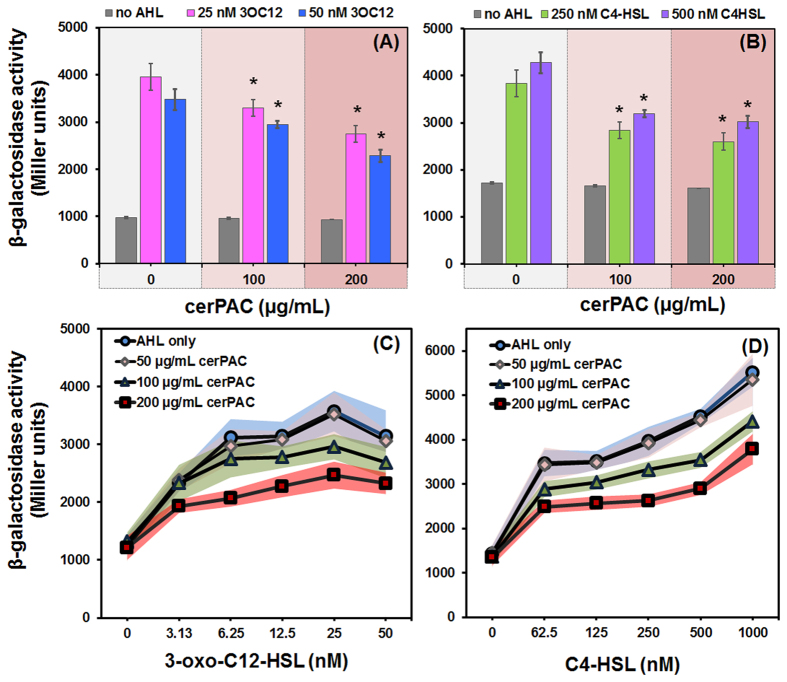
Figure 5. cerPAC represses AHL induction of LasR- and RhlR-controlled regulation in P. aeruginosa PA14.
(A) LasR activation of lasI-lacZ activity in ∆lasI- mutant of PA14, (B) RhlR activation of rhlI-lacZ activity in ∆rhlI- mutant of PA14. Titration for activation of (C) lasI-lacZ in ∆lasI- mutant of PA14 and (D) rhlI-lacZ in ∆rhlI- mutant of PA14 in absence and presence of cerPAC. Error bars (A,B) and shaded errors (C,D) represent SD of triplicate assays. Statistically significant differences are indicated for each sample treated with cerPAC and each autoinducer compared to the sample treated with the corresponding concentration of each autoinducer (*p < 0.05).
Figure 6
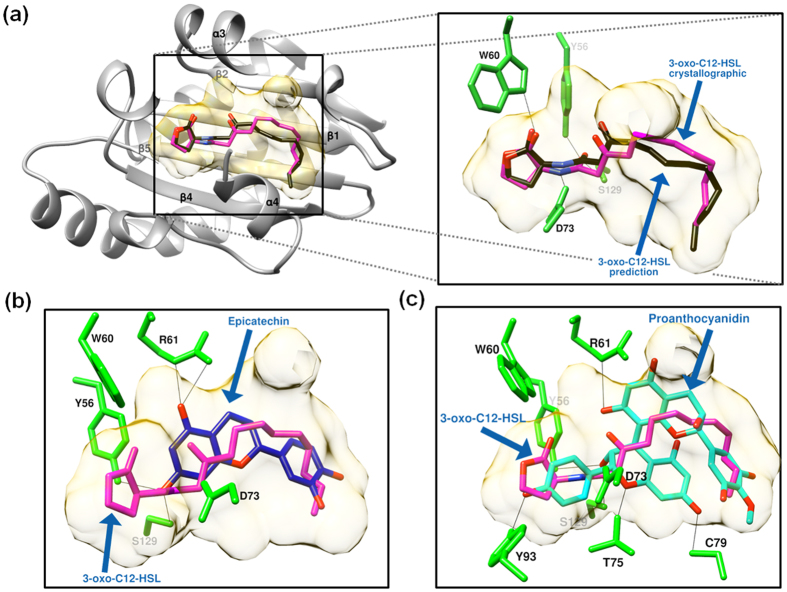
Figure 6. Molecular docking analysis of the LasR protein with AHL molecule and two main components of the cerPAC.
(a) Left panel represents full view of the ribbon structure of LasR protein with the ligand binding cavity (highlighted in golden color) between four β-sheets (β1, β2, β4 and β5) and two α-helixes (α3 and α4). Upper right panel represents the inset view of docked complex with known binding position (reported crystallographic structure) of ligand 3-oxo-C12-HSL (shown in magenta color) and the predicted binding position of 3-oxo-C12-HSL (shown in black color) during in silico docking. The docking complexes of LasR with (b) the monomer of epicatechin (shown in blue color) and (c) the dimeric form of the epicatechin (proanthocyanidin, shown in green aqua color) are shown in the presence of 3-oxo-C12-HSL (shown in magenta color) for the comparison of binding positions. All possible hydrogen bonds are shown using black lines and binding residues shown in bright green color.
Figure 7
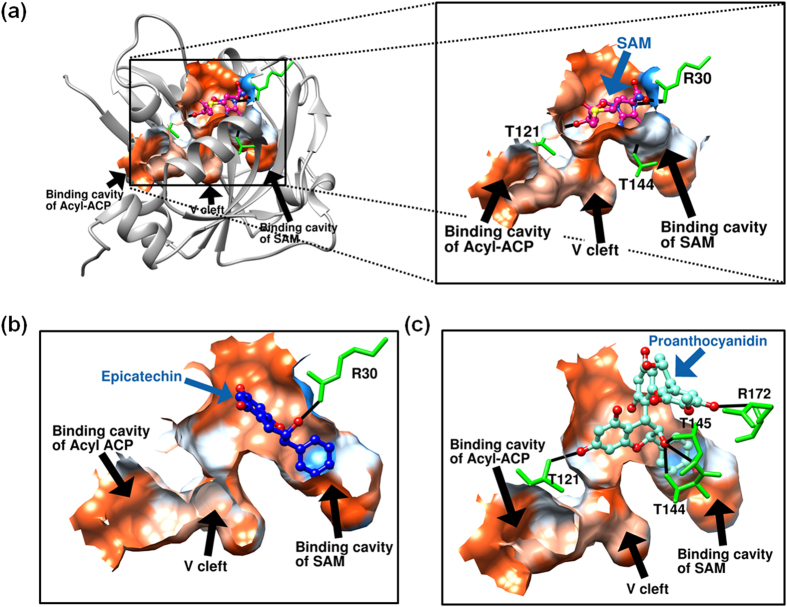
Figure 7. Molecular docking analysis of the LasI protein with substrate S-adenosyl L methionine (SAM) and two main components of the cerPAC.
(a) Left panel represents full view of the ribbon structure of LasI protein with its substrates binding cavities and right panel represents the inset view of docked complex with substrate SAM (shown in magenta color). The docking complexes of LasI with (b) the monomer of epicatechin (shown in blue color) and (c) the dimeric form of the epicatechin (proanthocyanidin, shown in green aqua color) are shown with predicted binding residues (shown in bright green color). The surface structures are shown in red and blue for hydrophobic and hydrophilic attributes, respectively, and possible hydrogen bonds are depicted using black lines.
Figure 8
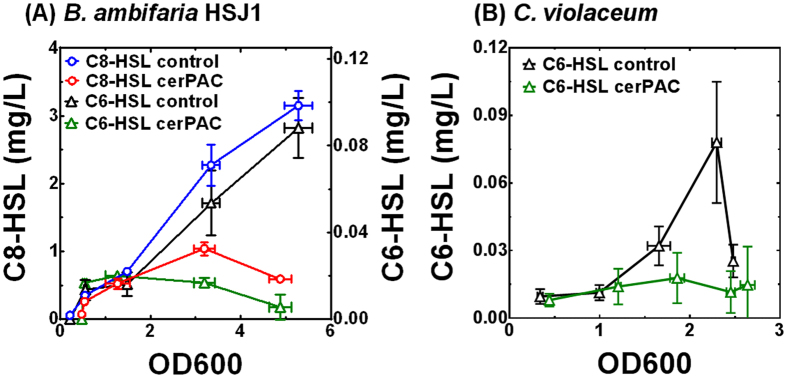
Figure 8. cerPAC (200 μg mL−1) impairs production of AHL-type QS molecules in wild type strains B. ambifaria HSJ1 and C. violaceum.
Concentrations of (A) N-octanoyl-homoserine lactone (C8-HSL) and N-hexanoyl-homoserine lactone (C6-HSL) in B. ambifaria HSJ1, and (B) N-hexanoyl-homoserine lactone (C6-HSL) in C. violaceum are shown as a function of cell growth (OD600). Results are expressed as average and standard deviations (SD) from values obtained from three replications.

References

    1. Lesic B. et al. Inhibitors of pathogen intercellular signals as selective anti-infective compounds. PLoS Pathog. 3, 1229–1239 (2007). - PMC - PubMed
    1. Shryock T. R. The future of anti-infective products in animal health. Nat Rev Micro. 2, 425–430 (2004). - PubMed
    1. Berdy J. Thoughts and facts about antibiotics: where we are now and where we are heading. J Antibiot (Tokyo) 65, 385–395 (2012). - PubMed
    1. Jakobsen T. H., Bjarnsholt T., Jensen P. O., Givskov M. & Hoiby N. Targeting quorum sensing in Pseudomonas aeruginosa biofilms: current and emerging inhibitors. Future Microbiol. 8, 901–921 (2013). - PubMed
    1. Blatherwick N. R. The specific role of foods in relation to the composition of the urine. Arch Intern Med. 14, 409–450 (1914).

Publication types

MeSH terms

LinkOut - more resources