. 2016 Aug 8;11(1):89.
doi: 10.1186/s13018-016-0423-9.

Kinematics of anterior cruciate ligament-deficient knees in a Chinese population during stair ascent

Affiliations

Kinematics of anterior cruciate ligament-deficient knees in a Chinese population during stair ascent

Chang Zhao et al. J Orthop Surg Res. .

Abstract

Background: The purpose of this study was to measure the tibiofemoral kinematics of anterior cruciate ligament (ACL) deficiency in a Chinese population and compare the kinematics with published data about a Caucasian population.

Methods: Unilateral knees of 18 Chinese ACL-deficient (ACL-D) subjects were studied while subjects ascended stairs. Kinematic alteration was compared between ACL-D knees and contralateral ACL-intact (ACL-I) knees. The kinematic alteration of ACL deficiency was also compared between the Chinese population and published data about a Caucasian population.

Results: A statistical difference was found in the three-dimensional rotations between ACL-D and ACL-I knees. In the sagittal plane, ACL-I knees had a larger flexion angle than ACL-D knees during 40 to 50 % of the activity during stair ascent (P < 0.027) and throughout the gait cycle. A significant difference in rotational motion between ACL-D and ACL-I knees was also observed in the frontal plane during 40 to 60 % (P < 0.017) of the activity and in the transverse plane during 70 to 80 % (P < 0.028) of the activity. A greater tibial varus was demonstrated in the Chinese population while the published data revealed external tibial rotation and a statistical difference in translation in the Caucasian population.

Conclusions: ACL-D knees show different kinematics than ACL-I knees in the Chinese population. ACL-I knees had a larger flexion angle than ACL-D knees in the middle stage of the activity during stair ascent. A significant difference in rotational motion between ACL-D and ACL-I knees was also observed in the frontal plane during the middle phase and in the transverse plane during the terminal phase of the activity. A greater tibial varus was demonstrated in the Caucasian population while the published data revealed external tibial rotation and a statistical difference in translation in the Caucasian population.

Keywords: Anterior cruciate ligament; Chinese; Gait; Kinematics; Knee.


Figures

Fig. 1
Fig. 1
a Measurement of in vivo knee kinematics during ascending stairs by single fluoroscopic imaging system. b Virtual reproduction of tibiofemoral kinematics during ascending stairs
Fig. 2
Fig. 2
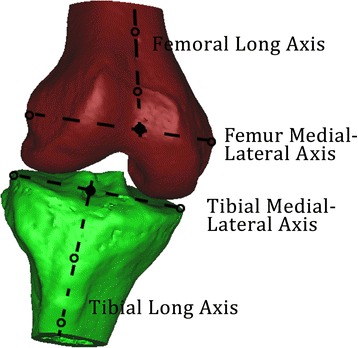
Definition of local femur and tibia coordinate systems. In the femur, the first two points were the prominent points of the medial and lateral femoral epicondyles. The other two points were located paralleling to the wall of the femur shaft. The transepicondylar line was obtained by linking the most pivot points on the medial and lateral condyles. The femoral origin was located at the midpoint of the transepicondylar axis. The line that is parallel to the shaft of the femur was defined as the long axis of the femur. In the tibia, the first two points were the most pivot points on the medial and lateral tibia plateau. The other two points were located paralleling to the wall of the tibia shaft. The line connecting to the most pivot points on the medial and lateral tibia plateau was defined as the medial-lateral axis, and the midpoint of this line was defined as the origin of the tibial coordinate system. The line that is parallel to the shaft of the femur was defined as the long axis of the femur. Tibiofemoral rotation and translation was defined as the motion of the femoral center move with respect to the origin in the tibial coordinate system
Fig. 3
Fig. 3
Tibiofemoral kinematics (rotations) of healthy and ACL-deficient knees during ascending stairs. The values represent the motion of the femur with respect to the tibia. Asterisk denotes statistically significant difference at P < 0.05
Fig. 4
Fig. 4
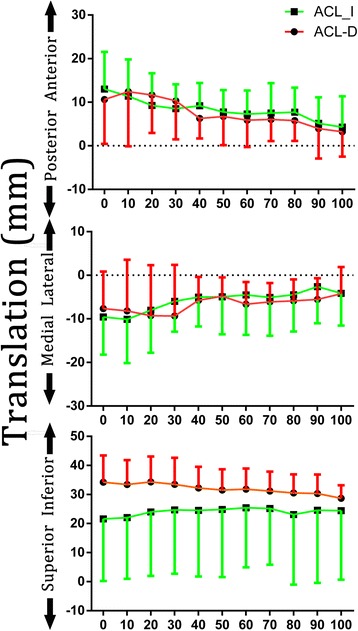
Tibiofemoral kinematics (translations) of healthy and ACL-deficient knees during ascending stairs. The values represent the motion of the femur with respect to the tibia. Asterisk denotes statistically significant difference at P < 0.05

References

    1. Andriacchi TP, Dyrby CO. Interactions between kinematics and loading during walking for the normal and ACL deficient knee. J Biomech. 2005;38(2):293–8. doi: 10.1016/j.jbiomech.2004.02.010. - DOI - PubMed
    1. Andriacchi TP, Mundermann A. The role of ambulatory mechanics in the initiation and progression of knee osteoarthritis. Curr Opin Rheumatol. 2006;18(5):514–8. doi: 10.1097/01.bor.0000240365.16842.4e. - DOI - PubMed
    1. Astephen JL, Deluzio KJ, Caldwell GE, Dunbar MJ, Hubley-Kozey CL. Gait and neuromuscular pattern changes are associated with differences in knee osteoarthritis severity levels. J Biomech. 2008;41(4):868–76. doi: 10.1016/j.jbiomech.2007.10.016. - DOI - PubMed
    1. Beard DJ, Soundarapandian RS, O’Connor JJ, Dodd CAF. Gait and electromyographic analysis of anterior cruciate ligament deficient subjects. Gait Posture. 1996;4(2):83–8. doi: 10.1016/0966-6362(95)01036-X. - DOI
    1. Besier TF, Lloyd DG, Cochrane JL, Ackland TR. External loading of the knee joint during running and cutting maneuvers. Med Sci Sports Exerc. 2001;33(7):1168–75. doi: 10.1097/00005768-200107000-00014. - DOI - PubMed

LinkOut - more resources