


Immunization in the United States: Recommendations, Barriers, and Measures to Improve Compliance: Part 2: Adult Vaccinations
- PMID: 27504066
- PMCID: PMC4959618
Item in Clipboard
Immunization in the United States: Recommendations, Barriers, and Measures to Improve Compliance: Part 2: Adult Vaccinations
P T.
2016 Aug.
Abstract
Despite annual recommendations, American adults remain inadequately vaccinated. The author outlines how compliance may be improved through health care professional interventions, as well as government and community-based programs.
Figures
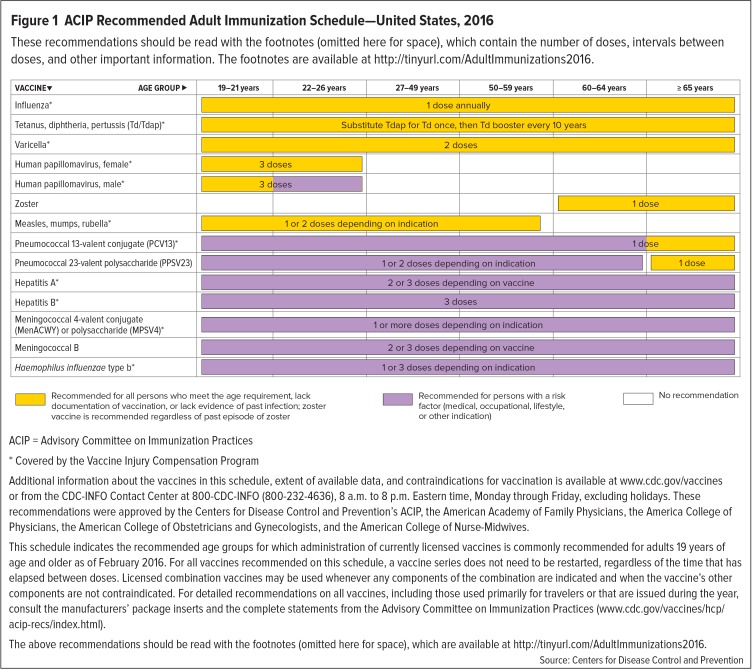
ACIP Recommended Adult Immunization Schedule—United States, 2016 These recommendations should be read with the footnotes (omitted here for space), which contain the number of doses, intervals between doses, and other important information. The footnotes are available at http://tinyurl.com/AdultImmunizations2016 . ACIP = Advisory Committee on Immunization Practices * Covered by the Vaccine Injury Compensation Program Additional information about the vaccines in this schedule, extent of available data, and contraindications for vaccination is available at www.cdc.gov/vaccines or from the CDC-INFO Contact Center at 800-CDC-INFO (800-232-4636), 8 a.m. to 8 p.m. Eastern time, Monday through Friday, excluding holidays. These recommendations were approved by the Centers for Disease Control and Prevention’s ACIP, the American Academy of Family Physicians, the America College of Physicians, the American College of Obstetricians and Gynecologists, and the American College of Nurse-Midwives. This schedule indicates the recommended age groups for which administration of currently licensed vaccines is commonly recommended for adults 19 years of age and older as of February 2016. For all vaccines recommended on this schedule, a vaccine series does not need to be restarted, regardless of the time that has elapsed between doses. Licensed combination vaccines may be used whenever any components of the combination are indicated and when the vaccine’s other components are not contraindicated. For detailed recommendations on all vaccines, including those used primarily for travelers or that are issued during the year, consult the manufacturers’ package inserts and the complete statements from the Advisory Committee on Immunization Practices (www.cdc.gov/vaccines/hcp/acip-recs/index.html ). The above recommendations should be read with the footnotes (omitted here for space), which are available at http://tinyurl.com/AdultImmunizations2016 . Source: Centers for Disease Control and Prevention
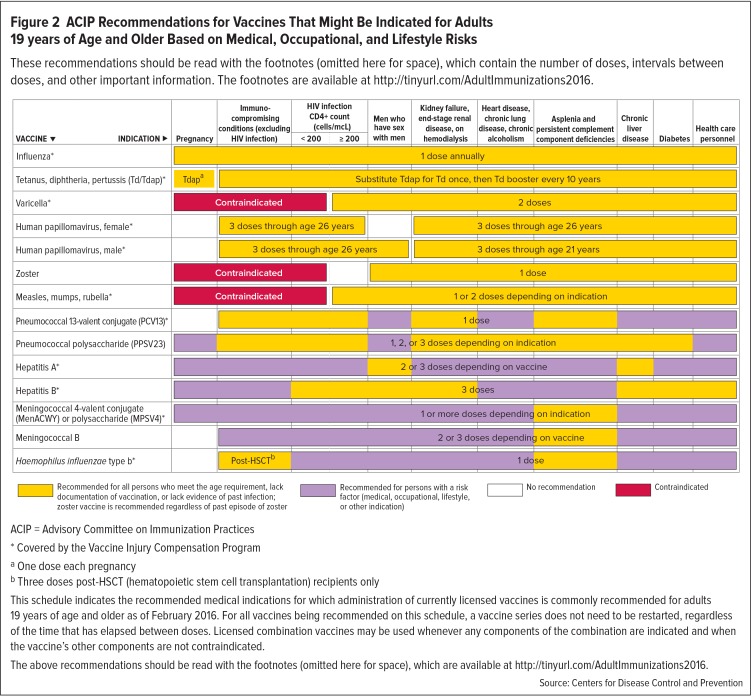
ACIP Recommendations for Vaccines That Might Be Indicated for Adults 19 years of Age and Older Based on Medical, Occupational, and Lifestyle Risks These recommendations should be read with the footnotes (omitted here for space), which contain the number of doses, intervals between doses, and other important information. The footnotes are available at http://tinyurl.com/AdultImmunizations2016 . ACIP = Advisory Committee on Immunization Practices * Covered by the Vaccine Injury Compensation Program aOne dose each pregnancy bThree doses post-HSCT (hematopoietic stem cell transplantation) recipients only This schedule indicates the recommended medical indications for which administration of currently licensed vaccines is commonly recommended for adults 19 years of age and older as of February 2016. For all vaccines being recommended on this schedule, a vaccine series does not need to be restarted, regardless of the time that has elapsed between doses. Licensed combination vaccines may be used whenever any components of the combination are indicated and when the vaccine’s other components are not contraindicated. The above recommendations should be read with the footnotes (omitted here for space), which are available at http://tinyurl.com/AdultImmunizations2016 . Source: Centers for Disease Control and Prevention
References
-
- Oldfield BJ, Stewart RW. Common misconceptions, advancements, and updates in pediatric vaccine administration. South Med J. 2016;109(1):38–41. - PubMed
-
- Williams DM, Weber DJ. Improving adult immunization across the continuum of care: making the most of opportunities in the ambulatory care setting. 50th American Society of Health-System Pharmacists Midyear Clinical Meeting and Exhibition; New Orleans, Louisiana. December 8, 2015; Available at: www.cemidday.com/handout-immunization.pdf. Accessed March 31, 2015.
-
- Poland GA, Schaffner W, Hopkins RH., Jr Immunization guidelines in the United States: new vaccines and new recommendations for children, adolescents, and adults. Vaccine. 2013;31(42):4689–4693. - PubMed
-
- Esposito S, Durando P, Bosis S, et al. Vaccine-preventable diseases: from paediatric to adult targets. Eur J Intern Med. 2014;25(3):203–212. - PubMed
LinkOut - more resources
Full Text Sources