


Effect of Gestational Diabetes on Purkinje and Granule Cells Distribution of the Rat Cerebellum in 21 and 28 days of Postnatal Life
- PMID: 27504151
- PMCID: PMC4741272
Effect of Gestational Diabetes on Purkinje and Granule Cells Distribution of the Rat Cerebellum in 21 and 28 days of Postnatal Life
Abstract
Introduction: Diabetes mellitus is associated with nervous system alterations in both human and animal models. This study was done to determine the effect of gestational diabetes on the Purkinje and granular cells in the cerebellum of rat offspring.
Methods: 10 Wistar rats Dams were randomly allocated in control and diabetic group. The experimental group received 40 mg/kg/body weight of streptozotocin (STZ) at the first day of gestation and control groups received saline injection intraperitoneally (IP). Six male offsprings of gestational diabetic mothers and control dams, at the 21, 28 postnatal days were randomly scarified and coronal sections of cerebellum (6 micrometer) serially collected. The neurons were stained with cresyl violet.
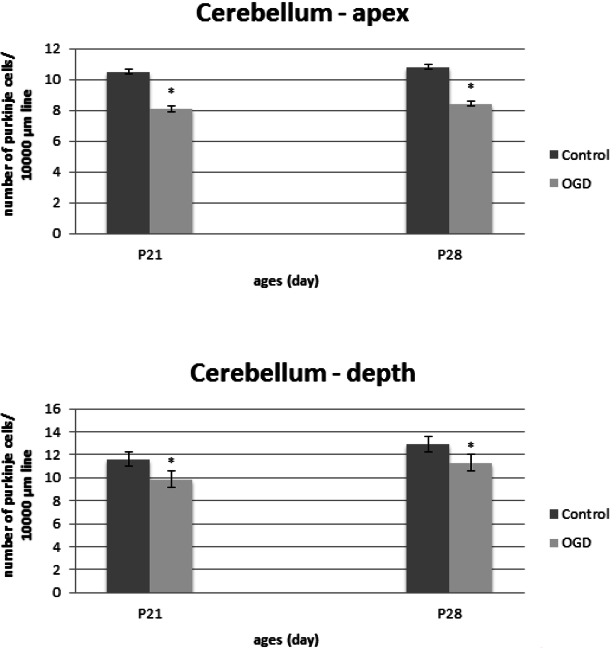
Results: The Purkinje cells density in the apex and depth of cerebellum in P21, in the experimental group was reduced 23% and 15% in comparison with the control group (P<0.001). The granular cells density in the experimental group was reduced 19.58% and 18.3% in comparison with the controls (P<0.001). The Purkinje cells density of cerebellum in P28, in the diabetic group reduced to 22.12% and 12.62% in comparison with the control group (P<0.001). The granular cells density in the diabetic group reduced 17.14% and 16.12% in comparison with the control group (P<0.001).
Discussion: The Purkinje and granular cells significantly reduced in gestational diabetes rat offspring.
Keywords: Cerebellum; Gestational diabetes; Granular cell; Purkinje cell; Rat.
Figures
References
-
- Ahmadpour S. H., Haghir H. (2011). Diabetes mellitus type 1 induces dark neuron formation in the dentate gyrus: a study by Gallyas’ method and transmission electron microscopy. Romanian Journal of Morphology and Embryology, 52 (2), 575– 579. - PubMed
-
- Allen D. A., Yaqoob M. M., Harwood S. M. (2005). Mechanisms of high glucose induced apoptosis and its relationship to diabetic complications. Journal of Nutritional Biochemistry, 16 (12), 705– 713. - PubMed
-
- Beauquis J., Roig P., Homo-Delarche F., De Nicola A., Saravia F. (2006). Reduced hippocampal neurogenesis and number of hilarneurones in streptozotocin-induced diabetic mice: reversion by antidepressant treatment. European Journal of Neuroscience, 23 (6), 1539– 1546. - PubMed
-
- Biessels G. J., Heide L. P. V., Kamal A., Bleys R. L. A. W., Gispen W. H. (2002). Ageing and diabetes: implications for brain function. European Journal of Pharmacology, 441, 1– 14. - PubMed
-
- Chen G., Goeddel D. V. (2002). TNF-R1 signaling: a beautiful pathway. Science, 296 (5573), 1634– 1635. - PubMed
LinkOut - more resources
Full Text Sources
Miscellaneous