. 2016 Jul 27;2(7):476-82.
doi: 10.1021/acscentsci.6b00150. Epub 2016 Jul 13.

In Vivo Bioorthogonal Chemistry Enables Local Hydrogel and Systemic Pro-Drug To Treat Soft Tissue Sarcoma

Affiliations

In Vivo Bioorthogonal Chemistry Enables Local Hydrogel and Systemic Pro-Drug To Treat Soft Tissue Sarcoma

Jose M Mejia Oneto et al. ACS Cent Sci. .

Abstract

The ability to activate drugs only at desired locations avoiding systemic immunosuppression and other dose limiting toxicities is highly desirable. Here we present a new approach, named local drug activation, that uses bioorthogonal chemistry to concentrate and activate systemic small molecules at a location of choice. This method is independent of endogenous cellular or environmental markers and only depends on the presence of a preimplanted biomaterial near a desired site (e.g., tumor). We demonstrate the clear therapeutic benefit with minimal side effects of this approach in mice over systemic therapy using a doxorubicin pro-drug against xenograft tumors of a type of soft tissue sarcoma (HT1080).


Conflict of interest statement

The authors declare the following competing financial interest(s): Jose M. Mejia Oneto is the founder of Shasqi, Inc. Its core technology is based on the research described herein.

Figures
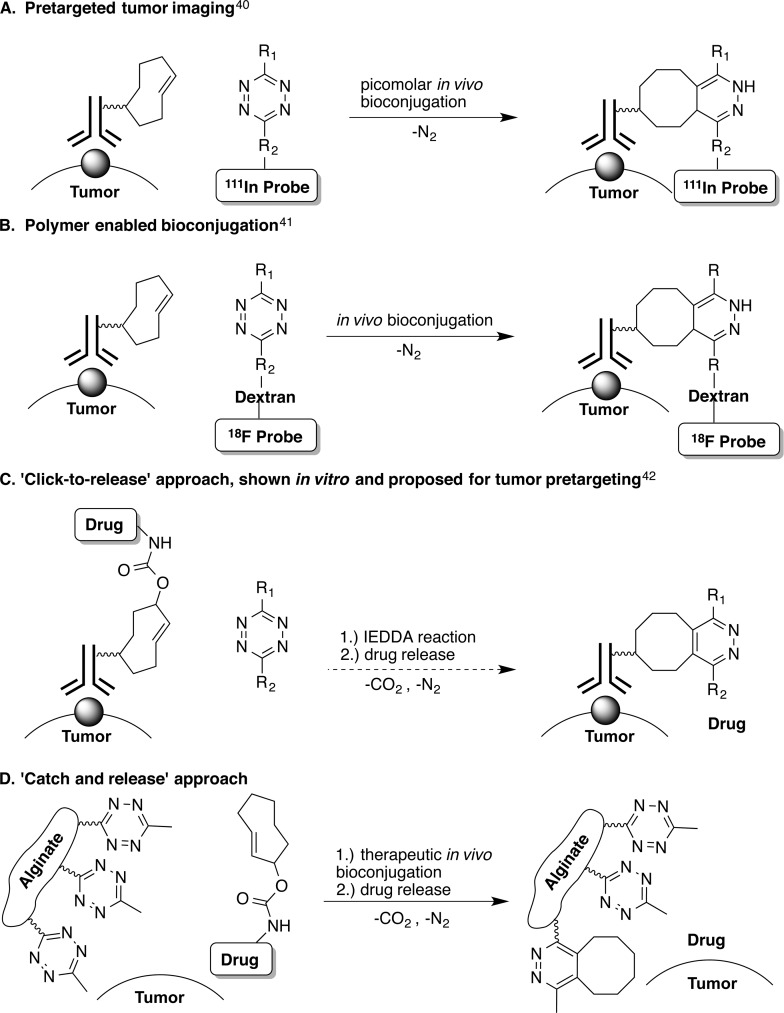
Figure 1
Figure 1
In vivo biconjugation using IEDDA chemistry: (A) pretargeted tumor imaging using SPECT/CT achieved picomolar bioconjugation; (B) bioconjugation using tetrazine attached to dextran; (C) proposed approach for in vivo drug release; (D) local drug activation approach for bioconjugation at therapeutically relevant concentrations described in this work.
Figure 2
Figure 2
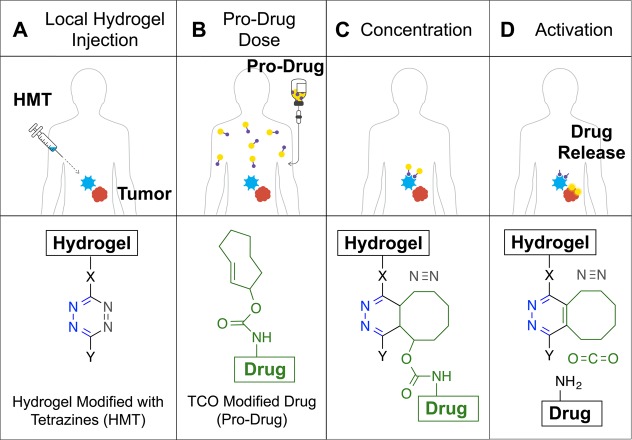
In vivo bioorthogonal chemistry for the concentration and activation of systemic pro-drugs. (A) A hydrogel modified with Tz (HMT) is injected into the area where the drugs are needed. (B) A drug covalently modified with a TCO carbamate (pro-drug) is given to the patient. (C) When the pro-drug and the material come in contact, the rapid cycloaddition reaction enhances the amount of drug present at the desired location with the concomitant release of a molecule of nitrogen. (D) The resulting cycloadduct isomerizes in vivo leading to decomposition of the self-immolable carbamate linker, releasing an equivalent of carbon dioxide and most importantly the drug at the local site to perform its therapeutic function.
Figure 3
Figure 3
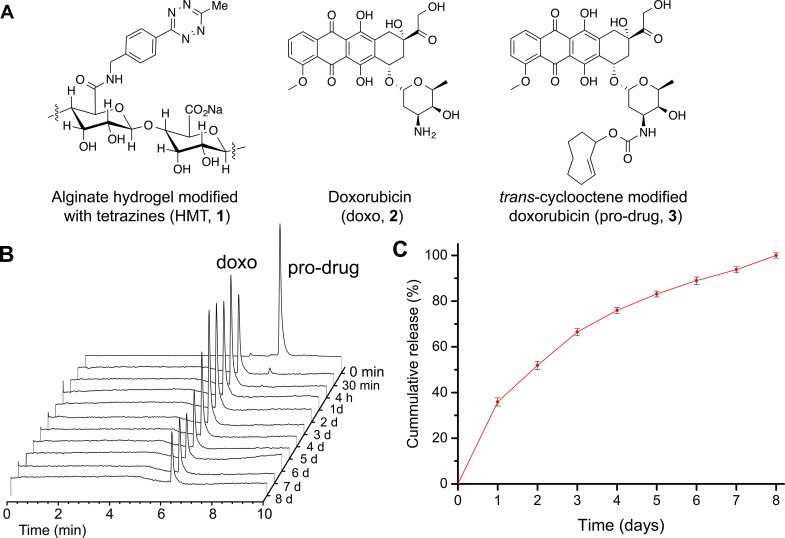
In vitro activation of doxorubicin pro-drug when mixed with HMT. (A) Chemical structures of an alginate monosaccharide modified with tetrazine, doxorubicin, and doxorubicin pro-drug. (B) Sample data from high-pressure liquid chromatography analysis of the supernatant after mixing HTM with doxorubicin pro-drug for 30 min. (C) Cumulative release of doxorubicin after mixing HTM with doxorubicin pro-drug. For HPLC analysis, the concentration of the pro-drug shown at t = 0 min was diluted 10-fold. Data are averages ± SEM, n = 3.
Figure 4
Figure 4
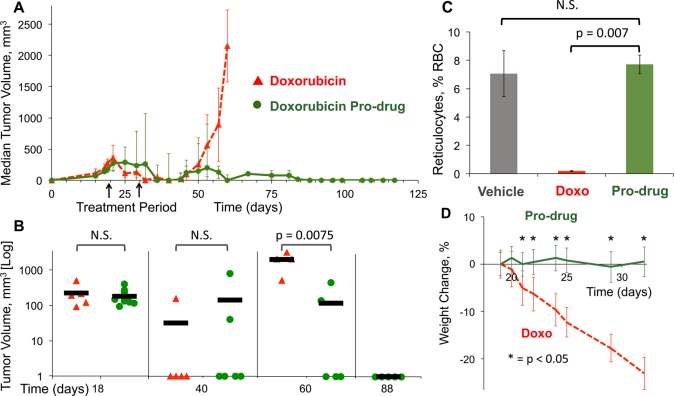
Therapeutic effect of doxorubicin pro-drug in a xenograft model of soft tissue sarcoma. (A) NCR/nu:nu mice were injected with human HT-1080 fibrosarcoma cells at day 0. Tumors were then injected with HMT and started on intravenous doses of either doxorubicin pro-drug or a maximum tolerable dose of doxorubicin. Tumor sizes were monitored for more than 16 weeks (n = 5–10). (B) The tumor size of the members of each cohort at relevant time points in a logarithmic scale illustrate the differences between standard chemotherapy treatment and the material pro-drug approach. P values were determined by unpaired t test. Solid bars represent the mean for each cohort (n = 5–10). (C) Evaluation of reticulocyte counts as a surrogate for bone marrow suppression in a xenograft model of soft tissue sarcoma. Mice were given vehicle, doxorubicin, or doxorubicin pro-drug after injection of HMT. Samples were collected 3 days after the last treatment. Data are means ± SD (n = 2). (D) Body weight changes in response to therapy. Data are mean body weight changes as a percentage of initial weight ± SD (n = 5–10). P values were determined by unpaired t test.

References

    1. von Mehren M.; Randall R. L.; Benjamin R. S.; Boles S.; Bui M. M.; Casper E. S.; Conrad E. U. 3rd; Delaney T. F.; Ganjoo K. N.; George S.; Gonzalez R. J.; Heslin M. J.; Kane J. M. 3rd; Mayerson J.; McGarry S. V.; Meyer C.; O’Donnell R. J.; Pappo A. S.; Paz I. B.; Pfeifer J. D.; Riedel R. F.; Schuetze S.; Schupak K. D.; Schwartz H. S.; Van Tine B. A.; Wayne J. D.; Bergman M. A.; Sundar H. National Comprehensive Cancer, N., Soft tissue sarcoma, version 2.2014. J. Natl. Compr. Canc. Netw. 2014, 12, 473–483. - PubMed
    1. Demetri G. D.; Antonia S.; Benjamin R. S.; Bui M. M.; Casper E. S.; Conrad E. U. 3rd; DeLaney T. F.; Ganjoo K. N.; Heslin M. J.; Hutchinson R. J.; Kane J. M. 3rd; Letson G. D.; McGarry S. V.; O’Donnell R. J.; Paz I. B.; Pfeifer J. D.; Pollock R. E.; Randall R. L.; Riedel R. F.; Schupak K. D.; Schwartz H. S.; Thornton K.; von Mehren M.; Wayne J. National Comprehensive Cancer Network Soft Tissue Sarcoma, P., Soft tissue sarcoma. J. Natl. Compr. Canc. Netw. 2010, 8, 630–674. - PubMed
    1. Clark M. A.; Fisher C.; Judson I.; Thomas J. M. Soft-tissue sarcomas in adults. N. Engl. J. Med. 2005, 353, 701–711. 10.1056/NEJMra041866. - DOI - PubMed
    1. Sarcoma Meta-analysis, C., Adjuvant chemotherapy for localised resectable soft tissue sarcoma in adults. Cochrane Database Syst. Rev. 2000, CD001419. - PubMed
    1. Brennan M. F.; Antonescu C. R.; Moraco N.; Singer S. Lessons learned from the study of 10,000 patients with soft tissue sarcoma. Ann. Surg. 2014, 260, 416–421. 10.1097/SLA.0000000000000869. - DOI - PMC - PubMed