First Detection of Bat White-Nose Syndrome in Western North America
- PMID: 27504499
- PMCID: PMC4973635
- DOI: 10.1128/mSphere.00148-16
First Detection of Bat White-Nose Syndrome in Western North America
Abstract
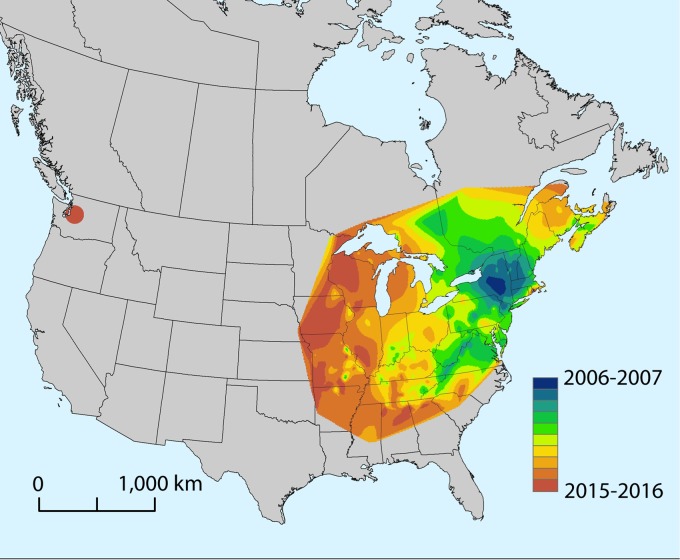
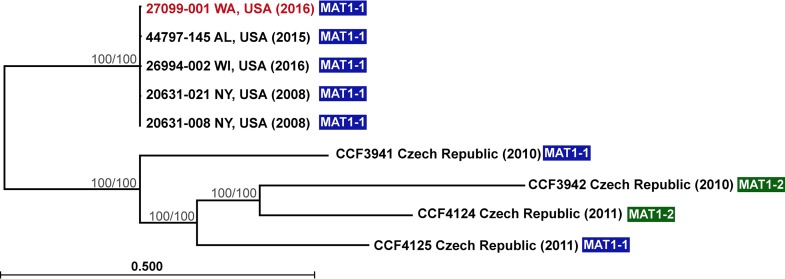
White-nose syndrome (WNS) is an emerging fungal disease of bats caused by Pseudogymnoascus destructans. Since it was first detected near Albany, NY, in 2006, the fungus has spread across eastern North America, killing unprecedented numbers of hibernating bats. The devastating impacts of WNS on Nearctic bat species are attributed to the likely introduction of P. destructans from Eurasia to naive host populations in eastern North America. Since 2006, the disease has spread in a gradual wavelike pattern consistent with introduction of the pathogen at a single location. Here, we describe the first detection of P. destructans in western North America in a little brown bat (Myotis lucifugus) from near Seattle, WA, far from the previously recognized geographic distribution of the fungus. Whole-genome sequencing and phylogenetic analyses indicated that the isolate of P. destructans from Washington grouped with other isolates of a presumed clonal lineage from the eastern United States. Thus, the occurrence of P. destructans in Washington does not likely represent a novel introduction of the fungus from Eurasia, and the lack of intensive surveillance in the western United States makes it difficult to interpret whether the occurrence of P. destructans in the Pacific Northwest is disjunct from that in eastern North America. Although there is uncertainty surrounding the impacts of WNS in the Pacific Northwest, the presence of the pathogen in western North America could have major consequences for bat conservation. IMPORTANCE White-nose syndrome (WNS) represents one of the most consequential wildlife diseases of modern times. Since it was first documented in New York in 2006, the disease has killed millions of bats and threatens several formerly abundant species with extirpation or extinction. The spread of WNS in eastern North America has been relatively gradual, inducing optimism that disease mitigation strategies could be established in time to conserve bats susceptible to WNS in western North America. The recent detection of the fungus that causes WNS in the Pacific Northwest, far from its previous known distribution, increases the urgency for understanding the long-term impacts of this disease and for developing strategies to conserve imperiled bat species.
Keywords: Pseudogymnoascus destructans; Washington; bat; white-nose syndrome.
Figures
References
-
- Gargas A, Trest MT, Christensen M, Volk TJ, Blehert DS. 2009. Geomyces destructans sp. nov. associated with bat white-nose syndrome. Mycotaxon 108:147–154. doi: 10.5248/108.147. - DOI
-
- Turner GG, Reeder DM, Coleman JTH. 2011. A five-year assessment of mortality and geographic spread of white-nose syndrome in North American bats and a look to the future. Bat Res News 52:13–27.
-
- Puechmaille SJ, Wibbelt G, Korn V, Fuller H, Forget F, Mühldorfer K, Kurth A, Bogdanowicz W, Borel C, Bosch T, Cherezy T, Drebet M, Görföl T, Haarsma AJ, Herhaus F, Hallart G, Hammer M, Jungmann C, Le Bris Y, Lutsar L, Masing M, Mulkens B, Passior K, Starrach M, Wojtaszewski A, Zöphel U, Teeling EC. 2011. Pan-European distribution of white-nose syndrome fungus (Geomyces destructans) not associated with mass mortality. PLoS One 6:e00148-16. doi: 10.1371/journal.pone.0019167. - DOI - PMC - PubMed
LinkOut - more resources
Full Text Sources
Other Literature Sources