Fall Prevention in a Primary Care Setting
- PMID: 27504699
- PMCID: PMC4908924
- DOI: 10.3238/arztebl.2016.0365
Fall Prevention in a Primary Care Setting
Abstract
Background: Falls and fall-related injuries are common in community-dwelling elderly people. Effective multifactorial fall prevention programs in the primary care setting may be a promising approach to reduce the incidence rate of falls.
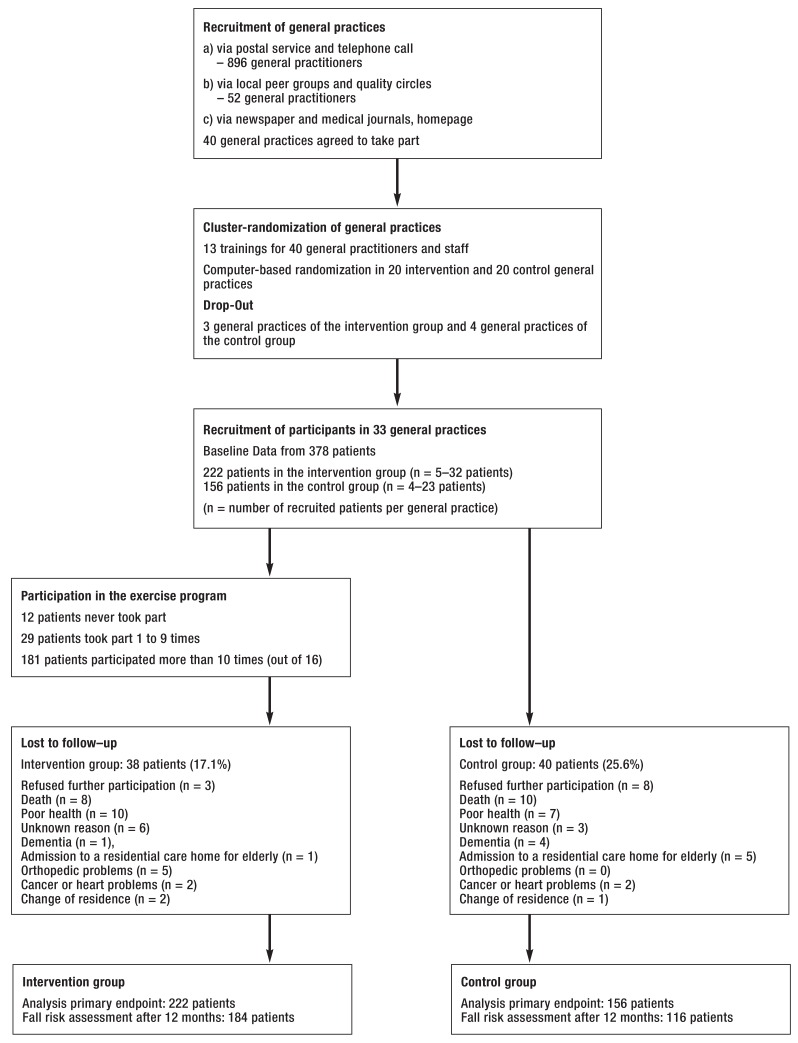
Methods: In a cluster randomized trial in 33 general practices 378 people living independently and at high risk of falling (65 to 94 years old; 285 women) were allocated to either a 16 week exercise-based fall prevention program including muscle strengthening and challenging balance training exercises, combined with a 12 week home-based exercise program (222 participants), or to usual care (156 participants). The main outcome was number of falls over a period of 12 months. Secondary outcomes were the number of fall-related injuries, physical function (Timed-Up-and-Go-Test, TUG, Chair-Stand-Test, CST, modified Romberg Test), and fear of falling.
Results: In the intervention group (n=222 patients in 17 general practices) 291 falls occurred, compared to 367 falls in the usual care group (n=156 patients in 16 general practices). We observed a lower incidence rate for falls in the intervention group (incidence rate ratio/IRR: 0.54; 95% confidence interval (CI): [0.35; 0.84], p=0.007) and for fall-related injuries (IRR: 0.66; [0.42; 0.94], p=0.033). Additionally, patients in the intervention group showed significant improvements in secondary endpoints (TUG: -2.39 s, [-3.91; -0.87], p=0.014; mRomberg: 1.70 s, [0.35; 3.04], p=0.037; fear of falling: -2.28 points, [-3.87; -0.69], p=0.022) compared to usual care.
Conclusion: A complex falls prevention program in a primary care setting was effective in reducing falls and fall-related injuries in community dwelling older adults at risk.
References
-
- Speechley M, Tinetti M. Falls and injuries in frail and vigorous community elderly persons. J Am Geriatr Soc. 1991;39:46–52. - PubMed
-
- Tinetti ME, Speechley M, Ginter SF. Risk factors for falls among elderly persons living in the community. N Engl J Med. 1988;319:1701–1707. - PubMed
-
- Ensrud KE, Ewing SK, Taylor BC, et al. Frailty and risk of falls, fracture, and mortality in older women: the study of osteoporotic fractures. J Gerontol A Biol Sci Med Sci. 2007;62:744–751. - PubMed
-
- Icks A, Haastert B, Wildner M, Becker C, Meyer G. Trend of hip fracture incidence in Germany 1995-2004: a population-based study. Osteoporos Int. 2008;19:1139–1145. - PubMed
Publication types
MeSH terms
LinkOut - more resources
Full Text Sources
Other Literature Sources
Medical