Genes Interacting with Occupational Exposures to Low Molecular Weight Agents and Irritants on Adult-Onset Asthma in Three European Studies
- PMID: 27504716
- PMCID: PMC5289825
- DOI: 10.1289/EHP376
Genes Interacting with Occupational Exposures to Low Molecular Weight Agents and Irritants on Adult-Onset Asthma in Three European Studies
Abstract
Background: The biological mechanisms by which cleaning products and disinfectants-an emerging risk factor-affect respiratory health remain incompletely evaluated. Studying genes by environment interactions (G × E) may help identify new genes related to adult-onset asthma.
Objectives: We identified interactions between genetic polymorphisms of a large set of genes involved in the response to oxidative stress and occupational exposures to low molecular weight (LMW) agents or irritants on adult-onset asthma.
Methods: Our data came from three large European cohorts: Epidemiological Family-based Study of the Genetics and Environment of Asthma (EGEA), Swiss Cohort Study on Air Pollution and Lung and Heart Disease in Adults (SAPALDIA), and European Community Respiratory Health Survey in Adults (ECRHS). A candidate pathway-based strategy identified 163 genes involved in the response to oxidative stress and potentially related to exposures to LMW agents/irritants. Occupational exposures were evaluated using an asthma job-exposure matrix and job-specific questionnaires for cleaners and healthcare workers. Logistic regression models were used to detect G × E interactions, adjusted for age, sex, and population ancestry, in 2,599 adults (mean age, 47 years; 60% women, 36% exposed, 18% asthmatics). p-Values were corrected for multiple comparisons.
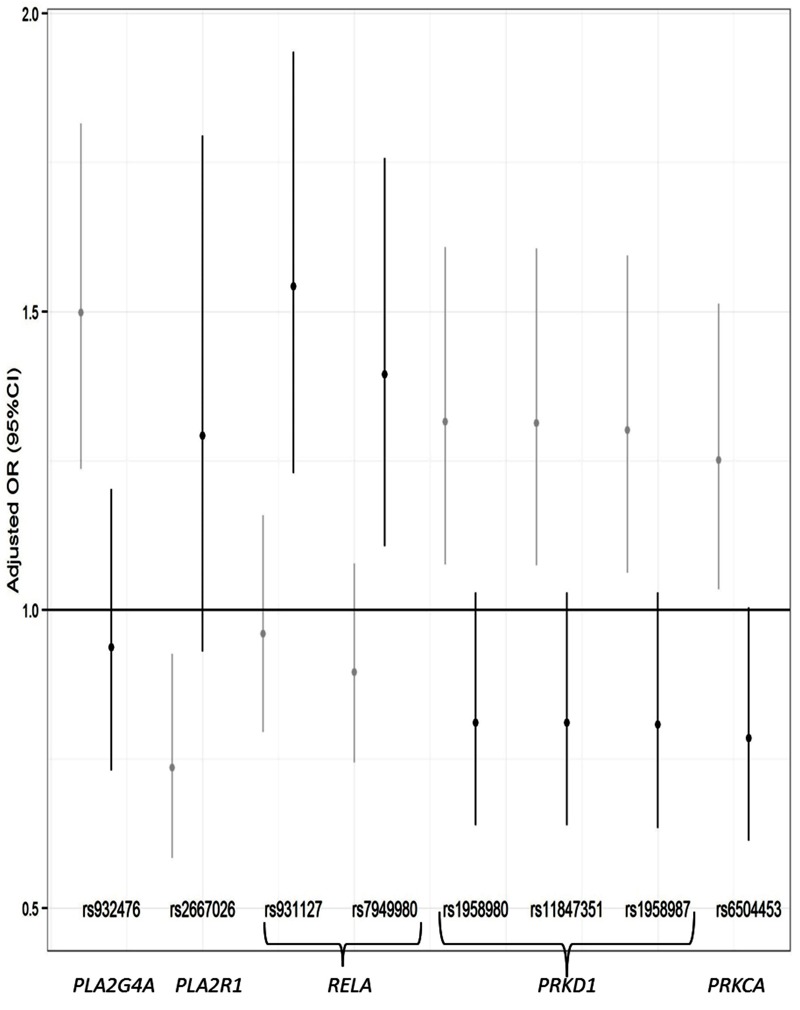
Results: Ever exposure to LMW agents/irritants was associated with current adult-onset asthma [OR = 1.28 (95% CI: 1.04, 1.58)]. Eight single nucleotide polymorphism (SNP) by exposure interactions at five loci were found at p < 0.005: PLA2G4A (rs932476, chromosome 1), near PLA2R1 (rs2667026, chromosome 2), near RELA (rs931127, rs7949980, chromosome 11), PRKD1 (rs1958980, rs11847351, rs1958987, chromosome 14), and PRKCA (rs6504453, chromosome 17). Results were consistent across the three studies and after accounting for smoking.
Conclusions: Using a pathway-based selection process, we identified novel genes potentially involved in adult asthma by interaction with occupational exposure. These genes play a role in the NF-κB pathway, which is involved in inflammation. Citation: Rava M, Ahmed I, Kogevinas M, Le Moual N, Bouzigon E, Curjuric I, Dizier MH, Dumas O, Gonzalez JR, Imboden M, Mehta AJ, Tubert-Bitter P, Zock JP, Jarvis D, Probst-Hensch NM, Demenais F, Nadif R. 2017. Genes interacting with occupational exposures to low molecular weight agents and irritants on adult-onset asthma in three European studies. Environ Health Perspect 125:207-214; http://dx.doi.org/10.1289/EHP376.
Conflict of interest statement
Glaxo Wellcome and Glaxo France, producers of asthma medication, partially funded the local studies (Bergen and Paris, respectively) in ECHRS II. The authors declare they have no other actual or potential competing financial interests.
Figures
References
-
- Ackermann-Liebrich U, Kuna-Dibbert B, Probst-Hensch NM, Schindler C, Felber Dietrich D, Stutz EZ, et al. Follow-up of the Swiss Cohort Study on Air Pollution and Lung Diseases in Adults (SAPALDIA 2) 1991–2003: methods and characterization of participants. Soz Praventivmed. 2005;50:245–263. - PubMed
-
- Barrett JC, Fry B, Maller J, Daly MJ. Haploview: analysis and visualization of LD and haplotype maps. Bioinformatics. 2005;21:263–265. - PubMed
-
- Beasley R, Semprini A, Mitchell EA. Risk factors for asthma: is prevention possible? Lancet. 2015;386:1075–1085. - PubMed
Publication types
MeSH terms
Substances
Grants and funding
LinkOut - more resources
Full Text Sources
Other Literature Sources
Medical
Miscellaneous