Randomized Controlled Trial
. 2016 Aug 9;13(1):74.
doi: 10.1186/s12984-016-0178-x.

Counteracting learned non-use in chronic stroke patients with reinforcement-induced movement therapy

Affiliations
Randomized Controlled Trial

Counteracting learned non-use in chronic stroke patients with reinforcement-induced movement therapy

Belén Rubio Ballester et al. J Neuroeng Rehabil. .

Abstract

Background: After stroke, patients who suffer from hemiparesis tend to suppress the use of the affected extremity, a condition called learned non-use. Consequently, the lack of training may lead to the progressive deterioration of motor function. Although Constraint-Induced Movement Therapies (CIMT) have shown to be effective in treating this condition, the method presents several limitations, and the high intensity of its protocols severely compromises its adherence. We propose a novel rehabilitation approach called Reinforcement-Induced Movement Therapy (RIMT), which proposes to restore motor function through maximizing arm use. This is achieved by exposing the patient to amplified goal-oriented movements in VR that match the intended actions of the patient. We hypothesize that through this method we can increase the patients self-efficacy, reverse learned non-use, and induce long-term motor improvements.

Methods: We conducted a randomized, double-blind, longitudinal clinical study with 18 chronic stroke patients. Patients performed 30 minutes of daily VR-based training during six weeks. During training, the experimental group experienced goal-oriented movement amplification in VR. The control group followed the same training protocol but without movement amplification. Evaluators blinded to group designation performed clinical measurements at the beginning, at the end of the training and at 12-weeks follow-up. We used the Fugl-Meyer Assessment for the upper extremities (UE-FM) (Sanford et al., Phys Ther 73:447-454, 1993) as a primary outcome measurement of motor recovery. Secondary outcome measurements included the Chedoke Arm and Hand Activity Inventory (CAHAI-7) (Barreca et al., Arch Phys Med Rehabil 6:1616-1622, 2005) for measuring functional motor gains in the performance of Activities of Daily Living (ADLs), the Barthel Index (BI) for the evaluation of the patient's perceived independence (Collin et al., Int Disabil Stud 10:61-63, 1988), and the Hamilton scale (Knesevich et al., Br J Psychiatr J Mental Sci 131:49-52, 1977) for the identification of improvements in mood disorders that could be induced by the reinforcement-based intervention. In order to study and predict the effects of this intervention we implemented a computational model of recovery after stroke.

Results: While both groups showed significant motor gains at 6-weeks post-treatment, only the experimental group continued to exhibit further gains in UE-FM at 12-weeks follow-up (p<.05). This improvement was accompanied by a significant increase in arm-use during training in the experimental group.

Conclusions: Implicitly reinforcing arm-use by augmenting visuomotor feedback as proposed by RIMT seems beneficial for inducing significant improvement in chronic stroke patients. By challenging the patients' self-limiting believe system and perceived low self-efficacy this approach might counteract learned non-use.

Trial registration: Clinical Trials NCT02657070 .

Keywords: Deductive medicine; Learned non-use; Rehabilitation; Stroke; Virtual reality.


Figures

Fig. 1
Fig. 1
Set-up and scenarios. a RGS setup in the hospital showing the transparent acrylic table in front of which the desktop computer with the Kinect (on a tadpole that elevates it above the screen) is placed. In order to use the second Kinect and the overhead projector on the scaffold above the table for the real world evaluation scenario, a white cover can be placed over the acrylic surface. During a training session, the user sits in a chair facing the screen while resting his/her arms on the table. b Spheroids scenario, where sets of colored spheres are launched towards the player who has to intercept them. c Whack-a-mole scenario, where the user freely chooses which limb to use in order to reach towards an appearing mole. d Collector scenario, where a set of patterned spheroids as indicated in the upper-left corner of the screen need to be collected. e Virtual evaluation scenario, an abstract version of the Whack-a-mole scenario, where the patient has to reach towards an appearing cylinder. f Real-world scenario, where the user has to reach towards randomly appearing dots that are projected from above on the table surface in front of him or her
Fig. 2
Fig. 2
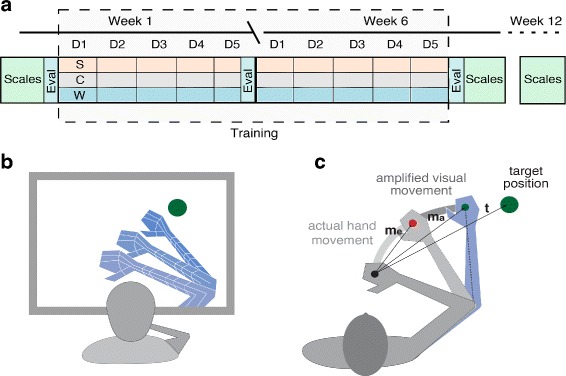
Experimental protocol. a Experimental condition: during training the participant visualizes augmented goal-oriented movements that match his/her intended actions. b Diagram showing the methodology for the amplification of goal-oriented reaching movements in VR. At each time step, the executed movement vector is attracted towards the target, both in terms of extent and direction. c The clinical assessments (light green) are performed before the training, at the end of the training and at 12 weeks follow-up. The virtual and the real world evaluation (dark green) are performed at the beginning of the treatment and at the end of every training week. Every workday for six weeks all patients completed a session containing the three training scenarios in the following order: Spheroids (S), Whack-a-mole (W) and Collector (C)
Fig. 3
Fig. 3
Validation of the movement amplification mechanism. a Example trajectory of the patient’s real arm movement (red curve) and the amplified movement in VR (green curve). b Median of reaching errors (i.e. distance from the center of the avatar’s hand to the target) of the virtual movement by group and scenario. Error bars indicate median absolute deviations for each group
Fig. 4
Fig. 4
Clinical measurements. Change in UE-FM (a) and CAHAI (b) from baseline to the end of treatment at week 6 (T1) and to follow-up at week 12 (T2) (i.e. 6 weeks after the end of the treatment) for the experimental (EG, green) and the control group (CG, red). Error bars indicate median absolute deviations for each group. The individual data for each subject is indicated with triangles for CG and with circles for EG
Fig. 5
Fig. 5
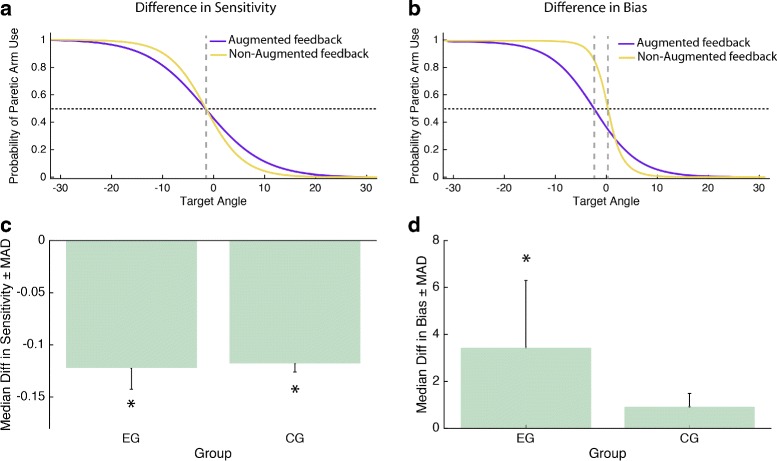
Influence of the augmented sensorimotor feedback on hand selection. a-b Psychometric functions describing hand selection patterns of two representative patients in the EG group. The purple line describes the probability of using the paretic limb in the Whack-a-Mole training scenario. The yellow line refers to arm use during the virtual evaluation scenario, when no augmented sensorimotor feedback was provided. Panel c indicates a difference in the sensitivity to the target position between scenarios (i.e. different slopes). Panel d presents a difference in bias (i.e. change in the Point of Subjective Equality between scenarios)
Fig. 6
Fig. 6
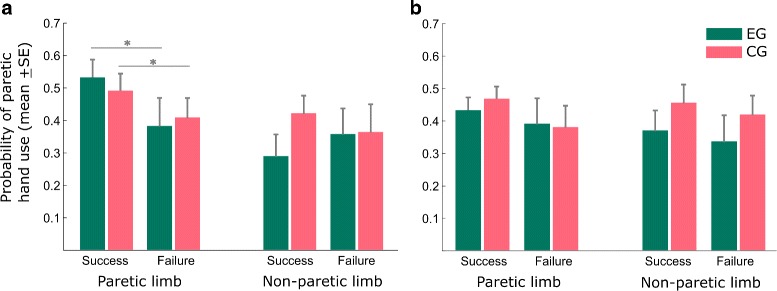
Sequential analysis of hand choice. Influence of hand choice and reinforcement history on arm use. Probability of using the affected arm in the virtual evaluation (no augmentation, a) and the Whack-a-mole scenario (augmented sensory feedback for EG, b) given the movement outcome (i.e. success or failure) and the hand used (i.e. paretic or non-paretic) in the previous trials (t-1). Error bars indicate standard error of the mean

References

    1. Taub E, Uswatte G. Constraint-Induced Movement therapy: Bridging from the primate laboratory to the stroke rehabilitation laboratory. J Rehabil Med. 2003;35(SUPPL. 41):34–40. doi: 10.1080/16501960310010124. - DOI - PubMed
    1. Andrews K, Steward J. Sroke recovery: he can but does he? Rheumatology. 1979;18(1):43–8. doi: 10.1093/rheumatology/18.1.43. - DOI - PubMed
    1. Taub E, Uswatte G, Mark VW, Morris DMM. The learned nonuse phenomenon: implications for rehabilitation. Europa Medicophysica. 2006;42(3):241–56. - PubMed
    1. Wolf SL, Blanton S, Baer H, Breshears J, Butler AJ. Repetitive task practice: a critical review of constraint-induced movement therapy in stroke. The neurologist. 2002;8(6):325–38. - PMC - PubMed
    1. Page SJ, Levine P, Sisto S, Bond Q, Johnston MV. Stroke patients’ and therapists’ opinions of constraint-induced movement therapy. Clin Rehabil. 2002;16(1):55–60. doi: 10.1191/0269215502cr473oa. - DOI - PubMed

Publication types

Associated data