. 2016 Oct;10(8):1317-29.
doi: 10.1016/j.molonc.2016.07.003. Epub 2016 Jul 14.

Characterization of a re-engineered, mesothelin-targeted Pseudomonas exotoxin fusion protein for lung cancer therapy

Affiliations

Characterization of a re-engineered, mesothelin-targeted Pseudomonas exotoxin fusion protein for lung cancer therapy

Frieder Bauss et al. Mol Oncol. 2016 Oct.

Abstract

Mesothelin overexpression in lung adenocarcinomas correlates with the presence of activating KRAS mutations and poor prognosis. Hence SS1P, a mesothelin-targeted immunotoxin, could offer valuable treatment options for these patients, but its use in solid tumor therapy is hampered by high immunogenicity and non-specific toxicity. To overcome both obstacles we developed RG7787, a de-immunized cytotoxic fusion protein comprising a humanized SS1 Fab fragment and a truncated, B-cell epitope silenced, 24 kD fragment of Pseudomonas exotoxin A (PE24). Reactivity of RG7787 with sera from immunotoxin-treated patients was >1000 fold reduced. In vitro RG7787 inhibited cell viability of lung cancer cell lines with picomolar potency. The pharmacokinetic properties of RG7787 in rodents were comparable to SS1P, yet it was tolerated up to 10 fold better without causing severe vascular leak syndrome or hepatotoxicity. A pharmacokinetic/pharmacodynamic model developed based on NCI-H596 xenograft studies showed that for RG7787 and SS1P, their in vitro and in vivo potencies closely correlate. At optimal doses of 2-3 mg/kg RG7787 is more efficacious than SS1P. Even large, well established tumors (600 mm(3)) underwent remission during three treatment cycles with RG7787. Also in two patient-derived lung cancer xenograft models, Lu7336 and Lu7187, RG7787 showed anti-tumor efficacy. In monotherapy two treatment cycles were moderately efficacious in the Lu7336 model but showed good anti-tumor activity in the KRAS mutant Lu7187 model (26% and 80% tumor growth inhibition, respectively). Combination of RG7787 with standard chemotherapies further enhanced efficacy in both models achieving near complete eradication of Lu7187 tumors.

Keywords: De-immunization; Immunotoxin; Lung cancer; Patient-derived xenografts; Pharmacokinetics; Targeted therapy.


Figures

Figure 1
Figure 1
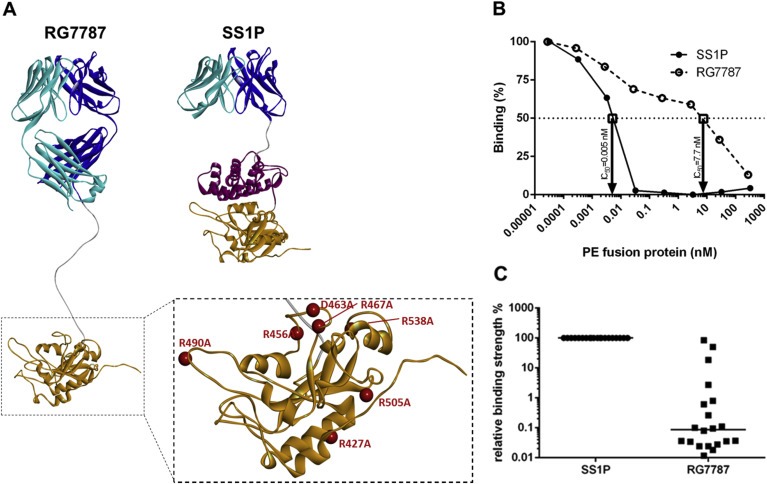
Structures of RG7787 and SS1P and assessment of their relative antigenicity (A) Ribbon diagrams showing the different domain structures of SS1P and RG7787 as well as the 7 amino acid substitutions (red balls) within the catalytic domain III of PE that were introduced in RG7787 to silence all 6 known human B‐cell epitopes. The mutated PE24 was modeled onto the crystal structure of PE (structure 1IKQ in the Research Collaboratory for Structural Bioinformatics protein data base), the linker with the furin cleavage site was modeled as linear peptide chain and energy minimized, and the Fab fragment was modeled onto fragments of different Fv structures and refined as described in Bujotzek et al., 2015. (B) The graph shows typical competition curves obtained using serum from an SS1P‐treated patient with a neutralizing anti‐drug antibody response. In this case the concentrations of RG7787 and SS1P at which binding to PE38 was inhibited by 50% (IC50) were 7.7 nM and 0.005 nM, respectively. Based on these IC50 values the binding ratio of SS1P/RG7787 was 0.065%. (C) Binding ratios for sera from 20 patients were plotted and the median binding ratio is indicated by a horizontal line.
Figure 2
Figure 2
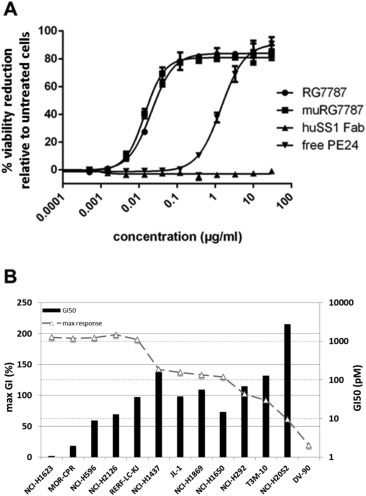
Cytotoxic potency of RG7787 (A) Humanization of the targeting Fab fragment did not negatively affect the cytotoxic potency of RG7787. Dose‐response curves comparing reduction of cell viability after 72 h incubation with just the humanized Fab fragment of SS1 (▴), free PE24 toxin (▾), RG7787 (●) or RG7787 with the murine SS1 Fab fragment (■) are shown. Cell viability was determined by luciferase‐based ATP measurement (CellTiter‐Glo®). (B) RG7787 has high cytotoxic potency on 11 of 13 lung cancer cell lines that were preselected based on Affymetrix data for mesothelin expression. GI50 values represent the concentrations necessary to reduce the ATP signal of vehicle‐treated control cells after 72 h by 50% and are shown as bars logarithmically scaled according to the y‐axis on the right. No bar is shown for cell line DV‐90 since a 50% reduction was not achieved. The maximum responses in % reduction versus viability signal before treatment start are plotted as line according to the linear scale of the y axis on the left. A max GI of 100% signifies that the ATP signal after 72 h was the same as at the starting time point t0 indicating complete inhibition of cell growth. A max GI of 200% indicates that all cells were dead after 72 h.
Figure 3
Figure 3
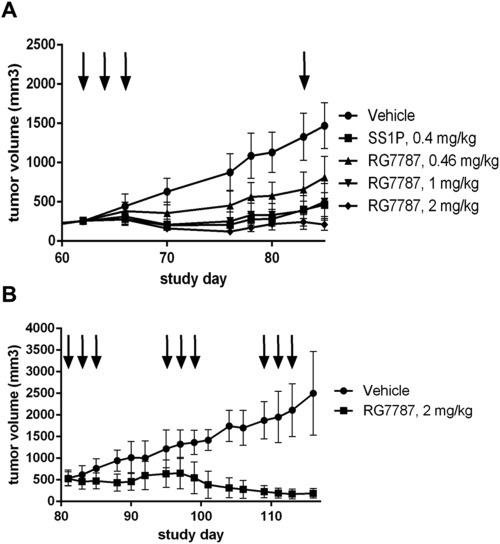
In vivo efficacy of RG7787 in NCI‐H596 xenografts (A) RG7787 dose‐dependently inhibits growth of NCI‐H596 xenografts in female SCID beige mice. Groups of mice (n = 10–12) were treated at the time points indicated by vertical arrows either with vehicle (●) or the maximally tolerated dose of SS1P (0.4 mg/kg: ■) or different doses of RG7787 (0.46 mg/kg: ▲; 1 mg/kg: ▼; 2 mg/kg: ♦). Data points indicate median tumor volumes and error bars represent interquartile ranges. (B) Three cycles of RG7787 therapy with intermittent breaks of 1 week shrank even large tumors in this model. Treatment of groups of mice (n = 12) with either vehicle or 2 mg/kg RG7787 started when subcutaneous NCI‐H596 tumors reached an average volume of 600 mm3. The three treatment cycles are indicated by the vertical arrows.
Figure 4
Figure 4
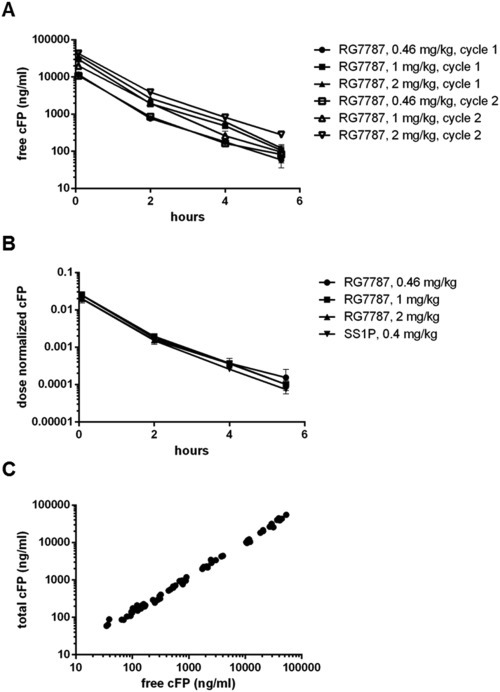
Pharmacokinetics of RG7787 and SS1P (A) Average free drug plasma levels of RG7787 are dose proportional during the 1st (filled symbols) and 2nd (open symbols) treatment cycle in female SCID beige mice bearing NCI‐H596 xenografts. RG7787 was given at 0.46 mg/kg (●, □), 1 mg/kg (■, ▵), and 2 mg/kg (▴,▿). (B) SS1P and RG7787 have similar pharmacokinetics. Dose‐normalized free drug plasma levels are plotted for the maximally tolerated dose of SS1P (0.4 mg/kg▼) and three different doses of RG7787 (0.46 mg/kg ●, 1 mg/kg ■, 2 mg/kg ▲). (A, B) All data points are mean values with standard deviations (n = 3/time point). (C) RG7787 shows a tight linear correlation between free and total drug plasma levels over a large concentration range. For all samples the free drug levels are plotted against the total drug levels.
Figure 5
Figure 5
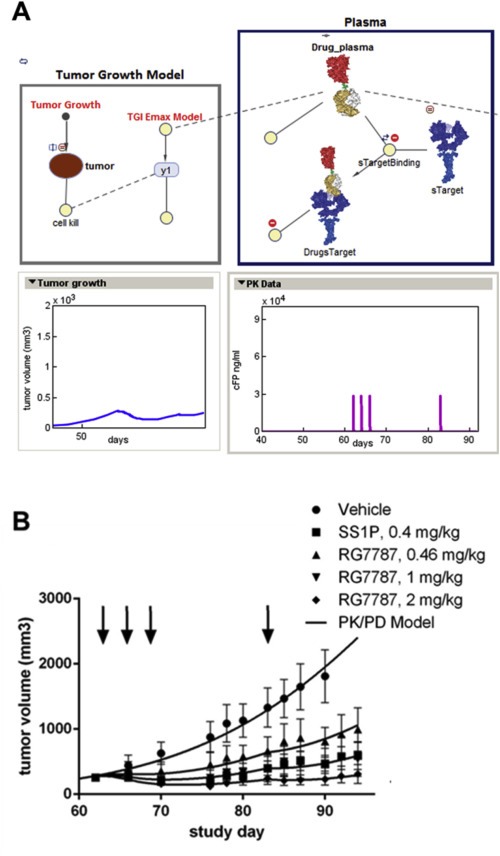
Modeling the relationship between pharmacokinetics and pharmacodynamics (A) The scheme illustrates the different model parameters and their relationships to each other. (B) Model predictions correlate well with the observed experimental data. Tumor growth curves calculated by the model are represented by the solid lines, while the data symbols show actual measured tumor volumes. Vehicle data were used for model fitting until day 90. Up to this time point no animals had to be sacrificed based on predefined termination criteria.
Figure 6
Figure 6
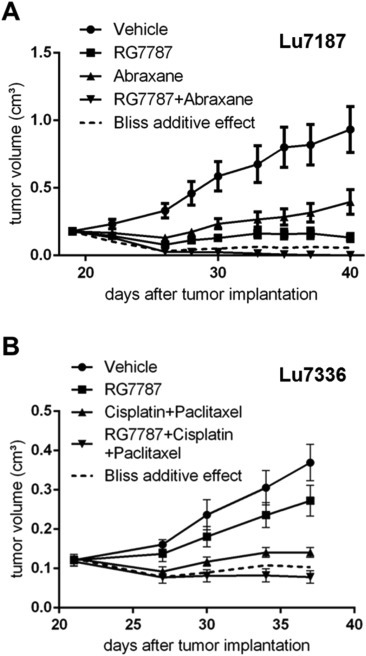
Efficacy of RG7787 in PDX lung cancer xenografts (A) In the KRASmut lung cancer model Lu7187 monotherapy with RG7787 was more efficacious than Abraxane® monotherapy and 2 cycles of combination therapy with both agents achieved near complete remissions. Animals were treated with either vehicle (●) or 2 mg/kg RG7787 (■, i.v. 2 cycles q2dx3, 2 days off then a final 7th treatment) or with 12.5 mg/kg Abraxane® (▴, i.v. q1dx5) or with a combination of both agents (▾). (B) In the KRASwt lung cancer model Lu7336 RG7787 had modest antitumor activity as monotherapy, but in combination with the chemotherapy doublet cisplatin plus paclitaxel also achieved tumor regressions. Animals were treated with either vehicle (●) or 2 mg/kg RG7787 (■, i.v. 2 cycles of q2dx3, 2 days off then a final 7th treatment) or with 5 mg/kg cisplatin (i.p. q7dx2) plus 12.5 mg/kg paclitaxel (i.v. q7dx2) (▴) or with the triple combination (▾). (A, B) Animals were randomized into treatment groups (n = 10) and therapy was started, when tumor volumes had reached a size of ∼100 mm3. Median tumor volumes are plotted with standard deviations as error bars. The dashed line indicates the calculated tumor growth assuming bliss additivity of the respective combination regimen.

References

    1. Alewine, C. , Xiang, L. , Yamori, T. , Niederfellner, G. , Bosslet, K. , Pastan, I. , 2014 Nov. Efficacy of RG7787, a next-generation mesothelin-targeted immunotoxin, against triple-negative breast and gastric cancers. Mol. Cancer Ther. 13, (11) 2653–2661. - PMC - PubMed
    1. Alewine, C. , Hassan, R. , Pastan, I. , 2015 Feb. Advances in anticancer immunotoxin therapy. Oncologist 20, (2) 176–185. - PMC - PubMed
    1. Argani, P. , Iacobuzio-Donahue, C. , Ryu, B. , Rosty, C. , Goggins, M. , Wilentz, R.E. , 2001 Dec. Mesothelin is overexpressed in the vast majority of ductal adenocarcinomas of the pancreas: identification of a new pancreatic cancer marker by serial analysis of gene expression (SAGE). Clin. Cancer Res. 7, (12) 3862–3868. - PubMed
    1. Baluna, R. , Rizo, J. , Gordon, B.E. , Ghetie, V. , Vitetta, E.S. , 1999 Mar 30. Evidence for a structural motif in toxins and interleukin-2 that may be responsible for binding to endothelial cells and initiating vascular leak syndrome. Proc. Natl. Acad. Sci. USA 96, (7) 3957–3962. - PMC - PubMed
    1. Barretina, J. , Caponigro, G. , Stransky, N. , Venkatesan, K. , Margolin, A.A. , Kim, S. , 2012 Mar 29. The cancer cell line encyclopedia enables predictive modelling of anticancer drug sensitivity. Nature 483, (7391) 603–607. - PMC - PubMed

MeSH terms