Review
. 2016 Jul 20:5:F1000 Faculty Rev-1770.
doi: 10.12688/f1000research.8661.1. eCollection 2016.

Recent advances in understanding cardiac contractility in health and disease

Affiliations
Review

Recent advances in understanding cardiac contractility in health and disease

Ken T MacLeod. F1000Res. .

Abstract

The aim of this review is to provide the reader with a synopsis of some of the emerging ideas and experimental findings in cardiac physiology and pathophysiology that were published in 2015. To provide context for the non-specialist, a brief summary of cardiac contraction and calcium (Ca) regulation in the heart in health and disease is provided. Thereafter, some recently published articles are introduced that indicate the current thinking on (1) the Ca regulatory pathways modulated by Ca/calmodulin-dependent protein kinase II, (2) the potential influences of nitrosylation by nitric oxide or S-nitrosated proteins, (3) newly observed effects of reactive oxygen species (ROS) on contraction and Ca regulation following myocardial infarction and a possible link with changes in mitochondrial Ca, and (4) the effects of some of these signaling pathways on late Na current and pro-arrhythmic afterdepolarizations as well as the effects of transverse tubule disturbances.


Conflict of interest statement

Competing interests: The author declares that he has no competing interests.

No competing interests were disclosed.

Figures
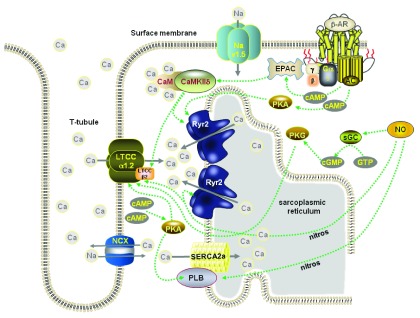
Figure 1.
Figure 1.. Schematic diagram of the main proteins involved in EC coupling in a ventricular myocyte and the main mechanisms for their phosphorylation or nitrosylation.
LTCC = L-type Ca channel, Cav1.2; Nav1.5 = cardiac isoform of the Na channel; NCX = Na/Ca exchange; Ryr2 = ryanodine receptor; PLB = phospholamban; AC = adenylyl cyclase; sGC = soluble guanylyl cyclase; EPAC = exchange protein activated by cAMP; PKA = protein kinase A; PKG = protein kinase G.
Figure 2.
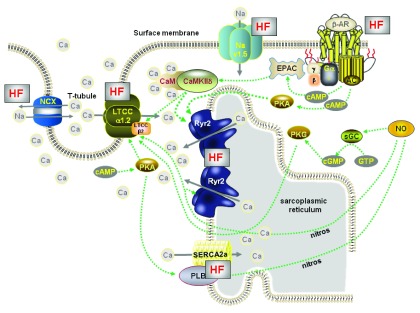
Figure 2.. Schematic diagram of the main proteins involved in EC coupling in a ventricular myocyte isolated from the failing heart.
The HF label signifies protein function has changed. T-tubule architecture alters resulting in less effective Ca-induced Ca release from the SR, uptake of Ca by SERCA is reduced, late Na current is increased. In addition to other changes in Na regulation this causes an increase in cytosolic [Na] that disturbs the function of NCX. Beta-adrenoceptors are down-regulated in heart failure and CaMKII activity is increased. Local decreases in protein phosphates results in hyperphosphorylation (chronic phosphorylation) of Ryr2 that destabilises the Ca release channel causing opening probability to increase. This results in greater diastolic Ca release from the SR (Ca leak) that, in parallel with reduced SERCA efficiency, lowers SR Ca content.
Figure 3.
Figure 3.. An increase in late Na current mediated by flux through the cardiac (Na v1.5) or neuronal (Na v1.1) isoforms of the Na channel leads to an increase in sub-sarcolemmal [Na] that reduces the efflux of Ca by NCX during the cardiac cycle.
CamKII can phosphorylate Na v1.5 which enhances the late Na current.
Figure 4.
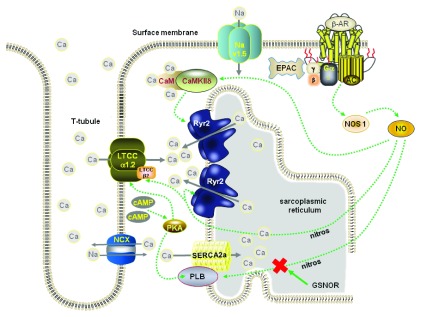
Figure 4.. Schematic diagram depicting the activation of nitric oxide synthase 1 (NOS1) following beta-adrenoceptor stimulation.
The NO formed can directly activate CaMKII that, in turn, phosphorylates Ryr2 or nitrosylates Ryr2 and PLB. GSNOR (S-nitrosoglutathione reductase) causes denitrosylation.
Figure 5.
Figure 5.. Stretching cardiac myocytes activates NOX2 in discrete locations in the cell to sensitise Ryr2 and increase Ca spark activity.
Phospholamban (PLB) phosphorylation that enhances SR Ca uptake occurs by ROS-mediated (O 2.) inhibition of protein phosphatase-1 activity.

References

    1. Bers DM: Cardiac excitation-contraction coupling. Nature. 2002;415(6868):198–205. 10.1038/415198a - DOI - PubMed
    1. Fabiato A: Simulated calcium current can both cause calcium loading in and trigger calcium release from the sarcoplasmic reticulum of a skinned canine cardiac Purkinje cell. J Gen Physiol. 1985;85(2):291–320. 10.1085/jgp.85.2.291 - DOI - PMC - PubMed
    1. Block BA, Imagawa T, Campbell KP, et al. : Structural evidence for direct interaction between the molecular components of the transverse tubule/sarcoplasmic reticulum junction in skeletal muscle. J Cell Biol. 1988;107(6 Pt 2):2587–600. 10.1083/jcb.107.6.2587 - DOI - PMC - PubMed
    1. Franzini-Armstrong C, Protasi F, Ramesh V: Shape, size, and distribution of Ca 2+ release units and couplons in skeletal and cardiac muscles. Biophys J. 1999;77(3):1528–39. 10.1016/S0006-3495(99)77000-1 - DOI - PMC - PubMed
    1. Soeller C, Cannell MB: Examination of the transverse tubular system in living cardiac rat myocytes by 2-photon microscopy and digital image-processing techniques. Circ Res. 1999;84(3):266–75. 10.1161/01.RES.84.3.266 - DOI - PubMed