


Cycled light in the intensive care unit for preterm and low birth weight infants
- PMID: 27508358
- PMCID: PMC6464252
- DOI: 10.1002/14651858.CD006982.pub4
Cycled light in the intensive care unit for preterm and low birth weight infants
Update in
-
Cycled light in the intensive care unit for preterm and low birth weight infants.Cochrane Database Syst Rev. 2024 Dec 19;12(12):CD006982. doi: 10.1002/14651858.CD006982.pub5. Cochrane Database Syst Rev. 2024. PMID: 39699174 Free PMC article.
Abstract
Background: Potential benefits and harms of different lighting in neonatal units have not been quantified.
Objectives: • To determine effectiveness and safety of cycled light (CL) (approximately 12 hours of light on and 12 hours of light off) for growth in preterm infants at three and six months' corrected age (CA).• In separate analyses, to compare effects of CL with those of irregularly dimmed light (DL) or near darkness (ND), and effects of CL with those of continuous bright light (CBL), on growth in preterm infants at three and six months' CA.• To assess, in subgroup analyses, the effectiveness and safety of CL (vs control interventions (DL, ND and CBL)) introduced at different postmenstrual ages (PMAs) - before 32 weeks', at 32 weeks' and from 36 weeks' PMA - and to compare effectiveness and safety of CL for small for gestational age (GA) infants versus appropriately grown infants.
Search methods: We used the standard search strategy of the Cochrane Neonatal Review Group to search the Cochrane Central Register of Controlled Trials (CENTRAL; 2016, Issue 12), MEDLINE via PubMed (1966 to January 2016), Embase (1980 to January 2016) and the Cumulative Index to Nursing and Allied Health Literature (CINAHL; 1982 to January 2016). We searched clinical trials databases, conference proceedings and reference lists of retrieved articles for randomised controlled trials and quasi-randomised trials.
Selection criteria: Randomised or quasi-randomised trials of CL versus ND or CBL in preterm and low birth weight infants.
Data collection and analysis: We performed data collection and analyses according to the methods of the Cochrane Neonatal Review Group. We used the Grading of Recommendations Assessment, Development and Evaluation (GRADE) approach to assess the quality of evidence.
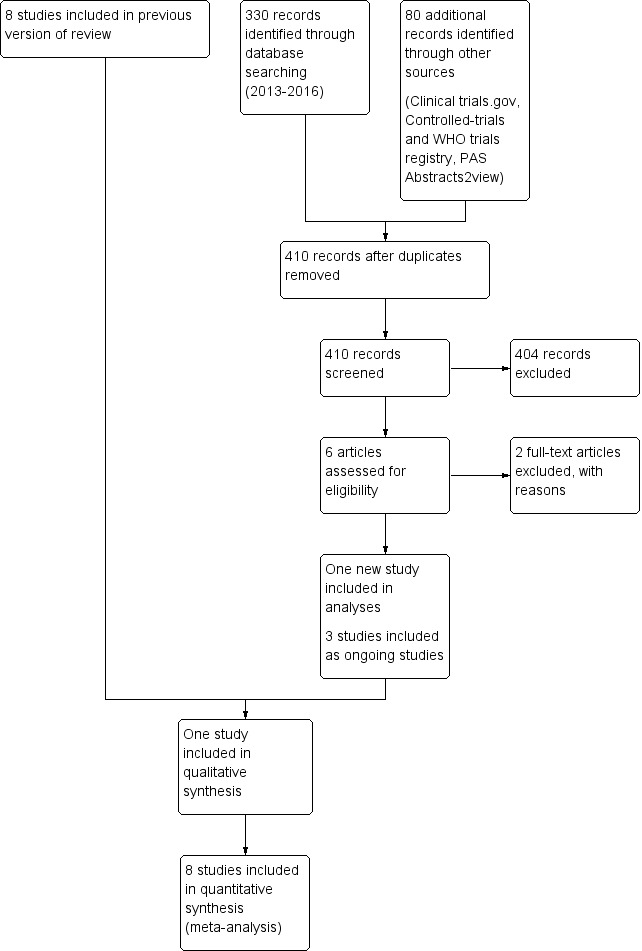
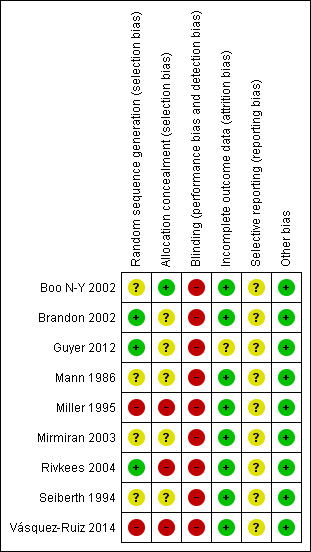
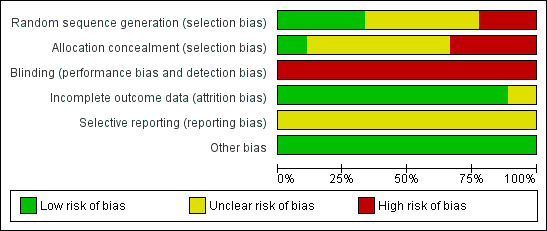
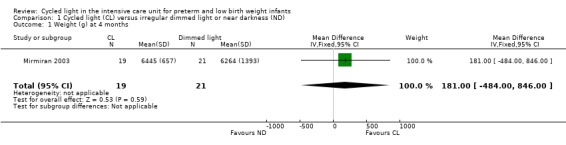
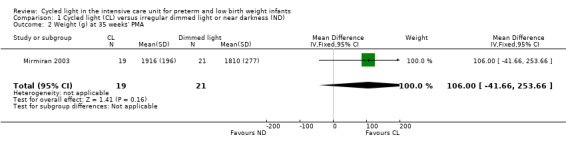
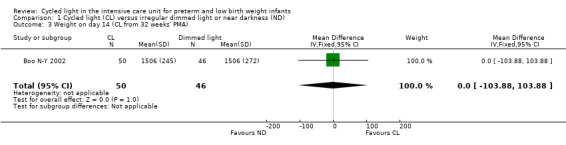
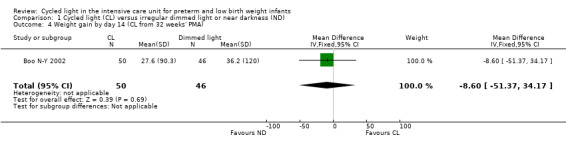
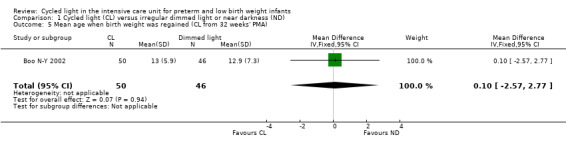
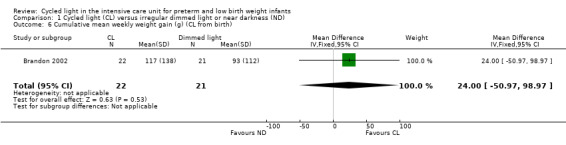
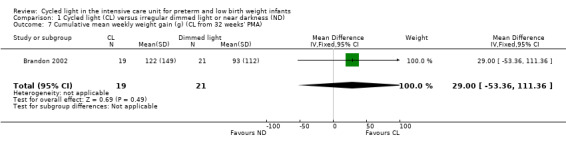
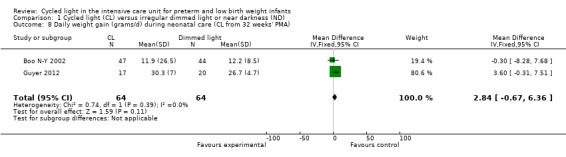
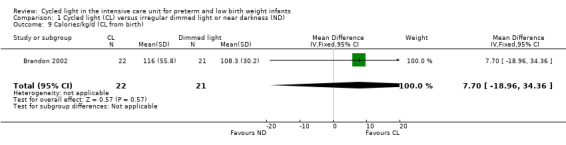
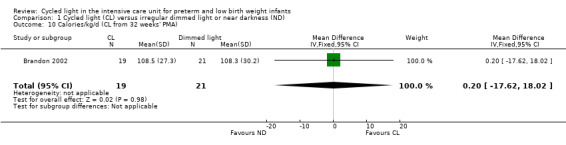
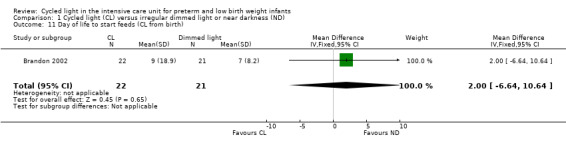
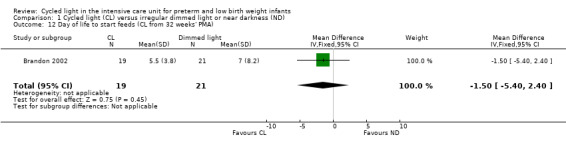
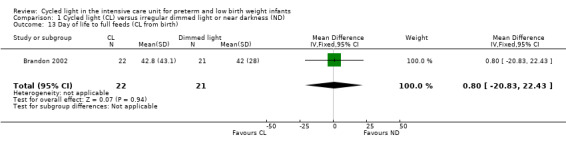
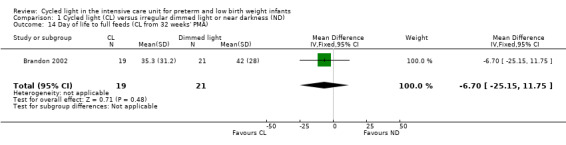
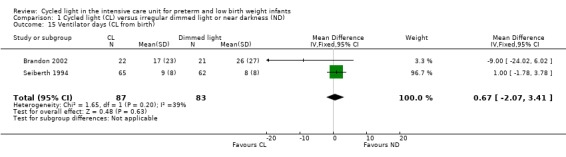
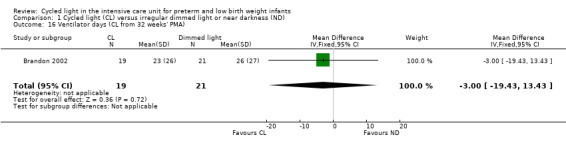
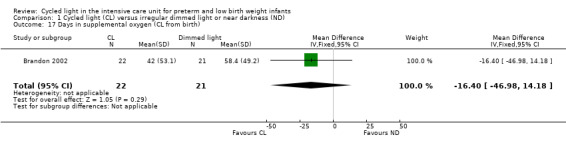
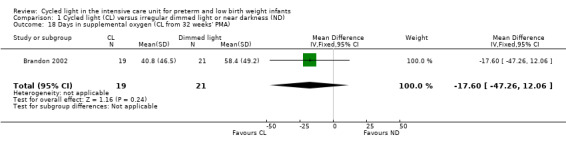
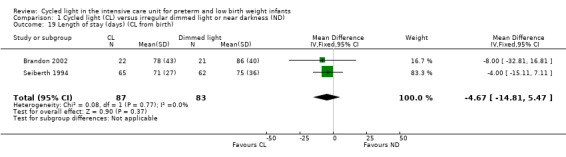
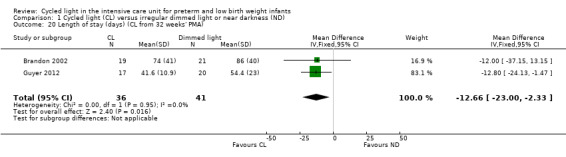
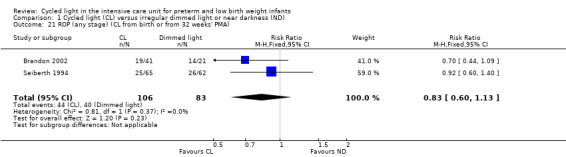
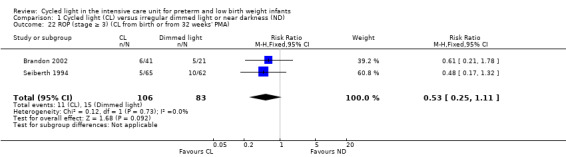
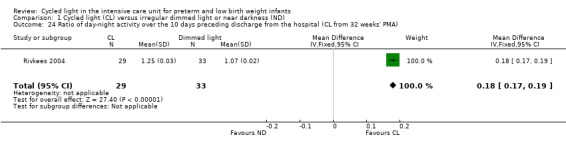
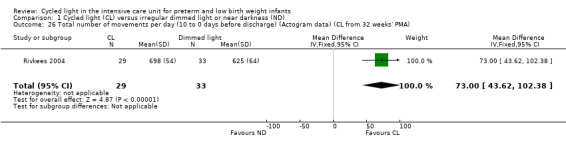
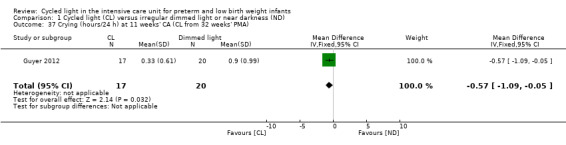
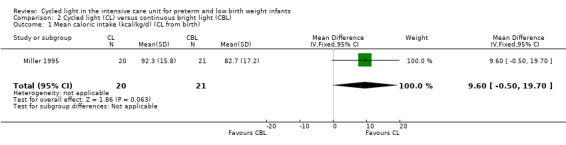
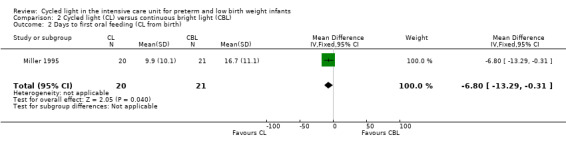
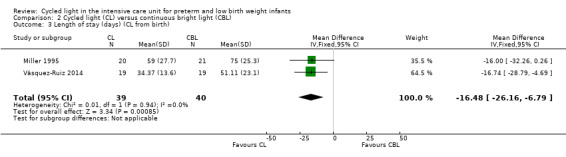
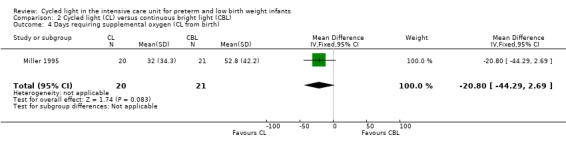
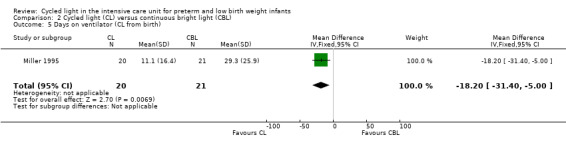
Main results: We identified one additional study enrolling 38 participants for inclusion in this update, for a total of nine studies reporting on 544 infants. In general, the quality of the studies was low, mainly owing to lack of blinding and small sample sizes.Six studies enrolling 424 infants compared CL versus ND. No study reported on weight at three or six months. One study (n = 40) found no statistically significant difference in weight at four months between CL and ND groups. In another study (n = 62), the ratio of day-night activity before discharge favoured the CL group (mean difference (MD) 0.18, 95% confidence interval (CI) 0.17 to 0.19), indicating 18% more activity during the day than during the night in the CL group compared with the ND group. Two studies (n = 189) reported on retinopathy of prematurity (stage ≥ 3) and reported no statistically significant differences between CL and ND groups (typical risk ratio (RR) 0.53, 95% CI 0.25 to 1.11, I(2) = 0%; typical risk difference (RD) -0.09, 95% CI -0.19 to 0.01, I(2) = 0%). Two studies (n = 77) reported length of hospital stay (days) and noted a significant reduction in length of stay between CL and ND groups favouring the CL group (weighted mean difference (WMD) -13 days, 95% CI -23 to -2, I(2) = 0%; no heterogeneity). The quality of the evidence according to GRADE was low for this outcome. One study (n = 37) reported less crying at 11 weeks' corrected age (CA) in the CL group compared with the ND group (MD -0.57 hours/24 h, 95% CI -1.09 to -0.05). Tests for heterogeneity were not applicable.Three studies enrolling 120 infants compared CL versus CBL. Two studies (n = 79) reported significantly shorter length of stay in the CL group compared with the CBL group (WMD -16.5 days, 95% CI -26.2 to -6.8, I(2) = 0%; no heterogeneity). The quality of the evidence according to GRADE was low for this outcome. One study (n = 41) reported higher mean weight at three months' CA among infants cared for in the CL nursery (P value < 0.02) and a lower mean number of hours spent awake in 24 hours at three months of age (P value < 0.005). Data could not be entered into RevMan or GRADE. One study (n = 41) reported shorter time on the ventilator in the CL compared with the CBL group (MD -18.2 days, 95% CI -31.40 to -5.0). One study (n = 41) reported a shorter time to first oral feeding in the CL group (MD -6.8 days, 95% CI -13.29 to -0.31). We identified no safety issues.
Authors' conclusions: Trials assessing the effects of CL have enrolled 544 infants. No study reported on our primary outcome of weight at three or six months. Results from one additional study strengthen our findings that CL versus CBL shortens length of stay, as does CL versus ND. The quality of the evidence on both comparisons for this outcome according to GRADE was low. Future research should focus on comparing CL versus ND.
Conflict of interest statement
Iris Morage ‐ none.
Arne Ohlsson ‐ none.
Figures


Update of
-
Cycled light in the intensive care unit for preterm and low birth weight infants.Cochrane Database Syst Rev. 2013 Aug 3;(8):CD006982. doi: 10.1002/14651858.CD006982.pub3. Cochrane Database Syst Rev. 2013. Update in: Cochrane Database Syst Rev. 2016 Aug 10;(8):CD006982. doi: 10.1002/14651858.CD006982.pub4. PMID: 23913547 Updated.
References
References to studies included in this review
Boo N‐Y 2002 {published data only}
-
- Boo NY, Chee SC, Rohana J. Randomized controlled study of the effects of different durations of light exposure on weight gain by preterm infants in a neonatal intensive care unit. Acta Pædiatrica 2002;91(6):674‐9. - PubMed
Brandon 2002 {published data only}
-
- Brandon DH, Holditch‐Davis D, Belyea M. Preterm infants born at less than 31 weeks' gestation have improved growth in cycled light compared with continuous near darkness. Journal of Pediatrics 2002;140(2):192‐9. - PubMed
-
- Brandon DH, Holditch‐Davis D, Belyea M, Tivnan DM. Factors affecting early neurobehavioral and sleep outcomes in preterm infants. E‐PAS: http://www.abstracts2view.com/pasall/. Proceedings of the Pediatric Academic Societies Meeting; 2003 May 3 ‐ 6; Seatle (WA). 2003:2004.
-
- Brandon DH, Holditch‐Davis D, Winchester DM. Factors affecting early neurobehavioral and sleep outcomes in preterm infants. Infant Behavior and Development 2005;28(2):206‐19.
Guyer 2012 {published data only}
-
- Guyer C, Huber R, Fontijn J, Bucher HU, Nicolai H, Werner H, et al. Cycled light exposure reduces fussing and crying in very preterm infants. Pediatrics 2012;130(1):e145‐51. - PubMed
Mann 1986 {published data only}
Miller 1995 {published data only}
-
- Miller CL, White R, Whitman TL, O'Callaghan MF, Maxwell SE. The effects of cycled versus noncycled lighting on growth and development in preterm infants. Infant Behavior and Development 1995;18(1):87‐95.
Mirmiran 2003 {published data only}
-
- Mirmiran M, Baldwin RB, Ariagno RL. Circadian and sleep development in preterm infants occurs independently from the influences of environmental lighting. Pediatric Research 2003;53(6):933‐8. - PubMed
-
- Mirmiran M, Pedu VD, Baldwin RB, Saporito AG, Ariagno RL. Cycled light in the intermediate nursery: effects on development of preterm infants. E‐PAS: http://www.abstracts2view.com/pasall/. Proceedings of the Pediatric Academic Societies Meeting; 2001 April 28 ‐ May 1; Baltimore (MD). 2001:2045.
-
- Peddu V, Mirmiran M, Boeddiker M, Baldwin RB, Ariagno RL. Effect of light‐dark (L/D) cycle on development of circadian rhythms in preterm infants. E‐PAS: http://www.abstracts2view.com/pasall/. Proceedings of the Pediatric Academic Societies Meeting; 2000 May 12 ‐ 16; Boston, MA. 2000:2507.
Rivkees 2004 {published data only}
-
- Rivkees SA, Mayes L, Jacobs H, Gross I. Rest‐activity patterns of premature infants are regulated by cycled lighting. Pediatrics 2004;113(4):833‐9. - PubMed
Seiberth 1994 {published data only}
-
- Seiberth V, Linderkamp O, Knorz MC, Liesenhof H. A controlled clinical trial of light and retinopathy of prematurity. American Journal of Ophthalmology 1994;118(4):492‐5. - PubMed
Vásquez‐Ruiz 2014 {published data only}
-
- Vásquez‐Ruiz S, Maya‐Barrios JA, Torres‐Narváez P, Vega‐Martínez BR, Rojas‐Granados A, Escobar C, et al. A light/dark cycle in the NICU accelerates body weight gain and shortens time to discharge in preterm infants. Early Human Development 2014;90(9):535‐40. - PubMed
References to studies excluded from this review
Aita 2012 {published data only}
-
- Aita M, Johnston C, Goulet C, Oberlander TF, Snider L. Intervention minimizing preterm infants’ exposure to NICU light and noise. Clinical Nursing Research 2012;22(3):337–58. - PubMed
Blackburn 1991 {published data only}
-
- Blackburn S, Patteson D. Effects of cycled light on activity state and cardiorespiratory function in preterm infants. Journal of Perinatal & Neonatal Nursing 1991;4(4):47‐54. - PubMed
Braz 2006 {published data only}
Hoogeveen 2004 {published data only}
-
- Hoogeveen E, Mirmiran M, Ariagno RL. Improved growth at four months in preterm infants receiving cycled light during newborn intermediate intensive care. E‐PAS: http://www.abstracts2view.com/pasall/. Proceedings of the Pediatric Academic Societies Meeting; 2004 May 1 ‐ 4; San Francisco, CA. 2004:2503.
Kennedy 2001 {published data only}
-
- Kennedy KA, Fielder AR, Hardy RJ, Tung B, Gordon DC, Reynolds JD, et al. Reduced lighting does not improve medical outcomes in very low birth weight infants. Journal of Pediatrics 2001;139(4):527‐31. - PubMed
References to studies awaiting assessment
Jung 2005 {published data only}
-
- Jung IS. Effects of cycled lighting on body weight, physiological variables and behavioral states in low birth weight infants. Taehan Kanho Hakhoe Chi 2005;35(1):143‐53. - PubMed
Kennaway 1996 {published data only}
-
- Kennaway DJ, Goble FC, Stamp GE. Factors influencing the development of melatonin rhythmicity in humans. Journal of Clinical Endocrinology and Metabolism 1996;81(4):1525‐32. - PubMed
References to ongoing studies
Aita 2014 {published data only}
-
- Aita M, Stremler R, Feeley N, Barrington K, Nuyt AM. Reducing NICU light and noise during kangaroo mother care: feasibility, acceptability and estimated effects on preterm infants' and mothers' outcomes. Pediatric Critical Care Medicine. Istanbul, Turkey: Conference: 7th World Congress on Pediatric Intensive and Critical Care, PICC, 2014.
NCT02146287 {published data only}
-
- Brandon DH. Preterm infants: light effects on health and development. ClinicalTrials.gov 2014.
Sanadgol 2013 {published data only}
-
- Sanadgol V. Creating an artificial night on physiological changes in preterm infants. Version ClinicalTrials.gov Identifier: NCT01833091. ClinicalTrials.gov, 2013.
Additional references
Arduini 1987
-
- Arduini D, Rizzo G, Parlati E, Dell'Acqua S, Romanini C, Mancuso S. Loss of circadian rhythms of fetal behaviour in a totally adrenalectomized pregnant woman. Gynecologic and Obstetric Investigation 1987;23(4):226‐9. - PubMed
Begum 2006
Blackburn 1998
-
- Blackburn S. Environmental impact of the NICU on developmental outcomes. Journal of Pediatric Nursing 1998;13(5):279‐89. - PubMed
Christina 2004
Engwall 2014
-
- Engwall M, Fridh I, Bergbom I, Lindahl B. Let there be light and darkness: findings from a prestudy concerning cycled light in the intensive care unit environment. Critical Care Nursing Quarterly 2014;37(3):273‐98. - PubMed
Glotzbach 1995
-
- Glotzbach SF, Edgar DM, Ariagno RL. Biological rhythmicity in preterm infants prior to discharge from neonatal intensive care. Pediatrics 1995;95(2):231‐7. - PubMed
Gottfried 1985
-
- Gottfried A. Environmental neonatology. Infant Stress Under Intensive Care. Baltimore: University Park Press, 1985:252‐7.
GRADEpro 2014 [Computer program]
-
- McMaster University, The Cochrane Collaboration. GRADEpro. Version 20150131. Hamilton: McMaster University, The Cochrane Collaboration, 2014.
Halberg 1969
-
- Halberg F. Chronobiology. Annual Review of Physiology 1969;31:675‐725. - PubMed
Halberg 2003
Hao 1999
Higgins 2011
-
- Higgins JPT, Green S (editors). Cochrane Handbook for Systematic Reviews of Interventions Version 5.1.0 [updated March 2011]. Cochrane Collaboration, 2011. www.cochrane‐handbook.org.
Hozo 2005
Jacobs 2002
-
- Jacobs SE, Sokol J, Ohlsson A. The Newborn Individualized Developmental Care and Assessment Program is not supported by meta‐analyses of the data. Journal of Pediatrics 2002;140(6):699‐706. - PubMed
Keener 1988
-
- Keener MA, Zeanah CH, Andreas TF. Infant temperament, sleep organization, and night time parental interventions. Pediatrics 1988;81(6):762‐71. - PubMed
Kennaway 1992
-
- Kennaway DJ, Stamp GE, Goble FC. Development of melatonin production in infants and the impact of prematurity. Journal of Clinical Endocrinology and Metabolism 1992;75(2):367‐9. - PubMed
Kintraia 2005
Lotas 1992
-
- Lotas MJ. Effects of light and sound in the neonatal intensive care unit environment on the low‐birth‐weight infant. NAACOGs' Clinical Issues in Perinatal and Women's Health Nursing 1992;3(1):34‐44. - PubMed
Maguire 2008
-
- Maguire CM, Veen S, Sprij AJ, Cessie S, Wit JM, Walther FJ, Leiden Developmental Care Project. Effects of basic developmental care on neonatal morbidity, neuromotor development, and growth at term age of infants who were born at <32 weeks. Pediatrics 2008;121(2):e239‐45. - PubMed
Maguire 2009
-
- Maguire CM, Walther FJ, Zwieten PH, Cessie S, Wit JM, Veen S, Leiden Developmental Care Project. No change in developmental outcome with incubator covers and nesting for very preterm infants in a randomised controlled trial. Archives of Disease in Childhood Fetal and Neonatal Edition 2009;94:F92‐7. - PubMed
McGraw 1999
-
- McGraw K, Hoffmann R, Harker C, Herman JH. The development of circadian rhythms in a human infant. Sleep 1999;22(3):303‐10. - PubMed
Mirmiran 1990
-
- Mirmiran M, Kok JH, Kleine MJ, Koppe JG, Overdijk J, Witting W. Circadian rhythms in preterm infants: a preliminary study. Early Human Development 1990;23(2):139‐46. - PubMed
Mirmiran 1996
-
- Mirmiran M, Lunshof S. Perinatal development of human circadian rhythms. Progress in Brain Research 1996;111:217‐26. - PubMed
Mirmiran 2000
-
- Mirmiran M, Ariagno RL. Influence of light in the NICU on the development of circadian rhythms in preterm infants. Seminars in Perinatology 2000;24(4):247‐57. - PubMed
Ohlsson 2007
-
- Ohlsson A, Jacob S. Meta‐regression can indicate if further NIDCAP studies are justified [Metaregression kan visa om fler NIDCAP‐studier är motiverade]. Läkartidningen 2007;104(3):134‐7. - PubMed
Ohlsson 2009
-
- Ohlsson A. NIDCAP: new controversial evidence for its effectiveness. Pediatrics 2009;124(4):1213‐5. - PubMed
Ohlsson 2013
-
- Ohlsson A, Jacobs SE. NIDCAP: a systematic review and meta‐analyses of randomized controlled trials. Pediatrics 2013;131(3):e881‐93. - PubMed
Paranjpe 2005
Patrick 1982
-
- Patrick J, Campbell K, Carmichael L, Natale R, Richardson B. Patterns of gross fetal body movements over 24‐hour observation intervals during the last 10 weeks of pregnancy. American Journal of Obstetetrics and Gynecology 1982;142(4):363‐71. - PubMed
Phelps 2001
Rea 2008
Rea 2010
Refinetti 2003
RevMan 2014 [Computer program]
-
- The Nordic Cochrane Centre, The Cochrane Collaboration. Review manager (RevMan). Version 5.3. Copenhagen: The Nordic Cochrane Centre, The Cochrane Collaboration, 2014.
Rivkees 2000
-
- Rivkees SA, Halo H. Developing circadian rhythmicity. Seminars in Perinatology 2000;24:232‐42. - PubMed
Rivkees 2003
-
- Rivkees SA. Developing circadian rhythmicity in infants. Pediatrics 2003;112(2):373‐81. - PubMed
Rivkees 2004a
-
- Rivkees SA. Emergence and influences of circadian rhythmicity in infants. Clinics in Perinatology 2004;31(2):217‐28. - PubMed
Schünemann 2013
-
- Schünemann H, Brożek J, Guyatt G, Oxman A, editors. GWG. GRADE handbook for grading quality of evidence and strength of recommendations. Available from www.guidelinedevelopment.org/handbook 2013.
Seron‐Ferre 2001
-
- Seron‐Ferre M, Torres‐Farfan C, Forcelledo ML, Valenzuela GJ. The development of circadian rhythms in the fetus and neonate. Seminars in Perinatology 2001;25(6):363‐70. - PubMed
Stetson 1986
-
- Stetson MH, Elliott JA, Goldman BD. Maternal transfer of photoperiodic information influences the photoperiodic responses of prepubertal Djungarian hamsters (Phodopus sungorus sungorus). Biology of Reproduction 1986;34(4):664‐9. - PubMed
Sukumaran 2010
Symington 2006
Thoman 1989a
-
- Thoman EB, Ingersoll EW. The human nature of the youngest human: prematurely born babies. Seminars in Perinatology 1989;13(6):482‐94. - PubMed
Thoman 1989b
-
- Thoman EB, Whitney MP. Sleep states of infants monitored in the home: individual differences, developmental trends, and origin of diurnal cyclicity. Infant Behavior and Development 1989;12(1):59‐75.
White 2007
-
- White RD. Recommended Standards for Newborn ICU Design: Report of the Seventh Census Conference on Newborn ICU Design Committee to Establish Recommended Standards for Newborn ICU Design, 2007. www.nd.edu/˜nicudes/index.html (accessed 29 July 2013).
References to other published versions of this review
Morag 2011
Publication types
MeSH terms
LinkOut - more resources
Full Text Sources
Other Literature Sources
Medical
Miscellaneous
