. 2016 Oct;36(4):1875-85.
doi: 10.3892/or.2016.5008. Epub 2016 Aug 8.

Combination of the histone deacetylase inhibitor depsipeptide and 5-fluorouracil upregulates major histocompatibility complex class II and p21 genes and activates caspase-3/7 in human colon cancer HCT-116 cells

Affiliations

Combination of the histone deacetylase inhibitor depsipeptide and 5-fluorouracil upregulates major histocompatibility complex class II and p21 genes and activates caspase-3/7 in human colon cancer HCT-116 cells

Kouji Okada et al. Oncol Rep. 2016 Oct.

Abstract

Epigenetic anticancer drugs such as histone deacetylase (HDAC) inhibitors have been combined with existing anticancer drugs for synergistic or additive effects. In the present study, we found that a very low concentration of depsipeptide, an HDAC inhibitor, potentiated the antitumor activity of 5-fluorouracil (5-FU) in a human colon cancer cell model using HCT-116, HT29, and SW48 cells via the inhibition of colony formation ability or cellular viability. Exposure to a combination of 5-FU (1.75 µM) and 1 nM depsipeptide for 24 and 48 h resulted in a 3- to 4-fold increase in activated caspase-3/7, while 5-FU alone failed to activate caspase-3/7. Microarray and subsequent gene ontology analyses revealed that compared to 5-FU or depsipeptide alone, the combination treatment of 5-FU and depsipeptide upregulated genes related to cell death and the apoptotic process consistent with the inhibition of colony formation and caspase-3/7 activation. These analyses indicated marked upregulation of antigen processing and presentation of peptide or polysaccharide antigen via major histocompatibility complex (MHC) class (GO:0002504) and MHC protein complex (GO:0042611). Compared with vehicle controls, the cells treated with the combination of 5-FU and depsipeptide showed marked induction (3- to 8.5-fold) of expression of MHC class II genes, but not of MHC class I genes. Furthermore, our global analysis of gene expression, which was focused on genes involved in the molecular regulation of MHC class II genes, showed enhancement of pro-apoptotic PCAF and CIITA after the combination of 5-FU and depsipeptide. These results may indicate a closer relationship between elevation of MHC class II expression and cellular apoptosis induced by the combination of depsipeptide and 5-FU. To the best of our knowledge, this is the first study to report that the combination of 5-FU and depsipeptide induces human colon cancer cell apoptosis in a concerted manner with the induction of MHC class II gene expression.


Figures
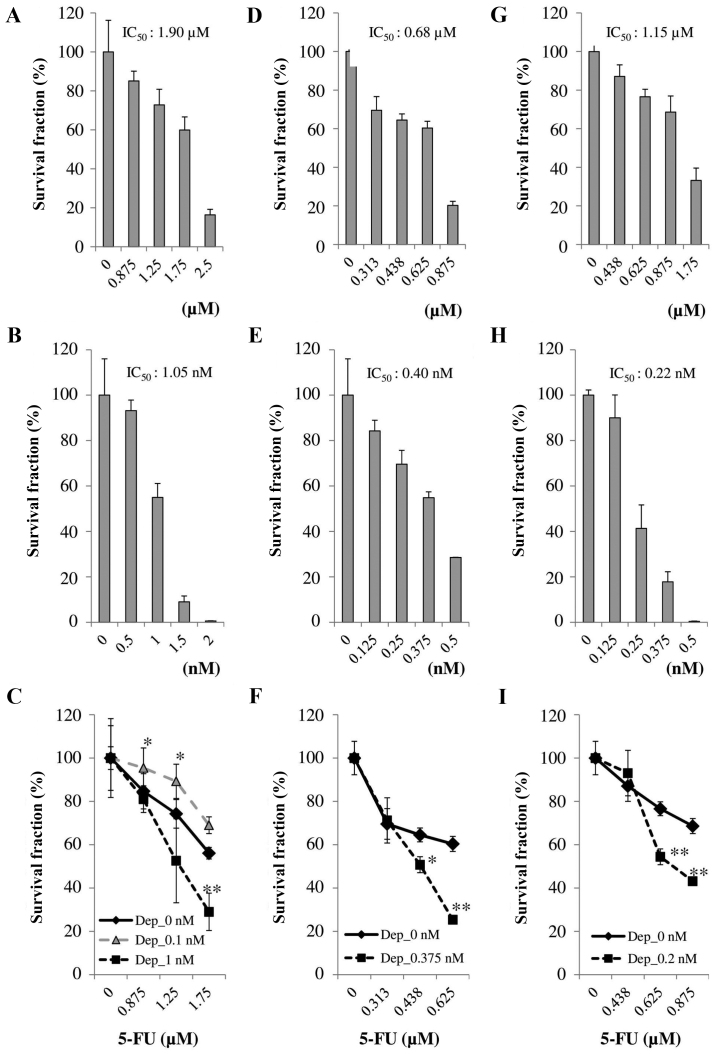
Figure 1
Figure 1
Effect of (A) 5-fluorouracil (5-FU), (B) depsipeptide (Dep) and the combination of (C) 5-FU and dep on the inhibition of colony formation ability of human colon cancer HCT-116 cells. Effect of (D) 5-FU, (E) Dep and the combination of (F) 5-FU and Dep on the inhibition of colony formation ability of human colon cancer HT29 cells. Effect of (G) 5-FU, (H) Dep and the combination of (I) 5-FU and Dep on inhibition of cellular viability of the human colon cancer SW48 cells. The x-axis represents drug concentrations, and y-axis represents survival fraction (i.e., colony-forming ability relative to 0 µM 5-FU). *P<0.05 vs. 0 nM Dep, **P<0.01 vs. 0 nM Dep by one-way ANOVA.
Figure 2
Figure 2
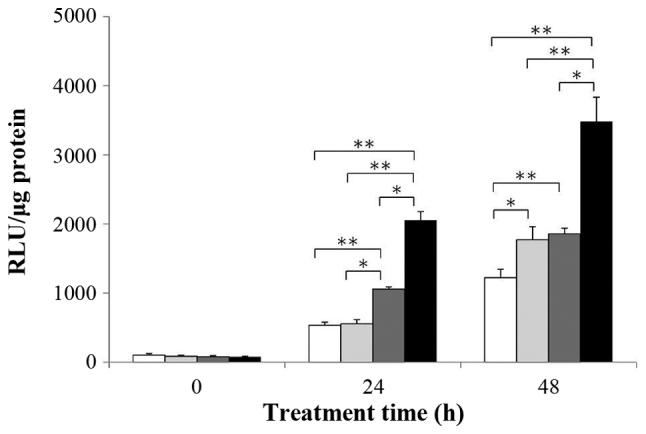
Time-course of caspase-3/7 activation in HCT-116 cells following treatment with the vehicle control (white bar), 5-fluorouracil (5-FU) (1.75 µM) alone (light gray bar), depsipeptide (Dep) (1 nM) alone (dark gray bar) and the combination of 5-FU (1.75 µM) + Dep (1 nM) (black bar). Data are expressed as relative light units (RLU)/µg of protein. The x-axis represents the length of the treatment period (h), and the y-axis represents RLU/µg of protein. *P<0.05 or **P<0.01 indicates a significant difference.
Figure 3
Figure 3
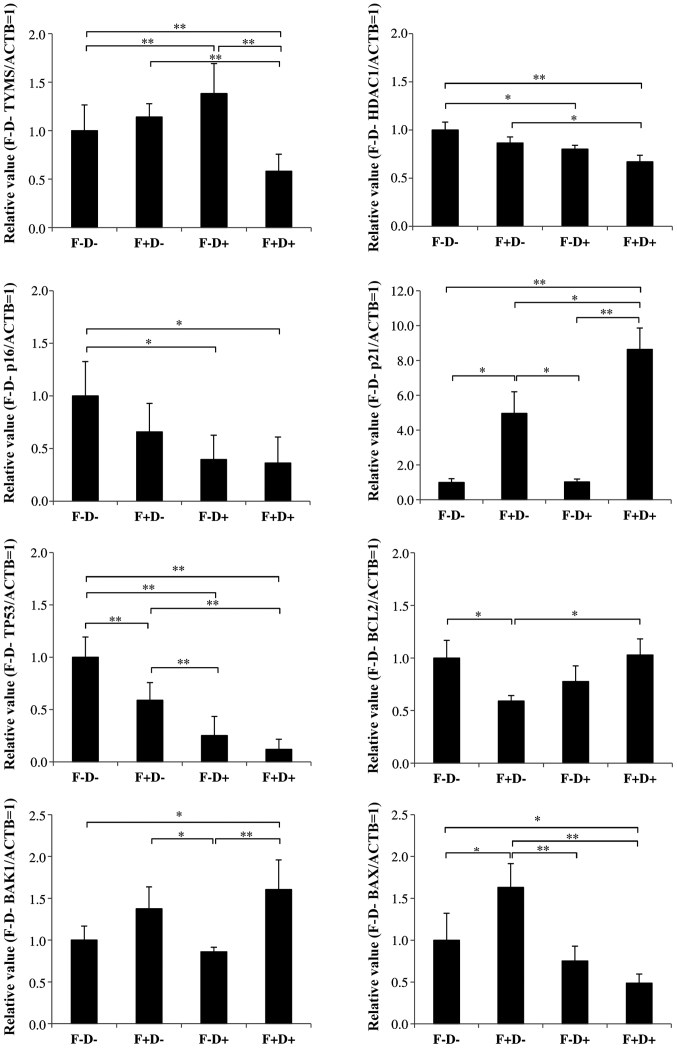
The mechanism of action, cell cycle- and apoptosis-related gene-expression in HCT-116 cells following treatment with the vehicle control (FD), 5-fluorouracil (5-FU) (1.75 µM) alone (F+D), depsipeptide (Dep) (1 nM) alone (F-D+) and the combination of 5-FU (1.75 µM) + Dep (1 nM) (F+D+). mRNA levels were assessed by qRT-PCR and were normalized by the ACTB mRNA level at each point. The y-axis represents mRNA levels of the genes of interest relative to ACTB mRNA. Data are expressed as mean ± SEM. *P<0.05 or **P<0.01 indicates a significant difference by one-way ANOVA.
Figure 4
Figure 4
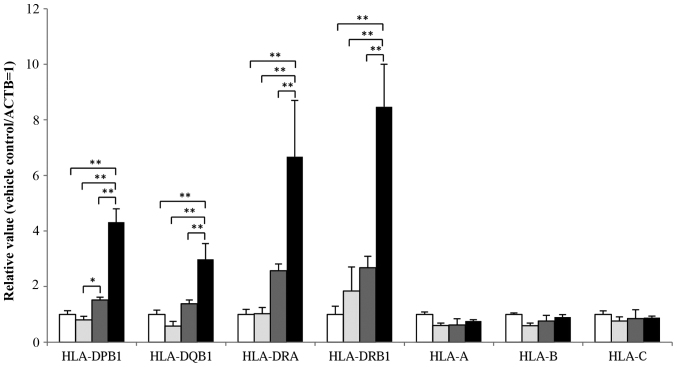
Expression of major histocompatibility complex (MHC) class II and I genes in the HCT-116 cells following treatment with the vehicle control (white bar), 5-fluorouracil (5-FU) (1.75 µM) alone (light gray bar), depsipeptide (Dep) (1 nM) alone (dark gray bar), and the combination of 5-FU (1.75 µM) + Dep (1 nM) (black bar). The mRNA levels were normalized by the ACTB mRNA level at each point. The x-axis indicates the MHC class II and MHC class I genes. The y-axis represents mRNA levels of the genes of interest relative to the ACTB mRNA. Data are expressed as mean ± SEM. *P<0.05 or **P<0.01 indicates a significant difference by one-way ANOVA.

References

    1. Longley DB, Harkin DP, Johnston PG. 5-fluorouracil: Mechanisms of action and clinical strategies. Nat Rev Cancer. 2003;3:330–338. doi: 10.1038/nrc1074. - DOI - PubMed
    1. Gustavsson B, Carlsson G, Machover D, Petrelli N, Roth A, Schmoll HJ, Tveit KM, Gibson F. A review of the evolution of systemic chemotherapy in the management of colorectal cancer. Clin Colorectal Cancer. 2015;14:1–10. doi: 10.1016/j.clcc.2014.11.002. - DOI - PubMed
    1. Meyerhardt JA, Mayer RJ. Systemic therapy for colorectal cancer. N Engl J Med. 2005;352:476–487. doi: 10.1056/NEJMra040958. - DOI - PubMed
    1. Tsai HC, Baylin SB. Cancer epigenetics: Linking basic biology to clinical medicine. Cell Res. 2011;21:502–517. doi: 10.1038/cr.2011.24. - DOI - PMC - PubMed
    1. Dokmanovic M, Clarke C, Marks PA. Histone deacetylase inhibitors: Overview and perspectives. Mol Cancer Res. 2007;5:981–989. doi: 10.1158/1541-7786.MCR-07-0324. - DOI - PubMed

MeSH terms