


Adaptive radiation therapy for bladder cancer: a review of adaptive techniques used in clinical practice
- PMID: 27512574
- PMCID: PMC4968556
- DOI: 10.1002/jmrs.129
Adaptive radiation therapy for bladder cancer: a review of adaptive techniques used in clinical practice
Abstract
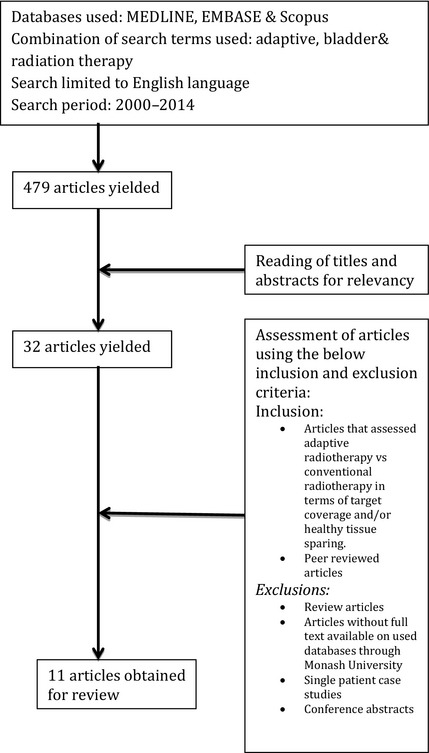
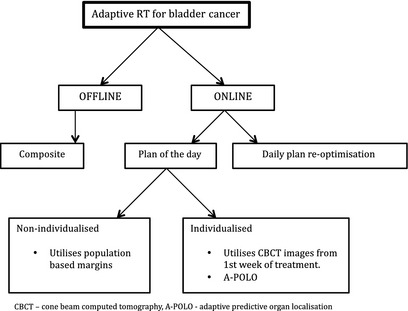
Significant changes in the shape, size and position of the bladder during radiotherapy (RT) treatment for bladder cancer have been correlated with high local failure rates; typically due to geographical misses. To account for this, large margins are added around the target volumes in conventional RT; however, this increases the volume of healthy tissue irradiation. The availability of cone beam computed tomography (CBCT) has not only allowed in-room volumetric imaging of the bladder, but also the development of adaptive radiotherapy (ART) for modification of plans to patient-specific changes. The aim of this review is to: (1) identify and explain the different ART techniques being used in clinical practice and (2) compare and contrast these different ART techniques to conventional RT in terms of target coverage and dose to healthy tissue: A literature search was conducted using EMBASE, MEDLINE and Scopus with the key words 'bladder, adaptive, radiotherapy/radiation therapy'. 11 studies were obtained that compared different adaptive RT techniques to conventional RT in terms of target volume coverage and healthy tissue sparing. All studies showed superior target volume coverage and/or healthy tissue sparing in adaptive RT compared to conventional RT. Cross-study comparison between different adaptive techniques could not be made due to the difference in protocols used in different studies. However, one study found daily re-optimisation of plans to be superior to plan of the day technique. The use of adaptive RT for bladder cancer is promising. Further study is required to assess adaptive RT versus conventional RT in terms of local control and long-term toxicity.
Keywords: Adaptive; bladder; cone beam computed tomography; conventional; radiation therapy.
Figures
References
-
- Australian Institute of Health and Welfare & Australasian Association of Cancer Registries . Cancer in Australia: An overview 2012. Cancer series no. 74. Cat. no. CAN 70. AIHW, Canberra, 2012.
-
- Thariat J, Aluwini S, Pan Q, et al. Image‐guided radiation therapy for muscle‐invasive bladder cancer. Nat Rev Urol 2012; 9: 23–9. - PubMed
-
- Harris VA, McDonald FMA, Huddart R. Latest advances in cone‐beam CT for bladder radiotherapy. Imaging Med 2011; 3: 321–32.
-
- Arthur C, Livsey J, Choudhury A. Delivering adaptive radiotherapy to the bladder during radical treatment. J Radiother Pract 2013; 12: 195–202.
-
- Kotwal S, Choudhury A, Johnston C, Paul AB, Whelan P, Kiltie AE. Similar treatment outcomes for radical cystectomy and radical radiotherapy in invasive bladder cancer treated at a United Kingdom specialist treatment center. Int J Radiat Oncol Biol Phys 2008; 70: 456–63. - PubMed
Publication types
MeSH terms
LinkOut - more resources
Full Text Sources
Other Literature Sources
Medical
