


Mindfulness and Coping Are Inversely Related to Psychiatric Symptoms in Patients and Informal Caregivers in the Neuroscience ICU: Implications for Clinical Care
- PMID: 27513536
- PMCID: PMC5069080
- DOI: 10.1097/CCM.0000000000001855
Mindfulness and Coping Are Inversely Related to Psychiatric Symptoms in Patients and Informal Caregivers in the Neuroscience ICU: Implications for Clinical Care
Abstract
Objective: To assess the correlation of psychosocial resiliency factors (mindfulness and coping) with symptoms of posttraumatic stress, anxiety, and depression in patients recently admitted to the neuroscience ICU and their primary informal caregivers.
Design: A descriptive, cross-sectional correlational study.
Setting: Neuroscience ICU in a major medical center.
Participants: A total of 78 dyads of patients (total n = 81) and their primary caregivers (total n = 92) from June to December 2015. Study enrollment occurred within the first 2 weeks of patient admission to the neuroscience ICU.
Intervention: None.
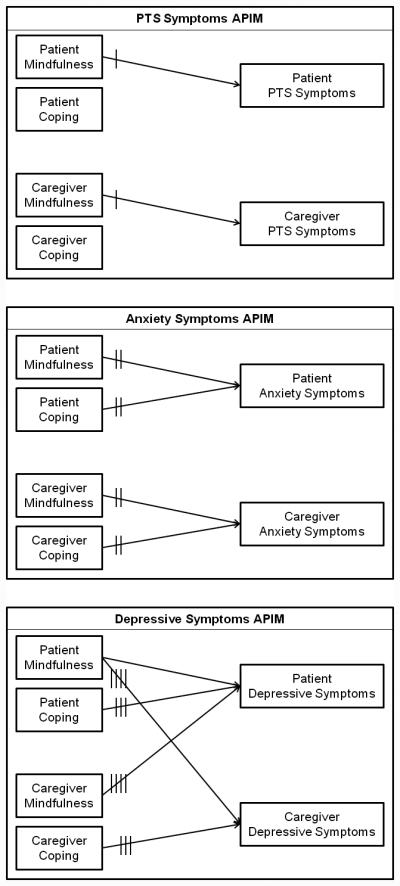
Measurements and main results: Dyads completed self-report measures of mindfulness (Cognitive and Affective Mindfulness Scale-Revised), coping (Measure of Coping Status-A), posttraumatic stress (Posttraumatic Checklist-Specific Stressor), anxiety (Hospital Anxiety and Depression Scale-A), and depression (Hospital Anxiety and Depression Scale-D). Rates of clinically significant posttraumatic stress, anxiety, and depressive symptoms were high and comparable between patient and caregiver samples. Own psychological resilience factors and psychiatric symptoms were strongly correlated for both patients and caregivers. Depressive symptoms were interdependent between patients and their caregivers, and one's own mindfulness was independently related to one's partner's depressive symptoms.
Conclusions: Rates of clinically significant psychiatric symptoms were high, equally prevalent in patients and caregivers, and interdependent between patients and their caregivers. For both patients and caregivers, psychological resiliency factors were associated with both self and partner psychiatric symptoms. Findings suggest that attending to the psychiatric health of both patients and caregivers in the neuroscience ICU is a priority and that patients and their caregivers must be considered together in a system to fully address either individual's psychiatric symptoms.
Figures
References
-
- Kiphuth IC, Utz KS, Noble AJ, Kohrmann M, Schenk T. Increased prevalence of posttraumatic stress disorder in patients after transient ischemic attack. Stroke. 2014;45(11):3360–3366. - PubMed
-
- Carek V, Norman P, Barton J. Cognitive appraisals and posttraumatic stress disorder symptoms in informal caregivers of stroke survivors. Rehabil Psychol. 2010;55(1):91–96. - PubMed
-
- Campbell Burton CA, Murray J, Holmes J, Astin F, Greenwood D, Knapp P. Frequency of anxiety after stroke: a systematic review and meta-analysis of observational studies. Int J Stroke. 2013;8(7):545–559. - PubMed
-
- Cumming TB, Blomstrand C, Skoog I, Linden T. The high prevalence of anxiety disorders after stroke. Am J Geriatr Psychiatry. 2015 pii:S1064-7481(15)00189-X. - PubMed
-
- Denno MS, Gillard PJ, Graham GD, DiBonaventura MD, Goren A, Varon SF, et al. Anxiety and depression associated with caregiver burden in caregivers of stroke survivors with spasticity. Arch Phys Med Rehabil. 2013;94(9):1731–1736. - PubMed
MeSH terms
Grants and funding
LinkOut - more resources
Full Text Sources
Other Literature Sources
Medical
