


Continued efforts to translate diabetes cardiovascular outcome trials into clinical practice
- PMID: 27514514
- PMCID: PMC4982334
- DOI: 10.1186/s12933-016-0431-4
Continued efforts to translate diabetes cardiovascular outcome trials into clinical practice
Abstract
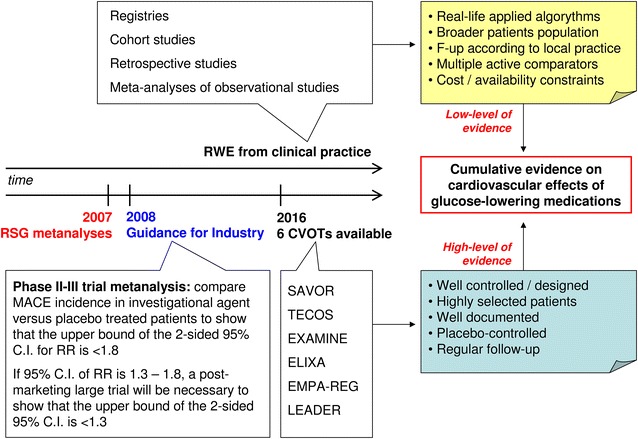
Diabetic patients suffer from a high rate of cardiovascular events and such risk increases with HbA1c. However, lowering HbA1c does not appear to yield the same benefit on macrovascular endpoints, as observed for microvascular endpoints. As the number of glucose-lowering medications increases, clinicians have to consider several open questions in the management of type 2 diabetes, one of which is the cardiovascular risk profile of each regimen. Recent placebo-controlled cardiovascular outcome trials (CVOTs) have responded to some of these questions, but careful interpretation is needed. After general disappointment around CVOTs assessing safety of DPP-4 inhibitors (SAVOR, TECOS, EXAMINE) and the GLP-1 receptor agonist lixisenatide (ELIXA), the EMPA-REG Outcome trial and the LEADER trial have shown superiority of the SGLT2-I empagliflozin and the GLP-1RA liraglutide, respectively, on the 3-point MACE outcome (cardiovascular death, non-fatal myocardial infarction or stroke) and cardiovascular, as well as all-cause mortality. While available mechanistic studies largely support a cardioprotective effect of GLP-1, the ability of SGLT2 inhibitor(s) to prevent cardiovascular death was unexpected and deserves future investigation. We herein review the results of completed CVOTs of glucose-lowering medications and suggest a possible treatment algorithm based on cardiac and renal co-morbidities to translate CVOT findings into clinical practice.
Keywords: Cardiovascular disease; Cardiovascular outcome trials; Complications; Diabetes; Treatment.
Figures

References
-
- Emerging Risk Factors C, Di Angelantonio E, Gao P, Khan H, Butterworth AS, Wormser D, Kaptoge S, Kondapally Seshasai SR, Thompson A, Sarwar N, et al. Glycated hemoglobin measurement and prediction of cardiovascular disease. JAMA. 2014;311(12):1225–1233. doi: 10.1001/jama.2014.1873. - DOI - PMC - PubMed
-
- Authors/Task Force M, Ryden L, Grant PJ, Anker SD, Berne C, Cosentino F, Danchin N, Deaton C, Escaned J, Hammes HP, et al. ESC guidelines on diabetes, pre-diabetes, and cardiovascular diseases developed in collaboration with the EASD: the Task Force on diabetes, pre-diabetes, and cardiovascular diseases of the European Society of Cardiology (ESC) and developed in collaboration with the European Association for the Study of Diabetes (EASD) Eur Heart J. 2013;34(39):3035–3087. doi: 10.1093/eurheartj/eht108. - DOI - PubMed
Publication types
MeSH terms
Substances
LinkOut - more resources
Full Text Sources
Other Literature Sources
Medical
Research Materials
Miscellaneous
