


Advanced Glycation End-Products Enhance Lung Cancer Cell Invasion and Migration
- PMID: 27517907
- PMCID: PMC5000686
- DOI: 10.3390/ijms17081289
Advanced Glycation End-Products Enhance Lung Cancer Cell Invasion and Migration
Retraction in
-
Retraction: Hsia, T.-C., et al. Advanced Glycation End-Products Enhance Lung Cancer Cell Invasion and Migration. Int. J. Mol. Sci. 2016, 17, 1289, doi:10.3390/ijms17081289.Int J Mol Sci. 2017 Jul 28;18(8):1642. doi: 10.3390/ijms18081642. Int J Mol Sci. 2017. PMID: 28788052 Free PMC article.
Abstract
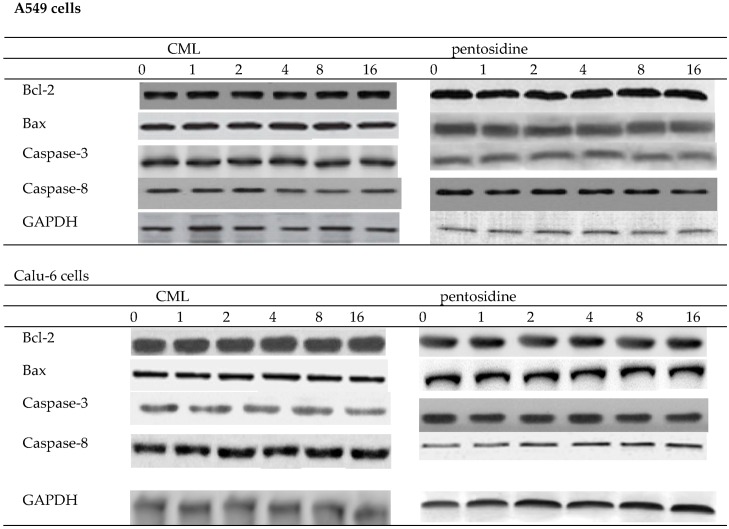
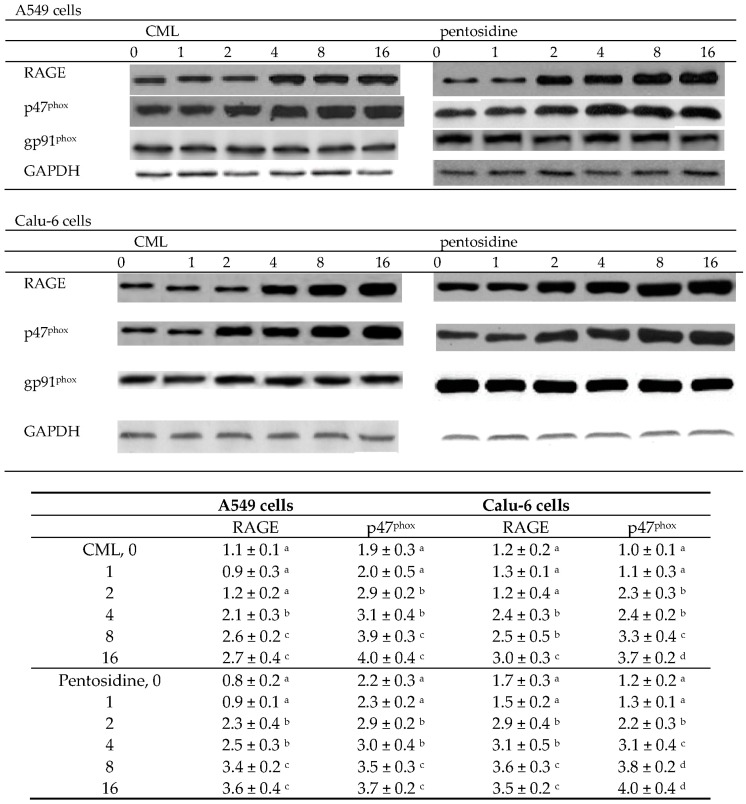
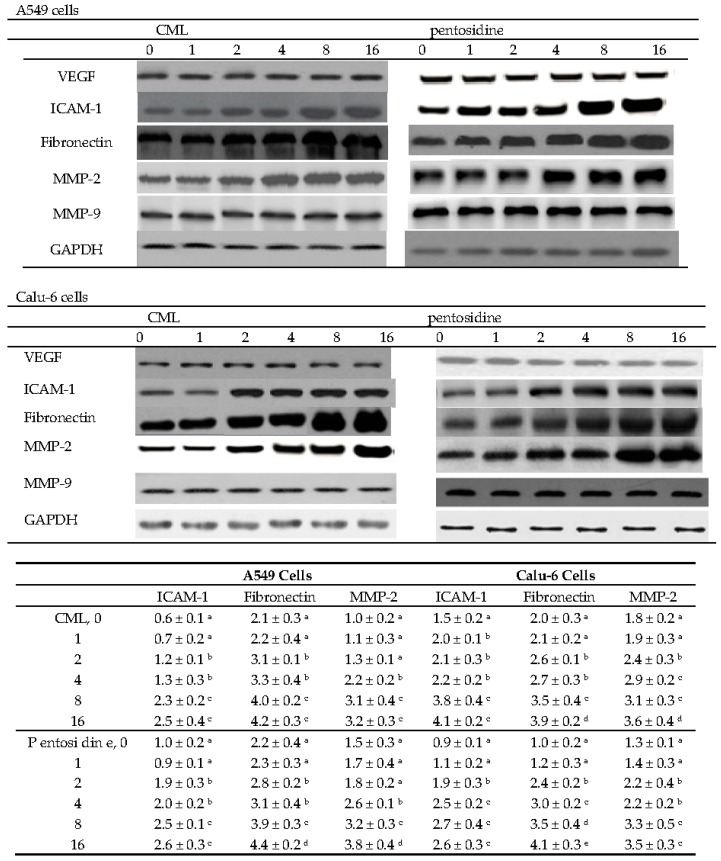
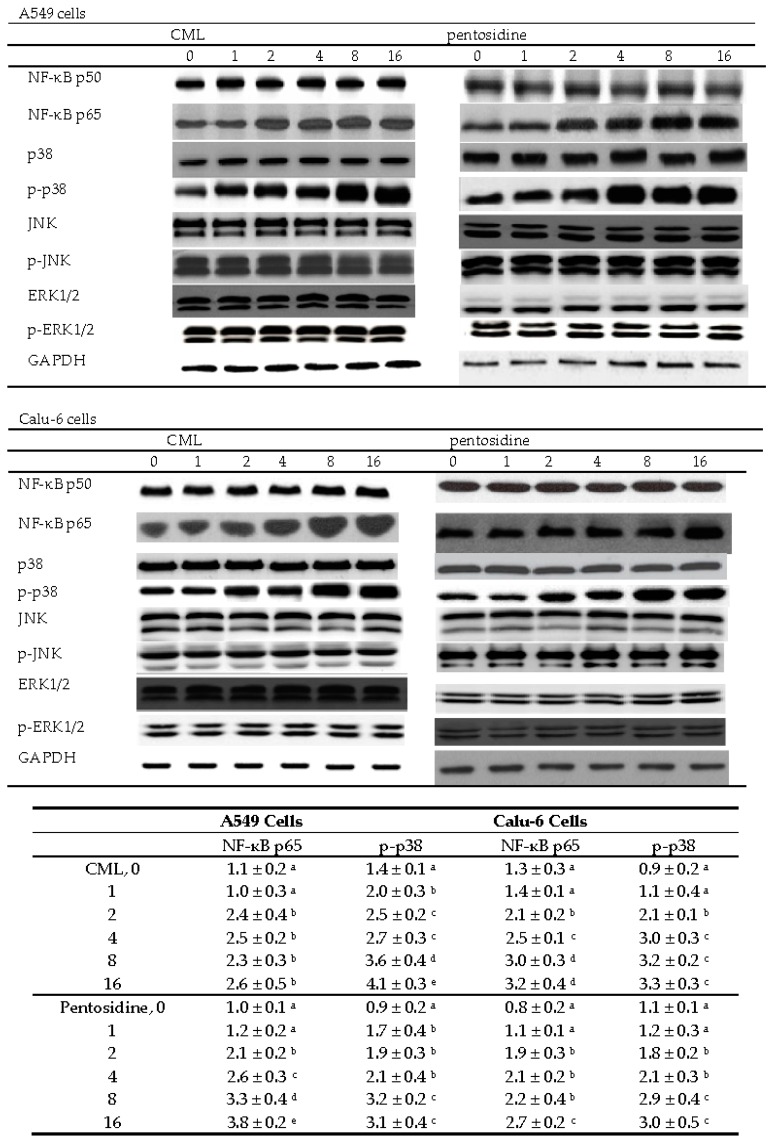
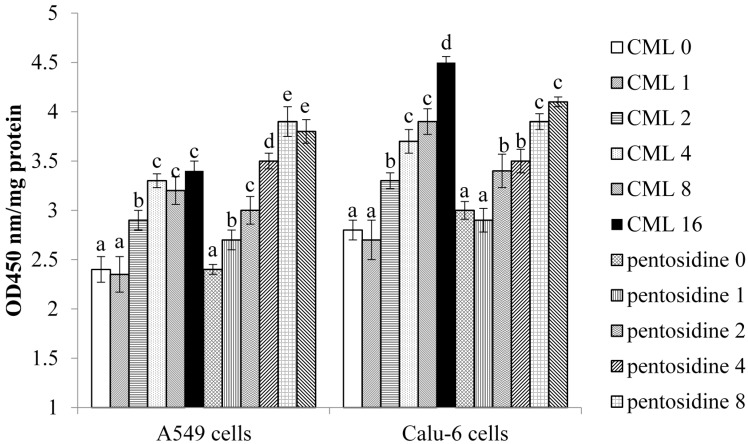
Effects of carboxymethyllysine (CML) and pentosidine, two advanced glycation end-products (AGEs), upon invasion and migration in A549 and Calu-6 cells, two non-small cell lung cancer (NSCLC) cell lines were examined. CML or pentosidine at 1, 2, 4, 8 or 16 μmol/L were added into cells. Proliferation, invasion and migration were measured. CML or pentosidine at 4-16 μmol/L promoted invasion and migration in both cell lines, and increased the production of reactive oxygen species, tumor necrosis factor-α, interleukin-6 and transforming growth factor-β1. CML or pentosidine at 2-16 μmol/L up-regulated the protein expression of AGE receptor, p47(phox), intercellular adhesion molecule-1 and fibronectin in test NSCLC cells. Matrix metalloproteinase-2 protein expression in A549 and Calu-6 cells was increased by CML or pentosidine at 4-16 μmol/L. These two AGEs at 2-16 μmol/L enhanced nuclear factor κ-B (NF-κ B) p65 protein expression and p38 phosphorylation in A549 cells. However, CML or pentosidine at 4-16 μmol/L up-regulated NF-κB p65 and p-p38 protein expression in Calu-6 cells. These findings suggest that CML and pentosidine, by promoting the invasion, migration and production of associated factors, benefit NSCLC metastasis.
Keywords: CML; invasion; migration; non-small cell lung cancer; pentosidine.
Figures
References
-
- Chao P.C., Hsu C.C., Yin M.C. Analysis of glycative products in sauces and sauce-treated foods. Food Chem. 2009;113:262–266. doi: 10.1016/j.foodchem.2008.06.076. - DOI
-
- Scheijen J.L., Clevers E., Engelen L., Dagnelie P.C., Brouns F., Stehouwer C.D., Schalkwijk C.G. Analysis of advanced glycation endproducts in selected food items by ultra-performance liquid chromatography tandem mass spectrometry: Presentation of a dietary AGE database. Food Chem. 2016;190:1145–1150. doi: 10.1016/j.foodchem.2015.06.049. - DOI - PubMed
-
- Piroddi M., Palazzetti I., Quintaliani G., Pilolli F., Montaldi M., Valentina V., Libetta C., Galli F. Circulating levels and dietary intake of the advanced glycation end-product marker carboxymethyl lysine in chronic kidney disease patients on conservative predialysis therapy: A pilot study. J. Ren. Nutr. 2011;21:329–339. doi: 10.1053/j.jrn.2010.06.024. - DOI - PubMed
Publication types
MeSH terms
Substances
LinkOut - more resources
Full Text Sources
Other Literature Sources
Medical
