


Emergency Department Use in a Cohort of Older Homeless Adults: Results From the HOPE HOME Study
- PMID: 27520382
- PMCID: PMC5857347
- DOI: 10.1111/acem.13070
Emergency Department Use in a Cohort of Older Homeless Adults: Results From the HOPE HOME Study
Abstract
Objective: The median age of single homeless adults is over 50, yet little is known about their emergency department (ED) use. We describe use of and factors associated with ED use in a sample of homeless adults 50 and older.
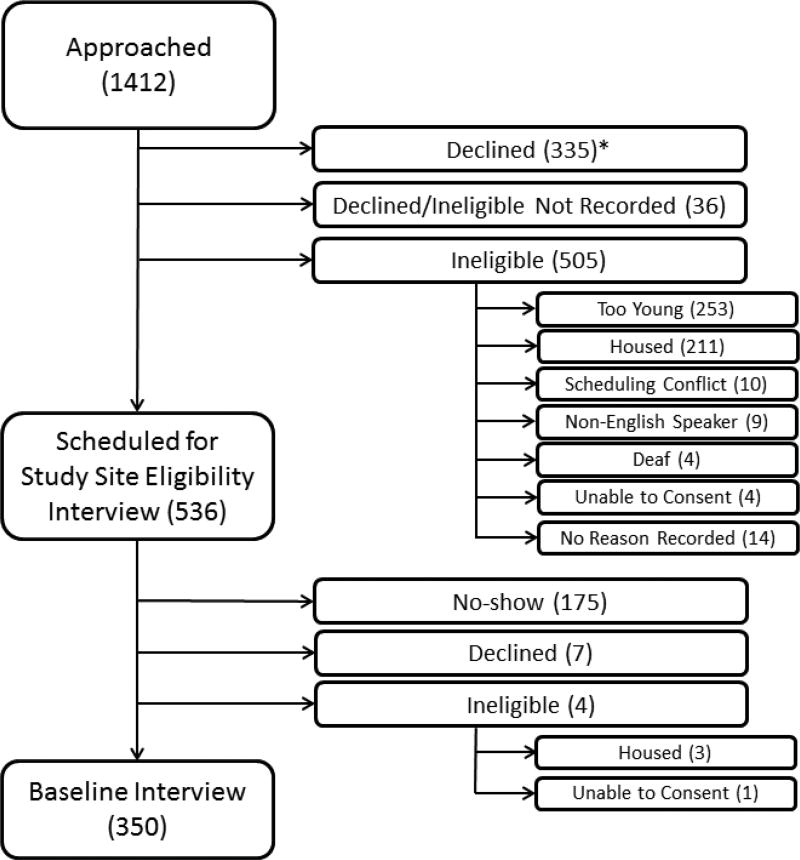
Methods: We recruited 350 participants who were homeless and 50 or older in Oakland, California. We interviewed participants about residential history in the prior 6 months, health status, health-related behaviors, and health services use and assessed cognition and mobility. Our primary outcome was the number of ED visits in the prior 6 months based on medical record review. We used negative binomial regression to examine factors associated with ED use.
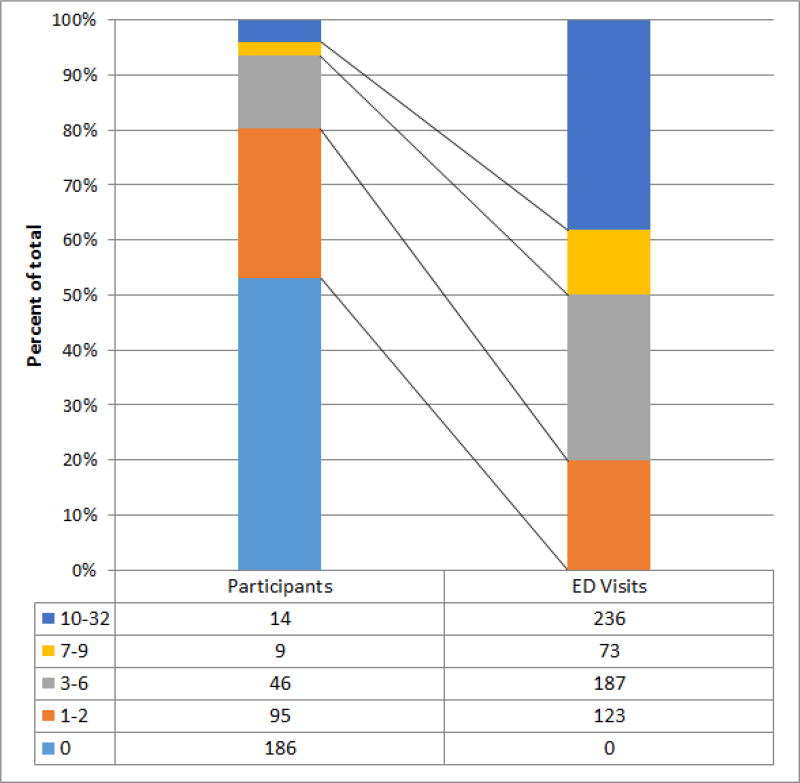
Results: In the 6 months prior to enrollment, 46.3% of participants spent the majority of their time unsheltered; 25.1% cycled through multiple institutions including shelters, hospitals, and jails; 16.3% primarily stayed with family or friends; and 12.3% had become homeless recently after spending much of the prior 6 months housed. Half (49.7%) of participants made at least one ED visit in the past 6 months; 6.6% of participants accounted for 49.9% of all visits. Most (71.8%) identified a regular non-ED source of healthcare; 7.3% of visits resulted in hospitalization. In multivariate models, study participants who used multiple institutions (incidence rate ratio [IRR] = 2.27; 95% confidence interval [CI] = 1.08 to 4.77) and who were unsheltered (IRR = 2.29; 95% CI = 1.17 to 4.48) had higher ED use rates than participants who had been housed for most of the prior 6 months. In addition, having health insurance/coverage (IRR = 2.6; CI = 1.5 to 4.4), a history of psychiatric hospitalization (IRR = 1.80; 95% CI = 1.09 to 2.99), and severe pain (IRR = 1.72; 95% CI = 1.07 to 2.76) were associated with higher ED visit rates.
Conclusions: A sample of adults aged 50 and older who were homeless at study entry had higher rates of ED use in the prior 6 months than the general U.S. age-matched population. Within the sample, ED use rates varied based on individuals' residential histories, suggesting that individuals' ED use is related to exposure to homelessness.
© 2016 by the Society for Academic Emergency Medicine.
Conflict of interest statement
Figures
References
-
- Hwang SW, Henderson MJ. Health Care Utilization in Homeless People: Translating Research into Policy and Practice: Agency for Healthcare Research and Quality. 2010
-
- Mandelberg JH, Kuhn RE, Kohn MA. Epidemiologic analysis of an urban, public emergency department's frequent users. Academic emergency medicine : official journal of the Society for Academic Emergency Medicine. 2000;7:637–46. - PubMed
-
- Tsai J, Rosenheck RA. Risk factors for ED use among homeless veterans. The American journal of emergency medicine. 2013;31:855–8. - PubMed
MeSH terms
Grants and funding
LinkOut - more resources
Full Text Sources
Other Literature Sources
Medical
Miscellaneous
