. 2016 Aug 12;15(1):96.
doi: 10.1186/s12938-016-0217-7.

Medical telerobotic systems: current status and future trends

Affiliations

Medical telerobotic systems: current status and future trends

Sotiris Avgousti et al. Biomed Eng Online. .

Abstract

Teleoperated medical robotic systems allow procedures such as surgeries, treatments, and diagnoses to be conducted across short or long distances while utilizing wired and/or wireless communication networks. This study presents a systematic review of the relevant literature between the years 2004 and 2015, focusing on medical teleoperated robotic systems which have witnessed tremendous growth over the examined period. A thorough insight of telerobotics systems discussing design concepts, enabling technologies (namely robotic manipulation, telecommunications, and vision systems), and potential applications in clinical practice is provided, while existing limitations and future trends are also highlighted. A representative paradigm of the short-distance case is the da Vinci Surgical System which is described in order to highlight relevant issues. The long-distance telerobotics concept is exemplified through a case study on diagnostic ultrasound scanning. Moreover, the present review provides a classification into short- and long-distance telerobotic systems, depending on the distance from which they are operated. Telerobotic systems are further categorized with respect to their application field. For the reviewed systems are also examined their engineering characteristics and the employed robotics technology. The current status of the field, its significance, the potential, as well as the challenges that lie ahead are thoroughly discussed.

Keywords: Medical robotics; Surgical robotics; Telemanipulation; Telemedicine; Teleoperation; Telepresence; Telerobotics; mHealth.


Figures
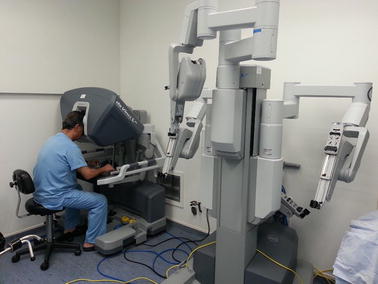
Fig. 1
Fig. 1
The da Vinci® surgical system [141]
Fig. 2
Fig. 2
Robotized tele-ultrasound using the MELODY system [54]
Fig. 3
Fig. 3
WORTEX 2012 [54] experiment demonstrated the intercontinental feasibility of remote robotized tele-echography in a range of cultural, technical and clinical contexts
Fig. 4
Fig. 4
Block diagram of the master–slave experimental set-up for needle insertion. Needle targeting can be carried out using images and preoperative planning tools (e.g., stereotactic approaches) or under real-time guidance using a suitable imaging modality (e.g., US). Reprinted with permission from [55]
Fig. 5
Fig. 5
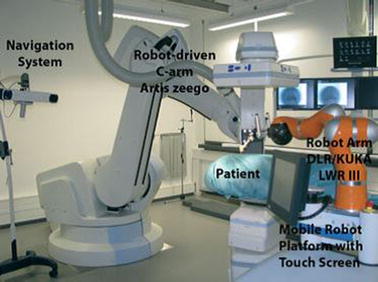
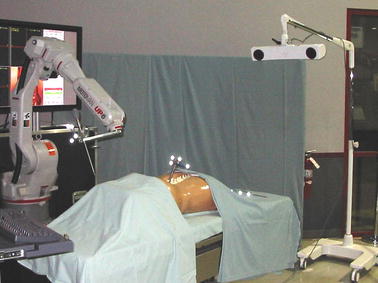
System for CT-guided robotically‐assisted interventions. Reprinted with permission from [58]
Fig. 6
Fig. 6
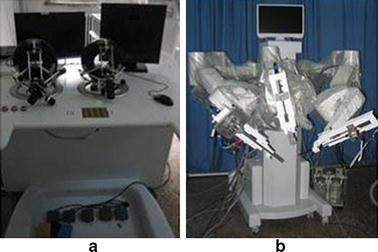
Medical robot for MIS: a surgery console; b robotic arm cart. Reprinted with permission from [59]
Fig. 7
Fig. 7
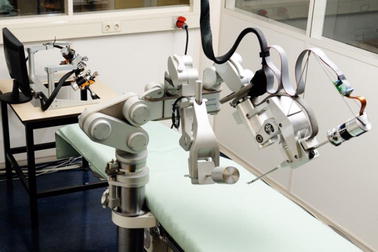
Surgical robot “Sofie”. Reprinted with permission from [60]
Fig. 8
Fig. 8
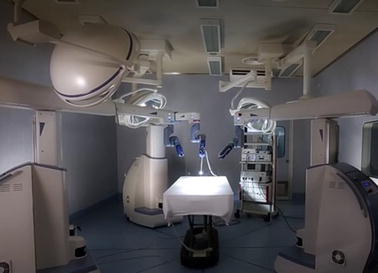
The Telelap ALF-X system consists of a console and three/four independent arms each one of which with six degrees-of-freedom. Reprinted with permission from [63]
Fig. 9
Fig. 9
Layout of Trauma Pod system main components. Reprinted with permission from [74]
Fig. 10
Fig. 10
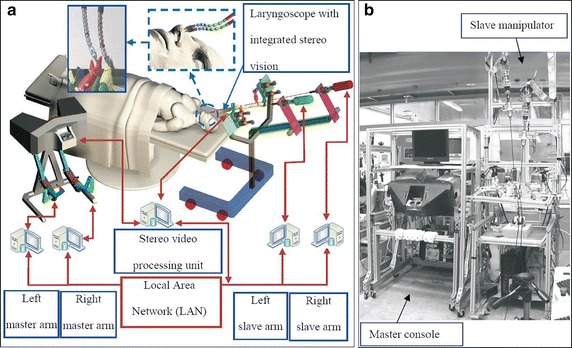
a Outline of the telerobotic system for MIS of the throat and upper airways. b The system prototype. Reprinted with permission from [66]
Fig. 11
Fig. 11
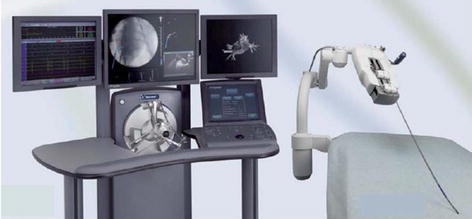
The Hansen robotic system includes the physician workstation and the remote catheter manipulator. Reprinted with permission from [98]
Fig. 12
Fig. 12
a Four Raven‐II robotic arms and two cameras arranged for collaborative telesurgery; b CAD rendering of the system; c Surgical console. Copyright © IEEE. All rights reserved. Reprinted with permission from [116]
Fig. 13
Fig. 13
The RIME surgical robotic system developed by Wright State University. Copyright © IEEE. All rights reserved. Reprinted with permission from [142]
Fig. 14
Fig. 14
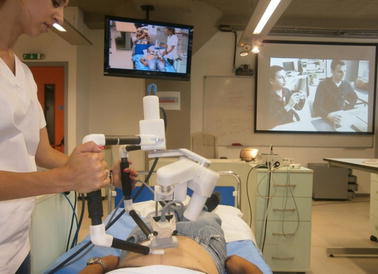
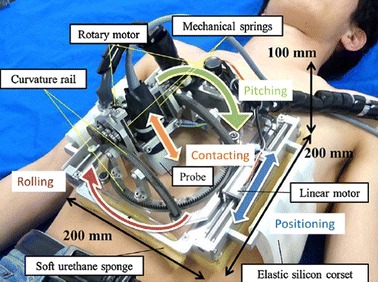
Wearable teleechography robot. The robot provides 4 DOF and control of the US probe for FAST. Reprinted with permission from [121]
Fig. 15
Fig. 15
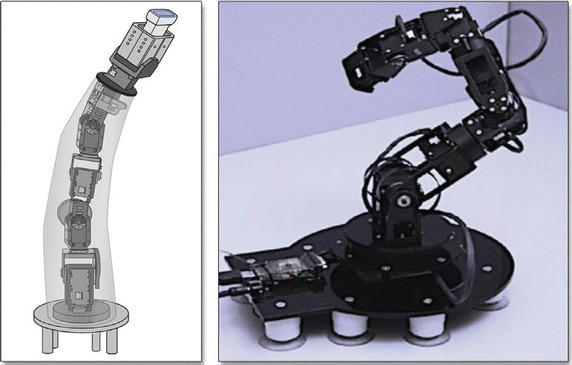
Robotic arm for slave station of telerobotic ultrasonography platform. Reprinted with permission from [122]
Fig. 16
Fig. 16
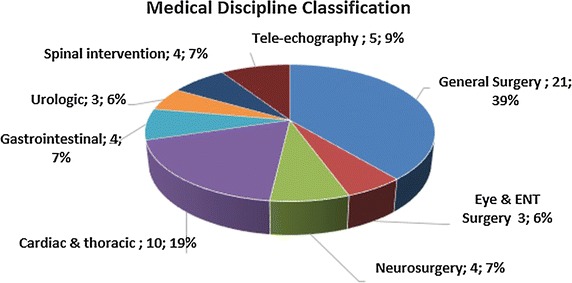
Medical discipline classification of the reviewed tele-robotic systems
Fig. 17
Fig. 17
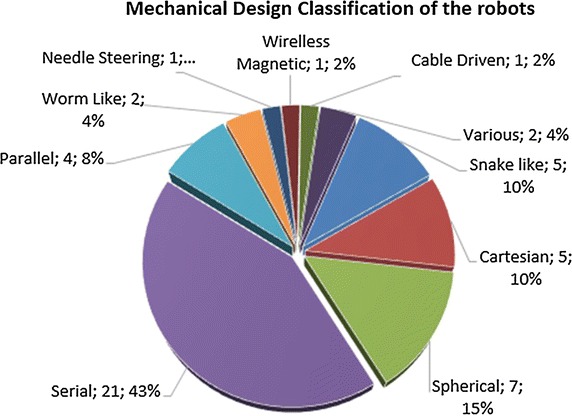
Mechanical design of the reviewed robotic systems
Fig. 18
Fig. 18
Status of the reviewed robotic systems

References

    1. Beasley RA. Medical robots: current systems and research directions. J Robot. 2012;2012:1–14. doi: 10.1155/2012/401613. - DOI
    1. Camarillo DB, Krummel TM, Salisbury JK. Robotic technology in surgery: past, present, and future. Am J Surg. 2004;188(4 SUPPL. 1):2–15. doi: 10.1016/j.amjsurg.2004.08.025. - DOI - PubMed
    1. Wang Y, Butner SE, Darzi RA. The developing market for medical robotics. Proc IEEE. 2006;94(9):1763–1771. doi: 10.1109/JPROC.2006.880711. - DOI
    1. Hoeckelmann M, Rudas IJ, Fiorini P, Kirchner F, Haidegger T. Current capabilities and development potential in surgical robotics. Int J Adv Robot Syst. 2015;12(61):1. doi: 10.5772/60133. - DOI
    1. Troccaz J. Medical robotics. New York: Wiley-ISTE; 2013.

Publication types